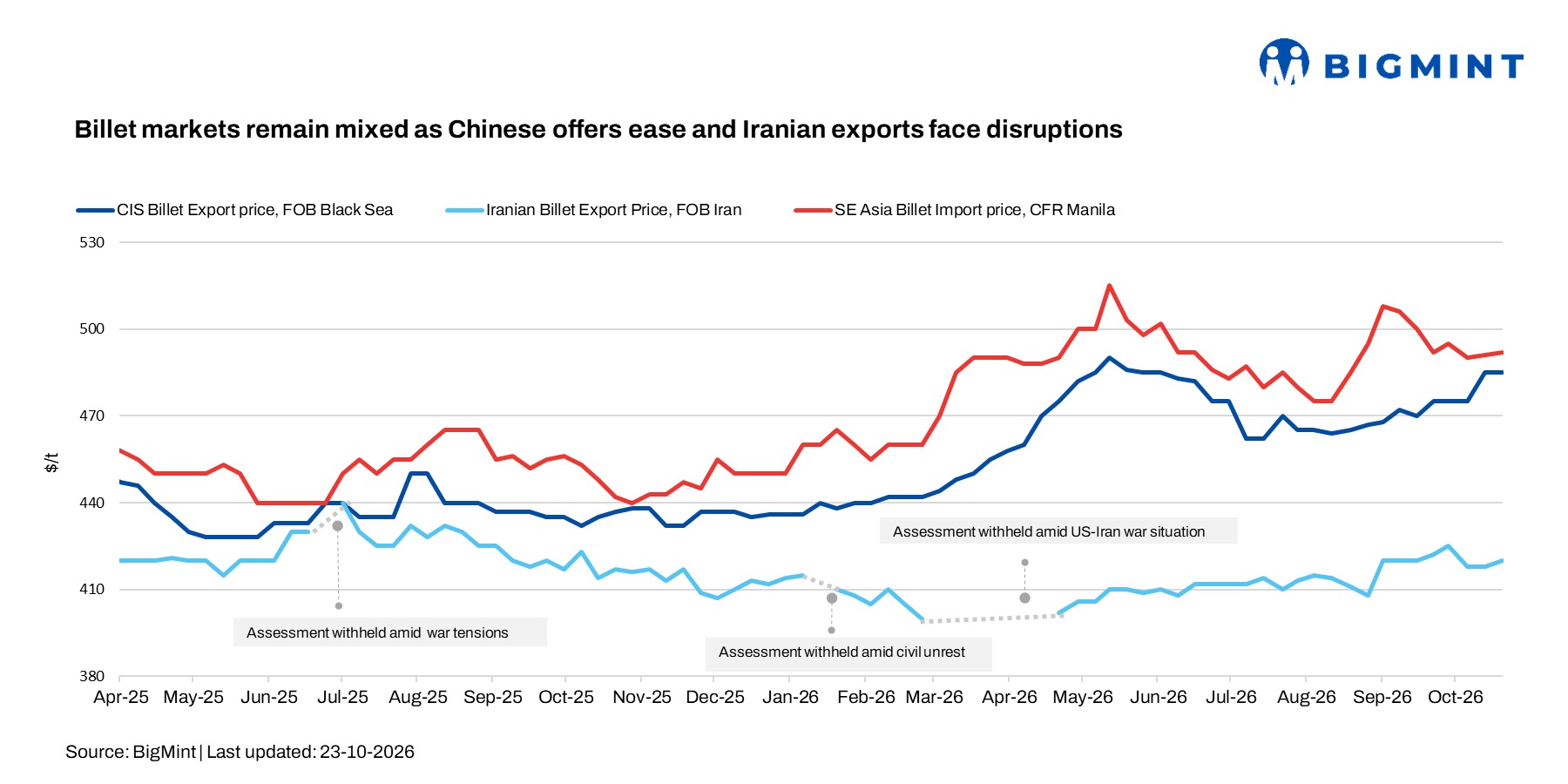
- Weak downstream demand, lower raw material prices weigh on Asian billet demand
- Egypt’s safeguard duties and regional freight pressures reshape import economics
Global billet markets remained mixed during the week ended 23 October, with weak finished steel demand and falling raw material prices limiting buying interest. Production cuts in Iran, higher freight and insurance costs, and Egypt’s import duties continued to influence regional prices. Steelmaker margins remained under pressure, although limited room for further raw material declines and supply constraints in some regions provided support.
Turkiye’s imported ferrous scrap market also remained weak, with cautious mill buying and weak steel demand limiting deep-sea transactions. US-origin HMS 80:20 scrap held steady at $395/t CFR on limited trades, and pressure on rebar prices further dampened buying interest.
China and Southeast Asia
Chinese 3SP 150 mm billet export offers eased to $460-462/t FOB China, with BigMint’s assessment standing at $462/t by 23 Oct’26. Although deals were reported around $464-465/t, including sales to the Middle East, indicative bids remained lower at $456-458/t FOB.
Negotiations for Chinese semi-finished steel were also underway in Nigeria. Domestic prices weakened amid sluggish demand and falling futures. Tangshan Q235 billet prices declined by RMB 20/t w-o-w to RMB 2,920/t ($438/t) on October 23, from RMB 2,940/t on October 16, while Beijing rebar prices fell by RMB 20/t to RMB 3,070/t. Weak real estate activity and lower iron ore prices weighed on sentiment. However, a 320,000 t reduction in steel inventories, lower output, and planned mill maintenance provided some downside support. A stronger yuan also partly limited the decline in export offers.
In Indonesia, a major steelmaker offered billet at $472-473/t FOB, down $2-3/t w-o-w, while around 25,0000 to 30,000 tonnes were reportedly sold to Vietnam at approximately $468-470/t FOB. Chinese 3SP billet traded at $475/t CFR Indonesia, but 5SP offers at $486-487/t CFR faced resistance. Thailand-origin billet was offered at $486-490/t CFR Vietnam, with additional arrivals likely to weigh on local prices. The Indonesian producer also faced water shortages amid drought conditions, limiting operating rates.
In the Philippines, a 25,000-28,000 t purchase of 125 mm billet was reported at $495-498/t CFR. Offers for 5SP 150 mm billet stood at $494-498/t CFR, while the import assessment was $490-492/t CFR Manila. Buyers remained cautious as long-steel demand stayed weak and higher freight costs supported sellers’ offers.
In Taiwan, Russian billet was reportedly purchased at $488-490/t CFR during the preceding week, although no Russian offers were reported towards weekends.
Chinese billet offers remained at $492-495/t CFR. Rebar markets also faced weak demand; Chinese rebar was offered at $510/t CFR Singapore, and Hong Kong, Malaysian rebar at $520-530/t CPT Singapore, and regional rebar assessments edged lower. In Vietnam, finished steel sales weakened after price increases, while imported billet arrivals added pressure to domestic prices.
Black Sea and Turkiye
The Russian billet was offered at $520-525/t CFR Turkiye, with workable levels at $510-515/t CFR, while Chinese offers stood at $510-520/t CFR. Imported billet prices remained stable at $520-525/t CFR, and domestic Turkish billet indicatives stood at $570-580/t exw, depending on the region.
Egypt
Egypt announced a committee to monitor billet availability, domestic production, and supply chains amid disagreements between integrated steelmakers and rerollers over raw material access. Some rerollers have reportedly closed or reduced production after struggling to secure billet, while integrated producers maintain that domestic supply can meet demand.
The government retained its safeguard duty at 12% of CIF value, subject to a minimum of $70/t. The rate is scheduled to fall to 11% from 14 September 2027, with the measure ending on 13 September 2028. Import billet prices rose to $550-560/t CFR from $535-540/t a week earlier. To reduce import dependence, Egypt is encouraging investment in domestic melting capacity. Eight proposed billet production licenses attracted 10 bids, representing a combined capacity of 2.8 mnt/year, with a decision expected within three weeks.
The committee will include representatives from the industry, investment and foreign trade, and supply and internal trade ministries, alongside the Egyptian Competition Authority. Its mandate is to monitor local billet availability, prices, and supply-chain regularity. The government also highlighted potential risks from proposed EU scrap export restrictions.
Iran
Iran’s domestic billet market remained sluggish amid weaker exports to Iraq, subdued long steel demand, currency fluctuations, and government restrictions on commodity exchange activity and credit. Rebar and I-beam prices declined, HRC and plate prices faced downward pressure, CRC stabilised unevenly, and HDG prices showed little response to exchange-rate changes.
Export prices, however, gained support from power and natural gas shortages that forced mills to cut output, undertake maintenance or retain billet for domestic rolling. The market offers at $420-430/t FOB, up around $8-10/t w-o-w, with deals for 30,000 t at $418-420/t FOB Bandar Abbas and 20,000 t of prime 3SP billet at $423-425/t FOB.
The free market rial depreciated by around 2.5% during the week, while rial-denominated billet prices on the Iran Mercantile Exchange declined by 1.34%. Shipping risks intensified after a merchant vessel incident in the Gulf on 22 October, with freight for the Oman route reportedly rising to $25-30/t. Despite supply constraints supporting export offers, shipping costs and safety concerns continued to limit trade.
Outlook
Global billet markets are likely to remain mixed. Weak finished steel demand and lower Chinese domestic prices may cap gains across Asia, while Iranian production cuts and higher shipping costs support export offers.
Leave a Reply