- Tracked retail stocks rise to 204,384 t
- NAPP and ILB lineup extends into December
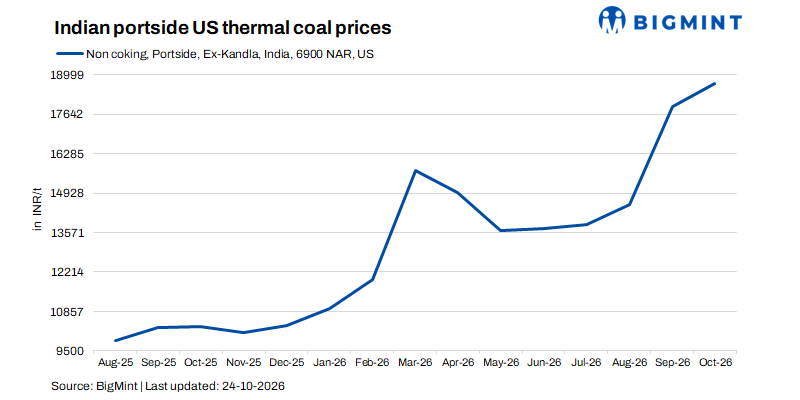
India’s portside US thermal coal market is seeing inventories rise even as replacement costs remain firm. Tracked retail inventories at Kandla and Tuna nearly doubled in the week to 19 October, while indicative prices softened as holiday-period buying remained subdued. Fresh imported NAPP offers, however, stayed firm, limiting the scope for a sustained price decline.
The updated vessel list shows substantial NAPP and Illinois Basin volumes headed to retail and industrial consumers. Much of this cargo has named allocations, leaving only a portion of the headline pipeline available as freely tradable spot supply.
Retail stocks recover sharply
Tracked retail inventories at Kandla and Tuna increased to 204,384 t on 19 October from 107,177 t on 12 October-a rise of approximately 91%. Kandla held 160,103 t and Tuna 44,281 t.
Weekly lifting increased to 54,122 t from 42,787 t, up 26.5%. Arrivals therefore replenished stocks even as dispatch activity improved.
The recovery changes the immediate market balance. Buyers have more material available than during September’s tightness, although the stock series covers only the monitored retail pool.
Prices soften as buyers defer purchases
Market feedback on 21-22 October placed most US coal retail indications around INR 18,500-18,600/t, with a wider range of INR 17,800-19,000/t.
These were offers and indicative levels, rather than a uniform set of concluded transactions. The lower end should therefore not be presented as the prevailing market price.
As per BigMint’s assessment, US-origin non-coking coal (6,900 NAR) prices at Kandla port declined by INR 100/t w-o-w to INR 18,500/t.
Early-October indications were commonly INR 19,000-19,500/t. Fresh arrivals and resistance from price-sensitive consumers have softened the market since then.
Brick-kiln buyers are evaluating domestic coal and blended consumption. Holiday-period enquiries were quiet, with participants looking for stronger activity after the festive break. The timing and scale of that recovery remain uncertain.
Kandla has the clearer price evidence. Tuna forms part of the same western supply pool, but the information does not establish a separate consistently assessed Tuna price.
October imports show wider industrial participation
BigMint’s cumulative lineup recorded 344,430 t of US non-coking coal imports through 18 October.
Identified allocations were:
- Nuvoco Vistas: 60,370 t at Kandla.
- Chettinad Cement: 82,633 t at Krishnapatnam.
- Wonder/ABGT: 84,500 t at Kandla.
- Rawmet Commodity: 56,027 t at Krishnapatnam.
- Wonder Cement: 60,900 t at Dahej.
These cargoes are classified as US non-coking coal without a separate NAPP/ILB designation.
Receiver attribution also requires care. Anglo Alexandria appears against Wonder/ABGT at Kandla in the cumulative lineup, while the retail dispatch statement associates it with a Tuna retail account. Its 84,500-t parcel is included once in the cumulative total, but its receiver and port descriptions require reconciliation.
Cement demand supports coal, but affordability limits retail buying
NAPP remains relevant to cement producers seeking high-energy, relatively low-ash fuel to substitute for petcoke or blend with domestic coal.
ILB provides another sourcing option, although its value depends on cargo-specific energy, ash and sulphur. It cannot automatically be priced or used as an identical substitute for NAPP.
Fresh NAPP indications above $180/t CFR contrast with softer local retail prices. This leaves importers exposed if replacement cargoes cost more than buyers will accept at the port.
Earlier commercial guidance placed Core Natural Resources’ new booking availability from April 2027, with a highest reported Q1 2027 transaction of $128/t FOB. No fresh confirmation has been supplied this week; that figure is not a current spot or Q2 offer.
BigMint assessment
The immediate scarcity in western India has eased. Inventories have recovered, lifting has increased and retail prices have softened.
The next test is demand absorption. Cement commitments support the incoming pipeline, while brick-kiln consumers remain sensitive to price and domestic-coal alternatives.
A post-holiday recovery could accelerate stock movement. If buying remains subdued, however, incoming cargoes may increase pressure on local prices even while overseas replacement costs stay firm.
Leave a Reply