- Rising input costs, power cut-led production disruptions support prices
- Sponge iron prices rise by $7/t w-o-w, billet prices remain stable
Nepal’s rebar market remained stable in the week ended 23 October 2026 as festive holidays kept buying activity subdued, while rising input costs limited the scope for price corrections.
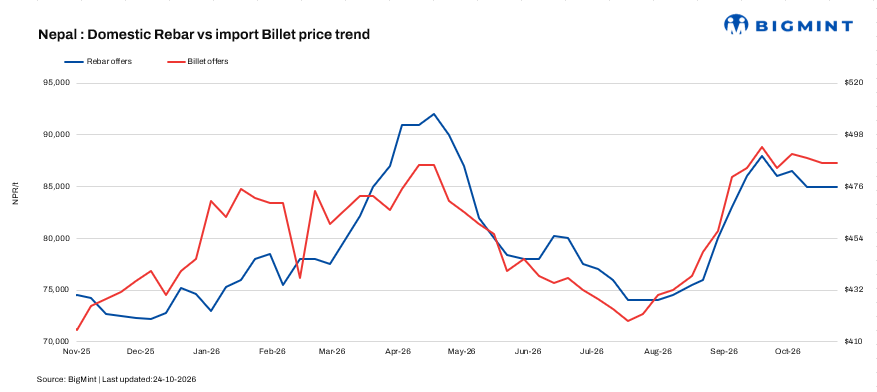
BigMint assessed cash rebar prices unchanged w-o-w at NPR 85,000/t ($561/t), while bank-guarantee prices continued to hover at NPR 87,000-89,000/t.
Market participants reported limited trading activity as festive holidays curtailed construction work and procurement. With most buyers remaining inactive, mills and traders maintained existing offers, awaiting a recovery in demand after the holiday period.
Rising input costs support prices
Despite weak demand, higher production costs prevented mills from lowering rebar prices. Power cuts across key production regions disrupted operations and increased manufacturing costs, further pressuring mill margins.
Sponge iron prices rose by $7/t w-o-w to $352/t CPT Raxaul, adding to input cost pressures for Nepalese mills dependent on Indian supplies.
Billet stable; wire rod prices decline
Billet prices remained unchanged w-o-w at around $486/t CNF Raxaul, broadly in line with the stable trend in the finished steel market.
In contrast, IF-EAF wire rod prices declined by $5/t w-o-w to around $555/t CNF Raxaul, reflecting softer regional market conditions.
Outlook
Nepal’s rebar market is likely to remain largely stable in the near term as festive holidays continue to restrict trading and construction activity. Demand is expected to improve after the holidays as work resumes. However, elevated input costs and power supply disruptions may continue to support prices, with mills potentially attempting hikes if buying activity strengthens.
Leave a Reply