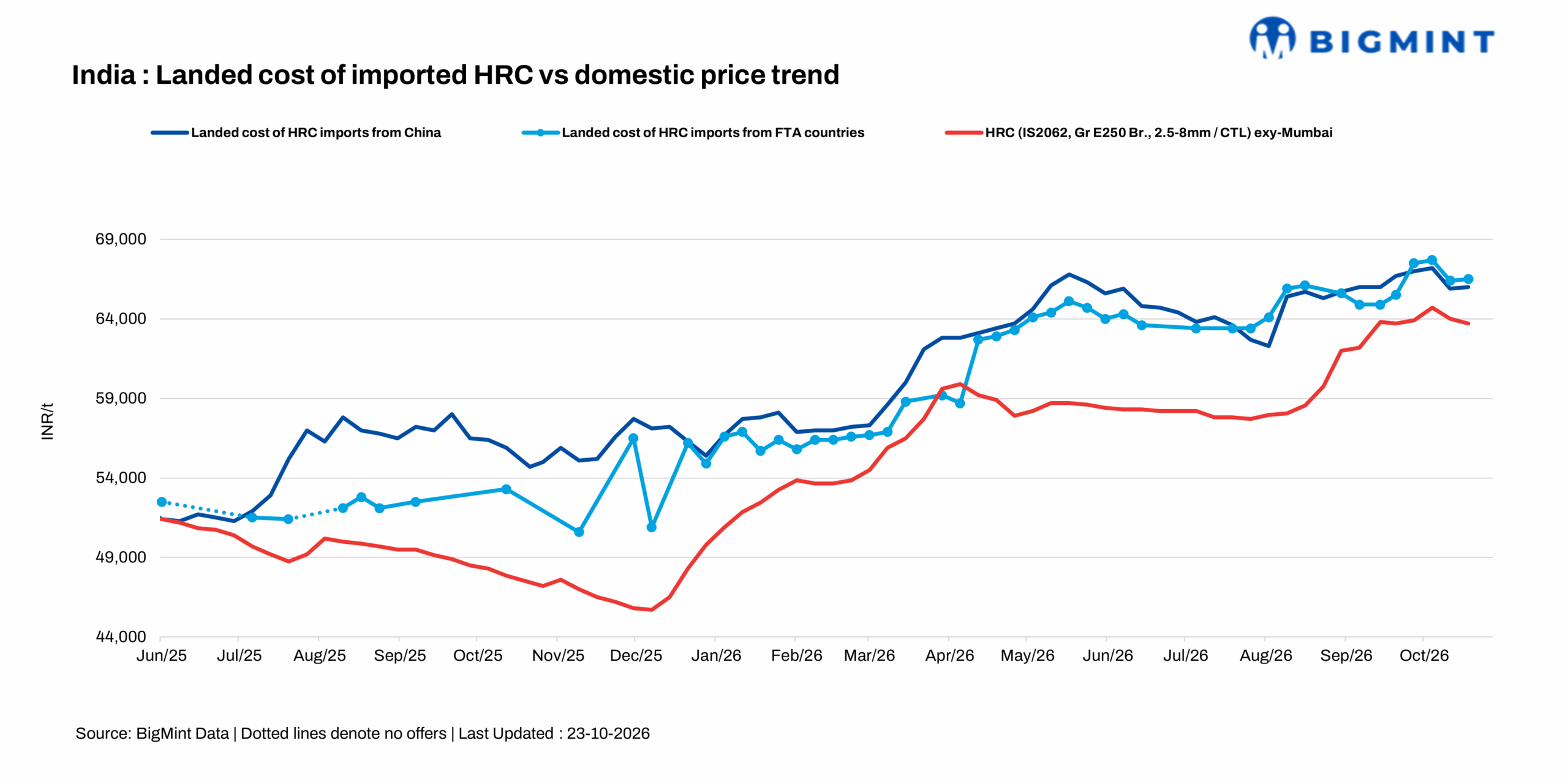
- Price gap with imports narrows post domestic price rally
- Subdued buying weighs on trade-level HRC prices
Domestic hot-rolled coil (HRC) prices in India remained below import parity as of 23 October, although the gap narrowed significantly following the sharp price recovery in late September. BigMint’s bi-weekly HRC benchmark stood at INR 63,700/t ex-Mumbai, around INR 1,900-2,500/t below the estimated landed cost of FTA and non-FTA imports at INR 65,600/t and INR 66,200/t, respectively.
The narrowing differential reflects stable Chinese HRC offers amid demand uncertainty, while subdued buying activity has weighed on domestic trade-level prices. Purchases remain largely need-based, with cautious procurement and limited cash flow among traders and distributors restricting buying activity and keeping domestic prices under pressure.
Domestic HRC prices remain below import parity
The CFR price of HRC from non-FTA countries was assessed at around $550/t as of 23 October. After adding 7.5% basic customs duty (BCD) and 0.75% cess, the import value rises to around $595/t. At an assumed exchange rate of INR 95/$, this translates to approximately INR 56,500/t.
The 11.5% safeguard duty and 1.15% cess add around $75/t, taking the import cost to approximately $670/t, or INR 63,600/t. After adding port handling and miscellaneous charges of around INR 2,000/t, the landed cost of non-FTA HRC is estimated at INR 65,600/t.
For FTA origins, CFR offers were heard at around $600/t. With BCD exempted under the FTA, the import value stands at around $600/t, or INR 56,600/t. The safeguard duty and cess add around $76/t, taking the import cost to approximately $670/t, or INR 64,200/t. Including port handling and miscellaneous charges, the landed cost is estimated at INR 66,200/t.
Against the domestic HRC price of INR 63,700/t ex-Mumbai, domestic material is priced around INR 1,900/t below non-FTA import parity and INR 2,500/t below FTA import parity. The price differential indicates that imports remain costlier than domestic material under both scenarios, limiting the immediate price competitiveness of imported HRC.

Weak demand and cautious buying weigh on HRC prices
Domestic HRC prices declined by INR 200-700/t w-o-w in the week ended 23 October 2026 across major markets amid subdued demand ahead of the festive period. Market participants reported that purchases remained largely need-based, with buyers procuring material mainly to meet immediate requirements rather than building inventories.
The slowdown in sales also tightened cash flow for traders and distributors, prompting some sellers to offer discounts to liquidate stocks and improve liquidity. However, moderate inventory levels across most markets meant that buyers had little incentive to build additional stocks, keeping procurement cautious and limiting price support.
With need-based buying and liquidity pressures continuing to weigh on transactions, HRC prices remained under pressure. A sustained recovery will depend on an improvement in end-user demand and stronger buying activity across the market.
Import flows shrink by 10% m-o-m in Sep’26
HRC imports declined by 10% m-o-m to 136,082 t in September from 151,741 t in August 2026, according to BigMint’s vessel line-up data. The decline was primarily driven by lower shipments from China and Japan, partly offset by continued inflows from South Korea, which remained the leading supplier. Market participants indicated that a significant share of South Korean shipments moved under long-term contracts between Indian companies and their parent entities.
BIS certification limits eligible HRC suppliers for India
BIS certification requirements determine which overseas suppliers are eligible to supply specified HRC grades to India. The applicable Indian Standards include IS 2062:2011, IS 1079:2017 and IS 10748:2004. According to the certification list, 9 companies from Japan, 8 from South Korea, and 5 from Russia hold BIS certification to supply the relevant grades.
The limited pool of certified suppliers may affect buyers’ sourcing flexibility when seeking competitively priced imports. However, BIS certification does not directly add to landed costs. Its potential impact on import competitiveness depends on the availability and pricing of material from certified suppliers, alongside freight, applicable duties, exchange rates and other import-related charges.
Outlook
Domestic HRC prices are likely to remain relatively firm in the near term, with limited scope for major increases unless demand strengthens further. While festive-season buying has improved slightly, most buyers continue to focus on immediate requirements, and comfortable inventories across trader and distributor channels may limit their willingness to purchase at higher prices. Further price increases will therefore depend on whether demand improves enough to support higher trade prices.
Meanwhile, HRC imports could become more viable if the gap between domestic prices and import parity narrows further, making overseas material more competitive after accounting for safeguard duty and other landed costs. However, the limited pool of BIS-certified suppliers for the relevant HRC grades may affect sourcing flexibility and the availability of competitive offers. Fresh bookings will depend on whether import offers become affordable relative to domestic supplies and buyers see sufficient demand to justify purchases.
Leave a Reply