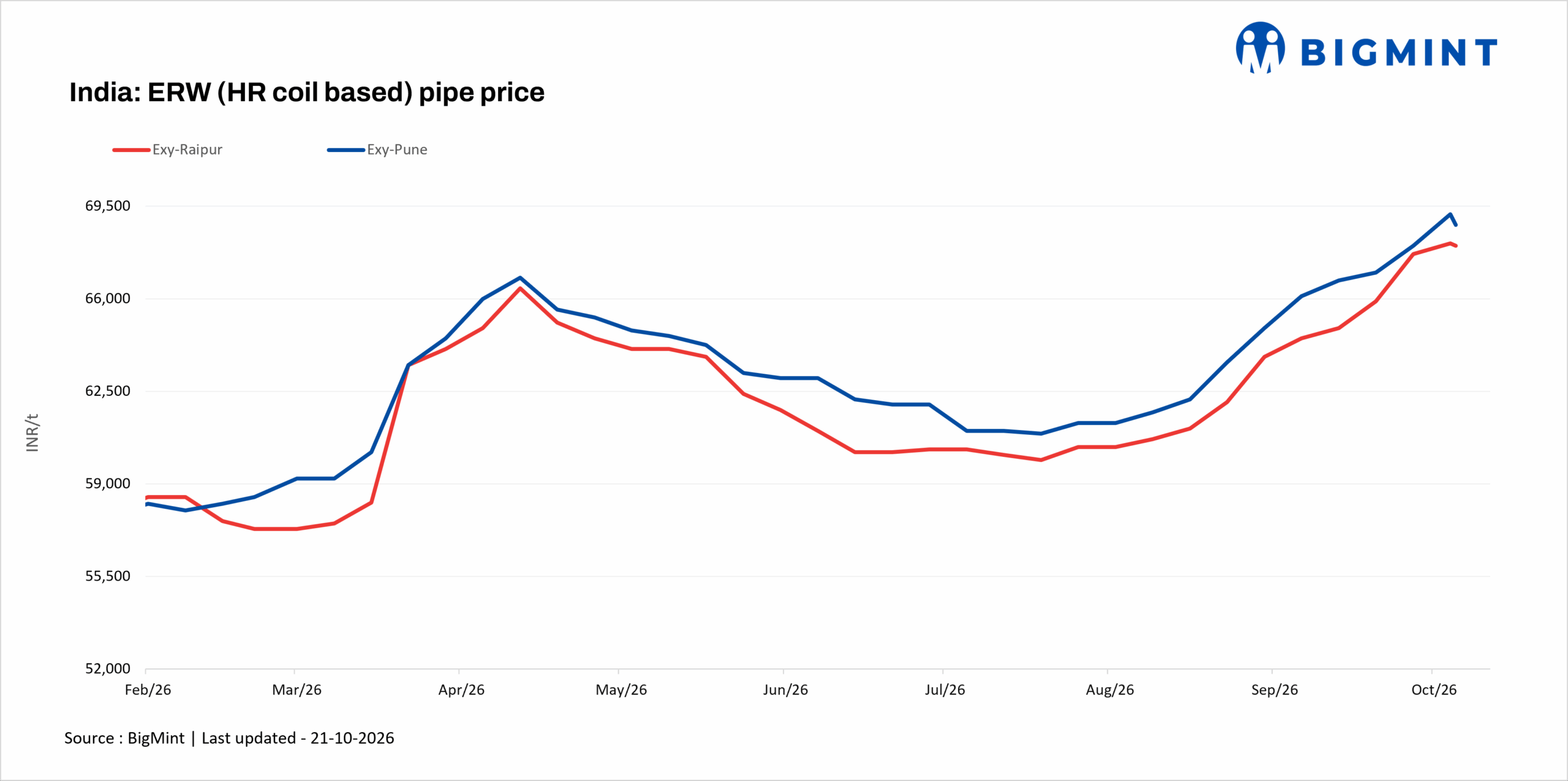
- Prices decline by INR 100-400/t across regions
- New price revision scheduled for 1 November
Indian electric resistance welded (ERW) pipe prices declined by INR 100-400/t ($1-4/t) w-o-w across key markets in the week ended 21 October 2026, as subdued trading activity and cautious procurement weighed on market sentiment. Prices in southern India remained stable despite limited buying interest and an extended holiday period for Dussehra.
The decline came despite a price increase announced by a major domestic producer effective 8 October. Distributors continued offering discounts to sustain sales, limiting the impact of the revision on realised prices. In western India, market participants reported that transactions were taking place at levels equivalent to the producer’s 1 October price list.
Discounts offset producer price hikes
Trading activity remained subdued across major markets during the week, with buyers largely restricting purchases to immediate requirements rather than building inventories. Uncertain demand conditions and limited visibility on price movements discouraged fresh bookings, prompting distributors to offer discounts to maintain sales volumes.
South India was an exception to the broader downward trend, with prices remaining stable during the week. Trading activity was limited, partly because of an extended Dussehra holiday period that lasted until Wednesday.
A market participant based in western India said, “Market trade is happening at the 1 October price list levels. The 8 October revision is effectively being nullified as discounts are being offered in the market.”
The trend highlights the gap between announced producer prices and actual transaction levels. With buying interest remaining weak, distributors have struggled to pass on higher list prices, keeping realised prices under pressure.
Buyers maintain need-based procurement
Procurement remained cautious across the ERW pipe market, with buyers avoiding significant inventory accumulation amid uncertain demand prospects. Although the festive period had raised expectations of improved purchasing, the anticipated recovery in trading activity remained limited during the assessment week.
Distributors continued to rely on discounts to attract buyers and support cash flow. This approach also reflects pressure to manage working capital and avoid carrying excess inventory in a market where demand has yet to strengthen.
Outlook
The 1st November price increase will test distributors’ ability to pass on higher prices in a market characterised by subdued trading and need-based procurement. Without a sustained improvement in downstream demand and fresh bookings, buyers are likely to remain cautious, limiting the scope for higher transaction prices. Price realisation will depend on whether demand strengthens enough to reduce reliance on discounts and support revised offers.
Leave a Reply