- Mills bid below $395/t CFR for US, Baltic HMS 80:20; sellers face resistance at higher levels
- Weak rebar demand, lower steel output, volatile freights weigh on deep-sea scrap trading
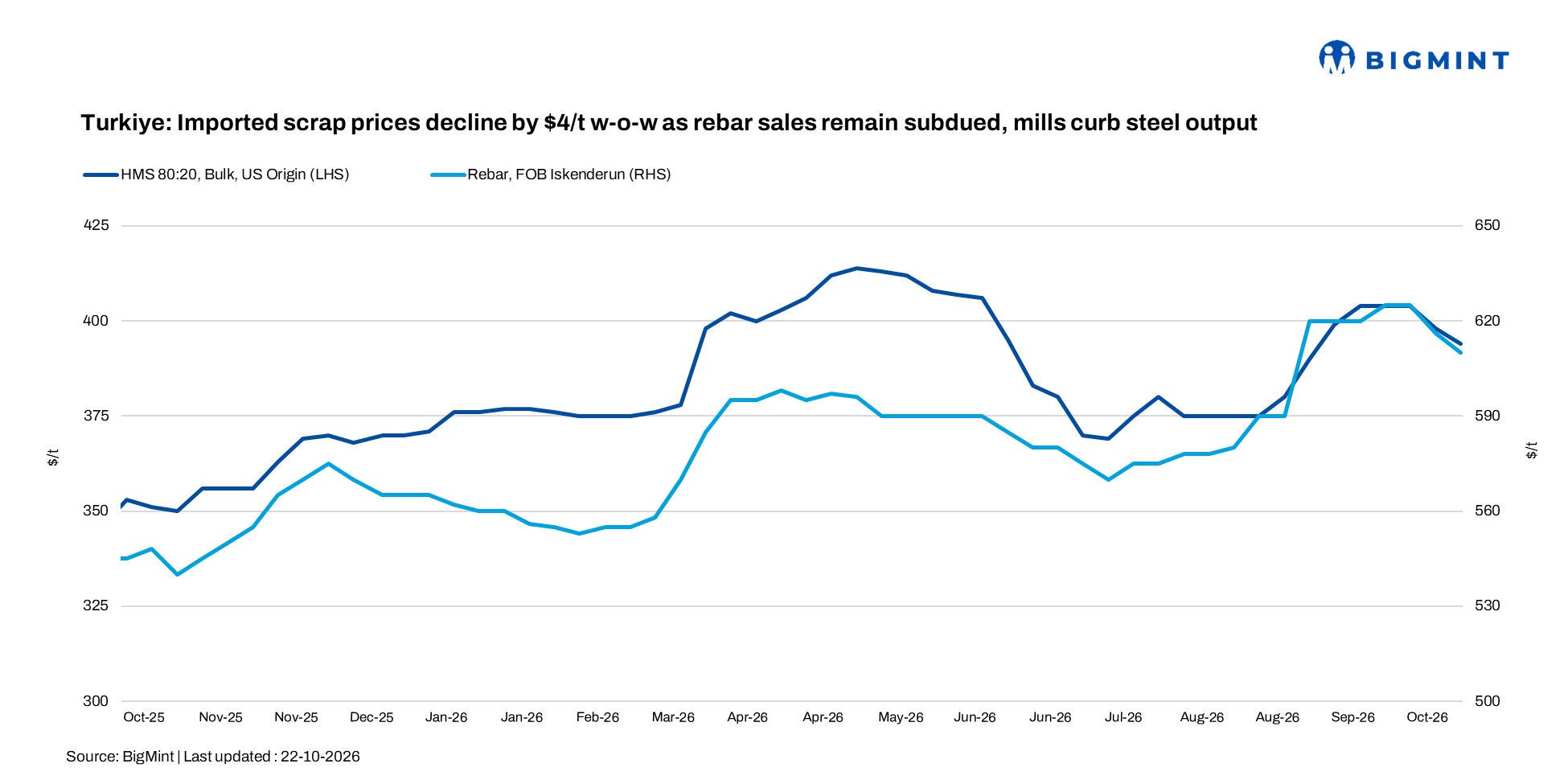
Turkiye’s deep-sea imported scrap market came under pressure during the week ended on 22 October, with prices declining by $4/tonne (t) w-o-w amid sluggish downstream demand, reports of production cuts, and limited mill procurement. Buyers remained cautious as weak rebar sales and pressure on finished steel prices reduced their willingness to pay higher prices for imported scrap. However, firm freight and logistics costs continued to limit sellers’ scope for discounts.
Price assessments
- US-origin HMS 80:20: Stood at $394/t CFR Turkiye, down $4/t w-o-w.
- US East Coast HMS 80:20: Stood at $361/t FOB, up by $3/t w-o-w.
Market scenario
Turkish mills were heard bidding $395/t CFR for US- and Baltic-origin HMS 80:20 during the middle of the week. Tradable values for US and other-origin material ranged from $392-394/t CFR, while EU-origin scrap was indicated in the $380s/t CFR. A Baltic-origin HMS 80:20 cargo was reportedly booked at around $393-395/t CFR or higher during the week, although details could not be confirmed by market participants.
Despite these bids, trading activity remained muted as mills continued to exercise caution amid weak rebar sales and limited availability of offers from US and European suppliers. A major steel mill source reported that scrap prices faced downward pressure during the week, while uncertainty over finished steel demand continued to limit buyers’ willingness to increase bids.
A Baltic-origin trader said mills were unlikely to pay $400/t CFR under prevailing market conditions. Meanwhile, a Turkish mill source indicated that HMS 80:20 prices would need to decline to around $390-392/t CFR to align with current rebar market economics.
A European supplier source added that Turkish mills were reluctant to pay above $385-386/t CFR for European-origin scrap, citing weak rebar sales and continued pressure on finished steel prices. Mills were expected to remain cautious with procurement until downstream demand showed signs of improvement.
Freight costs continued to complicate negotiations. Supramax freights from Rotterdam to Turkish ports were assessed at $43-44/t, while rates from major US ports to Turkiye stood at $38-39/t. High and volatile freight costs provided some support to scrap offers, limiting sellers’ scope for further discounts despite subdued buying interest.
Domestic steel market
Turkiye’s rebar export offers stood at $615-620/t FOB on 22 October, while an earlier market assessment placed exported rebar at $610-615/t FOB. The spread between imported scrap and exported rebar remained stable at $212-215/t. Despite relatively firm export offers, market participants continued to report limited sales and pressure on finished steel prices. A market participant noted that sluggish finished steel sales were prompting mills to reduce liquid steel production, limiting their need for fresh scrap purchases.
Outlook
Turkiye’s imported scrap market is likely to remain under pressure in the coming days, as weak rebar demand and reduced crude steel output continue to restrict mill procurement. Bids around $392-395/t CFR may shape negotiations for HMS 80:20, while firm freight costs could limit further price declines. Fresh deep-sea bookings, the availability of competitive US and European offers, and any improvement in finished steel sales will determine whether prices stabilise or weaken further.
Leave a Reply