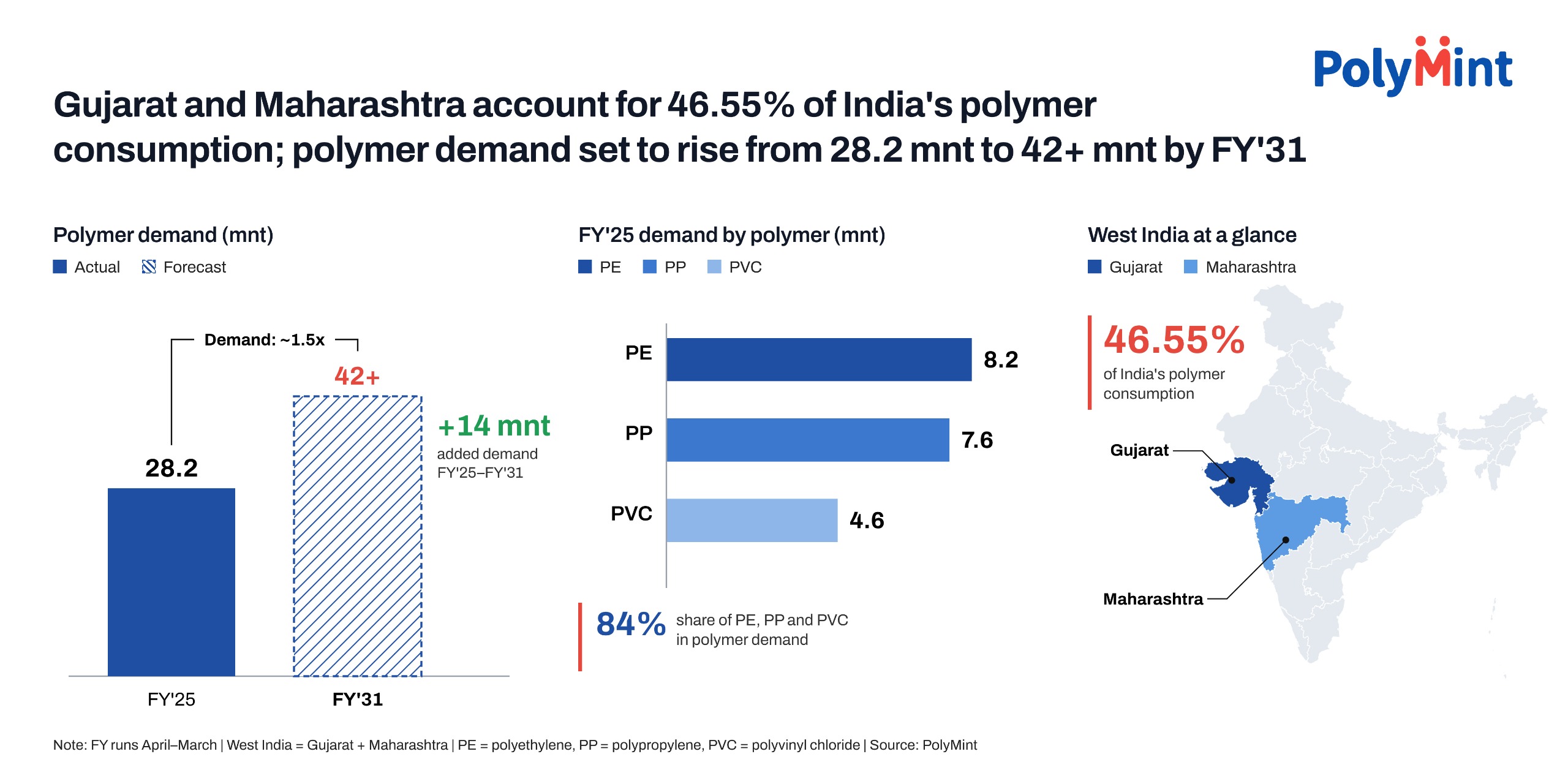
- India’s polymer demand to grow nearly 50% by FY’31, reaching 42 mnt
- Gujarat’s petrochemical base, Maharashtra’s industrial demand drive growth
India’s polymer demand is projected to exceed 42 million tonnes (mnt) by FY’31, up from 28.2 mnt in FY’25, creating opportunities for domestic producers, importers, and recyclers. Gujarat and Maharashtra are expected to remain central to this expansion, supported by integrated petrochemical complexes, downstream manufacturing and strong port connectivity.
Industry estimates indicate that West India accounts for around 46.55% of India’s polymer consumption, highlighting the region’s importance as both a production centre and a major market for plastic resins.
Gujarat leads integrated petrochemical production
Gujarat’s polymer industry is anchored by major refining and petrochemical complexes at Jamnagar, Hazira, Dahej, Vadinar, and Vadodara.
Reliance Industries operates major petrochemical facilities in Gujarat, producing polymers including polypropylene (PP), polyethylene (PE), and polyvinyl chloride (PVC). Nayara Energy operates a PP plant at Vadinar, while ONGC Petro additions Limited (OPaL) operates an integrated petrochemical complex at Dahej.
OPaL’s facility includes a cracker with stated capacities of approximately 1.1 mnt/year of ethylene and 0.4 mnt/year of propylene, alongside downstream PP and PE manufacturing units. Its integration with upstream feedstock infrastructure supports the production of petrochemical intermediates and finished resins.
Gujarat’s advantage extends beyond manufacturing. Ports including Mundra, Deendayal, Hazira, Dahej and Pipavav facilitate feedstock procurement, resin imports and exports. Ahmedabad, Vadodara, Bharuch, Vapi, Surat and Rajkot also support downstream plastics processing, packaging and recycling.
Maharashtra combines consumption with polymer manufacturing
Maharashtra complements Gujarat through its industrial base, petrochemical facilities and access to international markets.
Reliance Industries’ Nagothane operations contribute to the state’s petrochemical ecosystem, while Supreme Petrochem manufactures polystyrene and other plastic-related products at its Maharashtra facilities. The company’s reported effective polystyrene capacity is 300,000 tonnes/year.
Mumbai’s refineries, operated by Bharat Petroleum Corporation Limited and Hindustan Petroleum Corporation Limited, provide substantial refining capacity. However, refining capacity should not be treated as polymer production capacity, as the two represent distinct stages of the petrochemical value chain.
Mumbai, Pune, Nashik and surrounding industrial centres generate demand from packaging, automotive components, engineering, electrical equipment and consumer products. Jawaharlal Nehru Port and Mumbai Port further connect converters with imported resins and international markets.
PP, PE, PVC dominate national demand
Polyethylene remains India’s largest polymer category, with demand of 8.2 mnt in FY’25, followed by PP at 7.6 mnt and PVC at 4.6 mnt, according to PolyMint data.
Together, these three polymers account for approximately 84% of the commodity-plastics demand base referenced in the infographic.
PE demand is driven by films, flexible packaging, pipes and containers; PP by raffia, woven sacks, packaging, and injection moulding; and PVC by pipes, fittings, cables and construction applications.
Despite domestic production, imports remain important in meeting demand for specific polymers and grades. Import competition, global supply availability, freight costs and feedstock prices continue to influence domestic market conditions and the competitiveness of Indian producers.
Recycling strengthens West India’s position
Gujarat and Maharashtra also support plastic recycling and conversion through industrial clusters across Ahmedabad, Rajkot, Vapi, Surat and the Mumbai region.
The ecosystem includes recycled PP and PE granules, PET flakes and recycled PET (rPET) pellets. Growing demand for recycled-content materials offers opportunities for recyclers, although actual output depends on feedstock availability, processing efficiency, material quality and end-use requirements.
The commercial viability of recycled polymers also depends on the price difference between virgin and recycled material, consistent sourcing of plastic waste and the ability to meet buyer specifications. Food-contact applications require compliance with the applicable regulatory and quality standards.
Outlook
As India’s polymer demand expands towards 42 mnt by FY’31, Gujarat’s integrated production base and Maharashtra’s diversified industrial demand are likely to reinforce West India’s role in the domestic plastics industry.
Capacity additions, import competition, feedstock economics, logistics and recycling efficiency will influence the region’s future competitiveness. For producers and converters, the key challenge will be matching available resin grades with evolving demand while maintaining cost competitiveness.
West India’s strategic advantage lies in connecting petrochemical feedstock, virgin polymer manufacturing, downstream consumption, international trade and recycling within a single regional value chain.
Join us on 22 October in Ahmedabad and be part of the conversation shaping the polymer market.

Leave a Reply