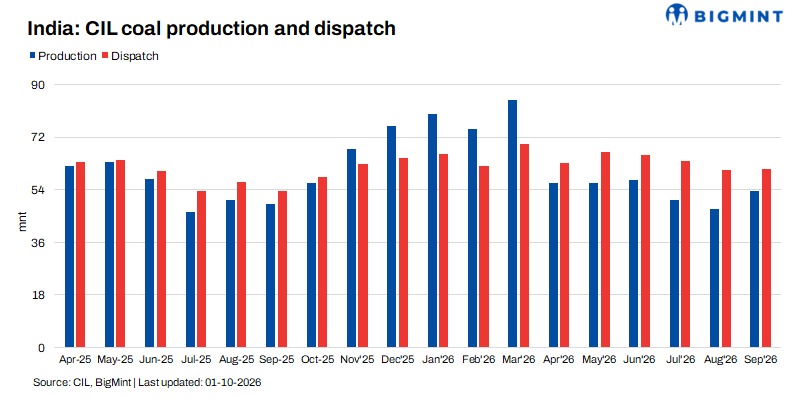
- Coal output rises, but first-half production remains below last year
- October recovery strengthens supplies; rail loading still needs attention
India’s coal supply response strengthened in September 2026, with production rising 10.6% year-on-year and dispatches increasing 13.2%. However, deliveries continued to exceed fresh output, indicating that existing inventories remained an important source of supply.
The transport mix reveals another significant development: road movement accounted for approximately 69% of Coal India’s incremental dispatches, while railway loading remained below plan.
October data show further improvement at Coal India (CIL) and Singareni Collieries Company (SCCL). The challenge is to sustain this recovery while ensuring that additional production reaches consumers quickly enough to rebuild depleted stocks.
September recovery does not erase the first-half production deficit
India produced 75.37 mnt of coal in September, against 68.14 mnt a year earlier, while dispatches reached 83.90 mnt, compared with 74.09 mnt.
CIL, SCCL and captive/other producers all increased output and deliveries. Nevertheless, April-September national production remained 1.1% below the corresponding period of 2025, while dispatches increased 7.1%.

September dispatches exceeded production by 8.53 mnt. Over April-September, the difference widened to 76.85 mnt, against 37.29 mnt a year earlier.
These differences indicate substantial reliance on previously mined coal, although production and dispatch figures alone are not a fully reconciled inventory account.
CIL’s September production also recovered from approximately 47.5 mnt in August, an increase of around 12.6%. Dispatches rose only about 1%, from approximately 60.6 mnt. Fresh output was therefore catching up with deliveries, but remained below them.
MCL and WCL offset weakness at NCL
The recovery was uneven across CIL subsidiaries.
Mahanadi Coalfields (MCL) increased September production by 22.3% to 17.65 mnt, while Western Coalfields (WCL) recorded 85.5% growth to 4.12 mnt. Together, they added approximately 5.12 mnt year-on-year.
Northern Coalfields (NCL), however, produced 8.53 mnt, down 26.1%, while dispatches fell 21.3% to 8.92 mnt. Its production achieved only 74.6% of September’s target.
This matters because stronger output elsewhere does not automatically replace coal lost from a particular supply corridor. Consumer linkages, coal quality and transport availability determine how readily substitution can occur.
Rail loading improves, but falls short of plan
CIL’s average loading across all sectors increased to 306.7 rakes/day in September from 304.8 in August. However, it remained below July’s 314.3 and June’s 323.8.
Power-sector loading recovered more clearly, reaching 287.4 rakes/day from 280.2 in August, matching July’s level.

All-sector loading achieved approximately 84.7% of plan, leaving a gap of 55.3 rakes/day. Power loading achieved 88.2%, approximately 38.6 rakes/day below plan.
Compared with September 2025, all-sector loading increased around 10%, from 278.7 rakes/day. The publication contains inconsistent prior-year power-loading figures, so a single power-sector year-on-year percentage would be misleading.
Within CIL, MCL raised total loading to 108.6 rakes/day from 106.2 in August. NCL recovered to 34.6 from 31.5, but Central Coalfields slipped to 38.1 from 41.8.
The figures show improvement, rather than a complete removal of transport constraints.
Road movement supplies most of the incremental tonnes
CIL’s road dispatches increased from 15.40 mnt in September 2025 to 20.10 mnt, up approximately 30.5%.
Rail dispatches rose more slowly, from 30.68 mnt to 33.20 mnt, up 8.2%. Merry-go-round movement declined from 7.59 mnt to 7.20 mnt.
Road consequently contributed 4.70 mnt of CIL’s 6.78 mnt increase in total deliveries. Its share of dispatches rose from approximately 28.3% to 32.8%, while conventional rail’s share declined from 56.4% to 54.3%.
Road transport is providing flexibility, but longer hauls bring greater exposure to diesel, truck availability and handling costs. More tonnes delivered do not necessarily mean lower delivered fuel costs.
Power remains the largest destination
National dispatches to utility power plants increased 10.4% to 67.18 mnt, accounting for approximately 80% of September deliveries.
However, coal-fired generation rose faster, by 13.6% year-on-year. Daily coal generation also increased approximately 2.6% from August after adjusting for September’s shorter month.
This helps explain why improved dispatches did not immediately translate into comfortable plant inventories. Mine dispatch and plant receipt are also different stages, separated by transport time.
Non-regulated-sector deliveries increased 26.1% to 16.73 mnt, although captive power plant supplies declined 26.1% to 3.87 mnt. Strong aggregate growth therefore concealed different sector outcomes.
October recovery strengthens, with NCL still lagging
The latest detailed production page retrieved was dated 17 October, while the dispatch page covered 18 October.
CIL produced 36.93 mnt during 1-17 October, up 25.0% year-on-year and achieving 97.2% of its cumulative target. SCCL produced 3.11 mnt, up 27.2%, reaching 109.8% of target.
During 1-18 October, CIL dispatched 40.83 mnt, up 21.9%, achieving 106.7% of target. SCCL delivered 3.289 mnt, up 26.6%, achieving 104.7%. These different reporting windows should not be subtracted to estimate stock changes.
NCL remained the exception: October production was down 3.2% through 17 October and dispatches were down 1.6% through 18 October.
Outlook
September’s recovery was meaningful, but depended on existing inventories and a substantial increase in road movement. October’s stronger production provides a firmer foundation.
The next test is sustained delivery above consumption at power plants. Faster mine output, adequate rail loading and effective road evacuation must work together before the supply recovery becomes a durable rebuilding of stocks.
Leave a Reply