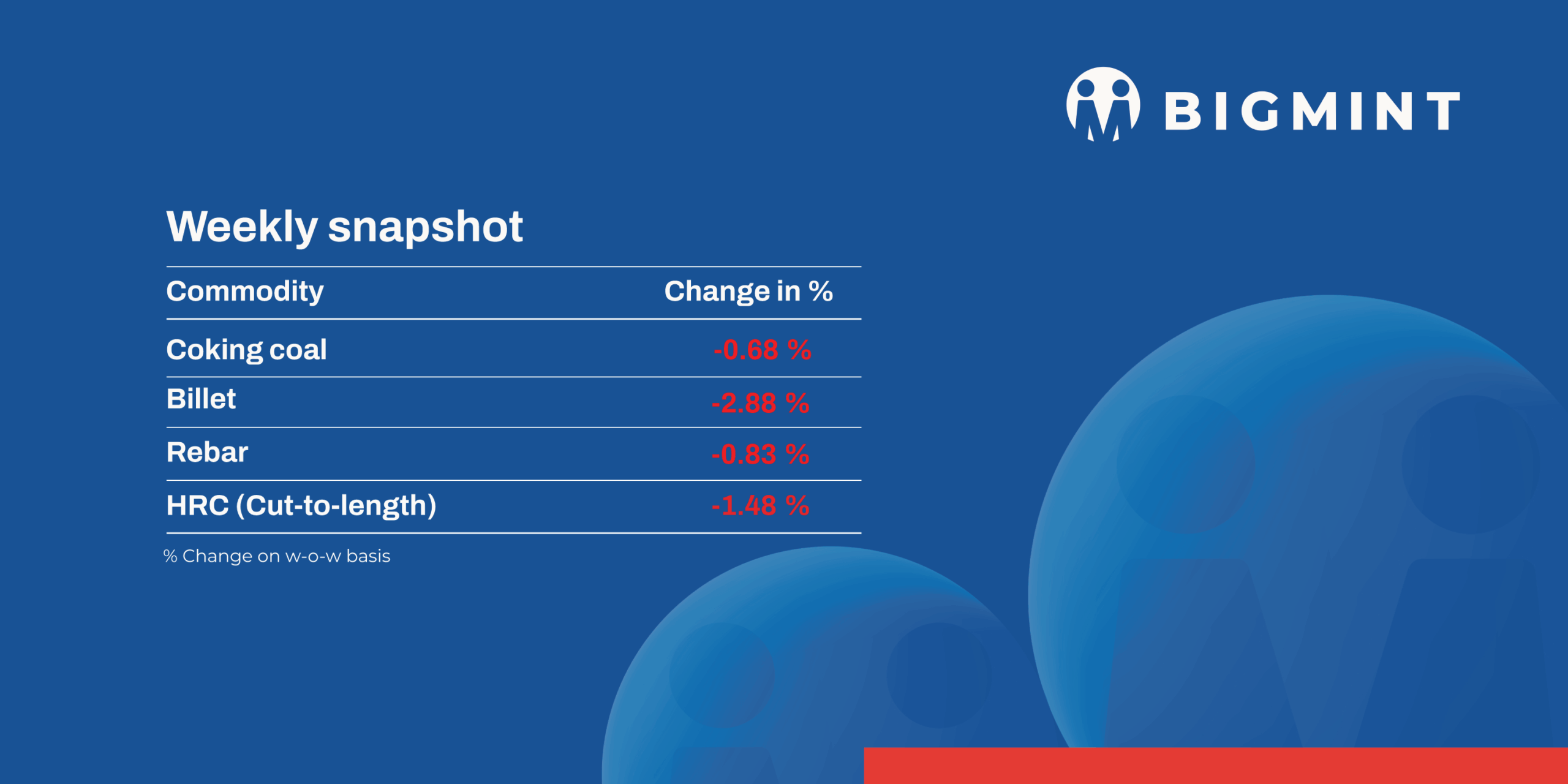
- Billet, sponge iron decline on weak demand, rising supply
- Ferro alloys remain mixed, while coal, scrap markets soften
Indian steel markets weakened during the week ended 17 October 2026 as festive-season demand, cautious procurement and liquidity constraints pressured prices across semi-finished, finished and raw material segments. Ferro alloys remained mixed, while pellet prices held firm despite bearish sentiment.
Iron ore and pellet
- Odisha Mining Corporation (OMC) has reduced base prices for its upcoming iron ore e-auctions on 22 Oct’26 amid weakening steel market conditions in eastern India. Fines prices have been cut by around INR 150/t, while calibrated lump ore (CLO) prices have declined by INR 50-450/t. The auction offers 1.43 million tonnes (mnt) of fines and 0.731 mnt of CLO from various OMC mines, as sponge iron and billet prices have fallen by up to INR 1,500/t over the past week.
- PELLEX, BigMint’s bi-weekly domestic pellet (Fe 63% ± 0.5%) index for Raipur, remained unchanged w-o-w at INR 11,900/t DAP Raipur on 16 October 2026, despite weak market sentiment driven by sharp declines in sponge iron and billet prices. Pellet manufacturers continued to maintain firm offers, while buyers remained cautious and reluctant to book material at prevailing levels, anticipating further price corrections in line with the weakening downstream steel market.
- BigMint’s India pellet export index declined by around $1/t w-o-w to $95/t FOB East Coast in the week ended 14 October 2026, equivalent to approximately $110/t CFR China. Prices continued to weaken following a seven-month low in the previous week, amid subdued Chinese buying interest, uncertain steel market conditions and persistent pressure on Indian exporters’ overseas realisations.
Ferrous scrap
- India’s imported scrap market remained subdued as falling domestic prices, weak rebar demand and cheaper alternatives limited buying. HMS 80:20 bids stayed at $355-360/t CFR Mundra, while UK shredded offers eased to $405-410/t and later $395/t CFR Nhava Sheva, with wide bid-offer gaps restricting fresh bookings.
- High freight costs and cheaper domestic alternatives kept Indian import demand subdued. Australian HMS offers to Chennai stood at $360-365/t, while shredded scrap was offered at $375-380/t; Nhava Sheva offers were $385-395/t CFR. A UK-origin 750 t turnings cargo was reportedly booked at $338/t CFR Chennai.
- Meanwhile, Nagpur Customs clarified PSIC exemption norms for eligible scrap imports, allowing unshredded scrap clearance through designated ports and eligible ICDs/CFSs, subject to origin verification, documentation and mandatory safety checks. Weak import economics continue to limit buying interest.
- In the last seven days, a total of 2,500-3,000 t of imported scrap was tracked for India, including 1,000-1,500 t of HMS 60:40 from Costa Rica, turnings, CR busheling.
Coal
- South African thermal coal prices softened at Indian ports on 16 October. Ex-Paradip RB2 fell INR 50/t w-o-w to INR 14,200/t, while RB3 remained stable at INR 12,200/t. At Vizag, RB2 declined INR 100/t to INR 14,150/t and RB3 dropped INR 100/t to INR 12,150/t. Weak spot demand, cautious sponge iron buying and improved domestic coal availability weighed on prices, while firm export offers and higher freight costs supported replacement costs.
- Domestic coal prices declined further as spot availability and weaker demand pressured the market. Ex-Bilaspur 4,500 GCV coal fell INR 700/t w-o-w to INR 6,200/t as of 16 October, while 5,000 GCV coal dropped INR 300/t to INR 8,700/t. Buyers who had secured coal at high SECL auction premiums became reluctant to lift material as market prices declined, with some reportedly defaulting on EMDs.
- Indian met coke prices remained stable despite softer international benchmarks and weak steel demand. BF-grade prices held at INR 41,300/t ex-Jajpur in eastern India and INR 37,400/t ex-Gandhidham in western India, while foundry-grade coke remained at INR 39,200/t ex-Rajkot. Imported Indonesian met coke declined $2/t to $368/t CFR India, and Australian PHCC fell $2/t to $269/t FOB. Chinese price cuts and lower pig iron realisations added to the bearish outlook, while selective buying limited domestic price movement.
Ferro alloys
- Silico manganese: Silico manganese prices went down by INR 1,425/t ($15/t) to INR 83,100-83,400/t ($868-871/t) across key regions, while export offers for 65-16 grades dropped by $21/t to $989/t FOB Vizag/Haldia.
- Subdued downstream demand offset support from limited spot availability. Persistent energy cost pressure and weak finished steel demand have prompted steelmakers to defer fresh procurement and prioritise inventory management amid market uncertainty.
- Ferro manganese: Ferro manganese prices edged down by INR 500/t ($8/t) w-o-w to INR 89,800/t ($938/t) exw Durgapur, while Raipur prices also dipped by INR 800/t ($8/t) to INR 89,800/t ($938/t). Prices declined as buyers remained reluctant to accept higher rates, limiting fresh enquiries and keeping trading activity subdued across key domestic markets.
- Ferro silicon: Ferro silicon prices increased by INR 1,000/t ($10/t) w-o-w to INR 96,000/t ($1,002/t) in Guwahati, while Bhutan prices also gained by INR 1,700 ($18/t) at 95,700/t ($999/t). Prices remained supported amid tight supplies in the Northeastern region and firm offers in Bhutan.
- Ferro chrome: Ferro chrome prices inched up by INR 500/t ($5/t) to INR 120,000/t ($1,253/t). Regular trades in the market along with positive outcome at recent Vedanta-FACORs ferro chrome auction were the key drivers of price increase.
- Additionally,Vedanta-Ferro Alloys Corporation Ltd (FACOR) will conduct its ferro chrome auction on 22 Oct’26. The auction will feature four lots of high-carbon (HC) ferro chrome, comprising two lots of material with Cr:57% min (10-150 mm), one lot of Cr:54% min (10-20 mm) and another lot of Cr:51% min (0-10 mm).
Semi finished
- Billet: India’a semi-finished steel prices soften further amid slow demand and festive slowdown. As per BigMint’s assessment, domestic billet prices declined by INR 300-1,700/t ($3-18/t) w-o-w across major markets, as weak downstream demand and production disruptions caused by power shortages weighed on market sentiment. Subdued buying interest and intense competition among sellers prompted downward revisions in spot offers to maintain market competitiveness. Upcoming festive holidays further dampened procurement activity, with buyers avoiding fresh bookings amid concerns over potential transportation and logistics disruptions.
- Sponge iron: Sponge iron prices across major Indian regions fell by INR 300-1,300/t ($3-13/t) w-o-w, due to weak offtake, limited procurement and rising spot availability. Increasing material availability, coupled with comparatively weak consumption, intensified selling pressure and pushed prices lower. Despite weak demand, sellers faced limited scope to reduce offers further, as raw material costs, particularly pellets and coal, remained on elevated levels, putting pressure on operating margins.
Indian sponge iron export offers declined by $1-3/t w-o-w, as demand from neighbouring countries remained weak amid festive holidays and market closures. Pellet-based DRI offers for Nepal fell by $1/t to $314/t CPT Raxaul, while CDRI/mix offers declined by $3/t to $345/t CPT Raxaul. Sponge iron export offers for Bangladesh decreased by $2/t to $358/t CPT Benapole. Overall, export sentiment remained subdued, with limited buying interest and festive-related disruptions weighing on cross-border trade activity.
Finished long steel
- IF-rebar: IF-route rebar prices witnessed a downward trend this week, declining by INR 100–1,900/t across markets. The decline was primarily driven by moderate to weak retail demand, which kept buying activity subdued and put pressure on prices. Mill inventories were estimated at around 8-10 days, while order booking visibility remained limited to 3-5 days, varying by location. The near-term outlook remains range-bound, with prices potentially facing further pressure due to subdued buying activity ahead of the upcoming festival. Market participants continue to adopt a cautious wait-and-watch approach, with procurement largely restricted to immediate requirements. Further price movements will depend on an improvement in underlying steel demand and the extent of buying activity following the festival.
- On a week-on-week basis, IF rebar prices declined by INR 100-1,900/t across key regions, according to BigMint’s assessment.
- Trade reference prices of Fe 500-grade rebars manufactured via the IF route (10–25 mm size) were assessed at INR 47,700-48,300/t exw Raipur and INR 51,200-51,800/t exw Jalna.
- Trade reference prices of heavy structural steel for the base size 150 mm channel stood at INR 50,000-50,500/t exw Raipur.
- Trade reference prices of wire rod stood at INR 48,000-48,900/t exw Raipur.
- BF-route rebar: BigMint’s trade-level BF-route rebar assessment increased by INR 400/t w-o-w to INR 64,300/t exy-Mumbai.
- Slow deliveries from major mills and limited market availability continued to support prices. Infrastructure and project-linked buying provided support, although retail demand remained selective at elevated prices.
- Leading producers raised list prices, reinforcing bullish price expectations despite cautious spot-market procurement.
- Prices may remain firm amid supply constraints, but sustained gains depend on actual demand and improved material availability.
Flat steel
- India’s trade-level HRC prices declined by INR 500-1,400/t w-o-w during the week ended 16 October 2026, as festive-season liquidity constraints prompted inventory liquidation. Demand remained need-based across western, northern and eastern India, with sellers offering discounts to clear stocks and manage cash flows.
- In contrast, HRC and CRC prices in southern India rose by INR 200-600/t on moderately stronger demand. However, elevated prices and cautious buying limited procurement. Limited availability of thinner-gauge CRC supported select specifications, while overall inventories remained comfortable.
- BigMint’s bi-weekly benchmark assessment for Mumbai HRC (IS2062, Grade E250, 2.5-8 mm/CTL) declined by INR 1,000/t w-o-w to INR 63,700/t exy-Mumbai as of 16 October, from INR 64,700/t a week earlier. Similarly, the benchmark assessment for Mumbai CRC (IS513, Grade O, 0.9 mm/CTL) fell by INR 1,200/t w-o-w to INR 73,400/t from INR 74,600/t on 9 October.
- Import volumes: India’s bulk HRC imports stood at 55,654 tonnes (t) as of 13 October 2026, with a further 85,567 t expected to arrive by the end of November. A significant share of these imports is being sourced under long-term agreements between Indian companies and their parent entities in South Korea and Japan.
Export volumes: India’s bulk HRC exports stood at 45,230 t as of 13 October 2026, with another 3,000 t expected to be shipped by the following week. - Indian HRC export offers varied w-o-w across key destinations during the week. Offers for the EU declined by $10/t w-o-w to around $730/t amid continued buyer resistance to prevailing price levels, with no fresh bookings reported during the week. Meanwhile, offers to the Middle East and Vietnam remained on hold as mills continued to prioritise domestic sales amid better domestic realisations, limiting fresh export availability to these markets.

Leave a Reply