- Indian aluminium prices fall on weak demand, lower LME
- Indian copper cathode prices drop despite falling LME inventories
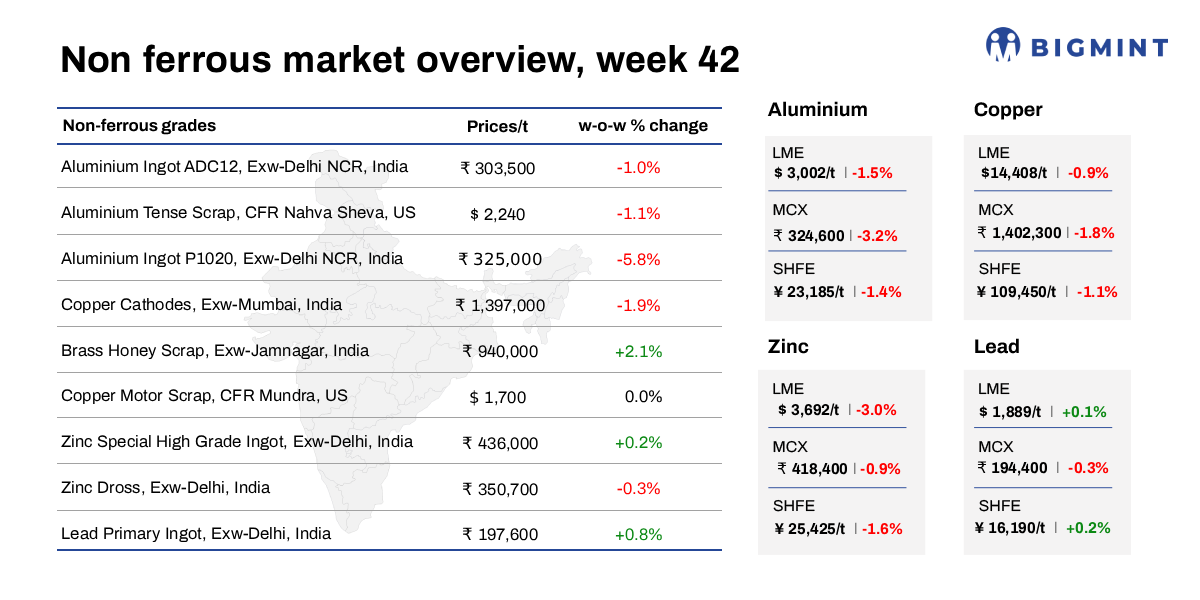
LME base metals showed a broadly weaker trend during the week ended 16 October, as a stronger US dollar, subdued demand expectations and profit-taking weighed on market sentiment. Aluminium fell 1.5% to $3,002/t, while copper declined 0.9% to $14,408/t. Zinc dropped 3.0% to $3,692/t, whereas lead edged up 0.1% to $1,889/t, supported by comparatively resilient demand.
Indian physical markets also remained under pressure. Aluminium ingot prices declined sharply amid subdued buying and weaker international benchmarks. Copper cathode and armature scrap prices fell, while weak brass scrap demand and lower China-bound export offers continued to constrain trading. Meanwhile, zinc dross and oxide prices eased marginally.
Aluminium
India’s aluminium market weakened during the week as lower global benchmarks and subdued domestic demand weighed on prices. Festival-related slowdowns and sufficient inventory availability limited buying interest, although tight physical availability continued to provide some underlying support.
According to BigMint’s assessment, P1020 aluminium ingot prices in Delhi NCR fell by INR 20,000/t (5.8%) w-o-w to INR 325,000/t from INR 345,000/t. ADC12 aluminium ingot prices ex-Delhi NCR declined to INR 303,500/t (1.0%).
Imported scrap offers also weakened. UK-origin Zorba 95-5 scrap prices fell by $15/t (0.6%) w-o-w to $2,620/t from $2,635/t. Meanwhile, US-origin Tense scrap offers, CFR Nhava Sheva, declined to $2,240/t (1.1%).
Globally, aluminium prices faced pressure as expectations of recovering Middle Eastern production and rising Indonesian shipments improved supply prospects. Japan’s fourth-quarter main port premium fell 35.4% q-o-q to $255/t CIF, reflecting softer spot-market conditions and an improved supply outlook. However, low exchange inventories and continued physical supply-chain risks remain supportive factors.
Domestic aluminium prices may remain under pressure in the near term as buyers remain cautious and global benchmarks weaken. However, tight primary metal availability could limit further declines. A recovery in post-festival demand and changes in global supply conditions will determine the next price direction.
Copper
India’s copper market weakened during the week as lower international prices and cautious buying weighed on domestic assessments. According to BigMint, copper armature scrap prices ex-Delhi fell by INR 12,000/t (0.9%) w-o-w to INR 1,340,000/t, while copper cathode prices ex-Mumbai declined by INR 28,000/t (2.0%) to INR 1,397,000/t.
Globally, copper markets faced conflicting supply and demand signals. Tight concentrate availability and mine supply risks continued to support prices, while uneven demand and regional supply imbalances limited momentum. Substantial copper stockpiles in the United States and uncertainty over future US tariffs also influenced global trade flows.
These mixed signals extended to India’s brass honey scrap market, where weak demand continued to constrain trading. Prices stood at around INR 940,000/t in Jamnagar and INR 915,000-920,000/t in northern India. Sellers offered discounts of INR 7,000-8,000/t to attract buyers. Meanwhile, China-bound Indian brass ingot buying offers fell to around 61% of LME copper from 63-64% previously, reflecting weak Chinese demand and high exporter inventories.
Domestic copper prices may remain volatile. Festive procurement could support brass scrap demand towards the end of October, although weak consumption and subdued Chinese buying may limit the recovery.
Zinc & lead
India’s zinc and lead markets weakened during the week, with secondary zinc prices edging lower and HZL reducing both benchmark prices. Lower three-month LME zinc prices and rising exchange inventories added pressure to sentiment, although tightness in nearby metal availability remained evident.
According to BigMint’s assessment, zinc dross prices ex-Delhi declined by INR 1,000/t (0.3%) w-o-w to INR 350,700/t from INR 351,700/t. Zinc oxide (99% Zn) prices eased by INR 500/t (0.15%) to INR 334,200/t from INR 334,700/t.
HZL reduced its SHG zinc ingot benchmark by INR 3,400/t to INR 407,900/t from INR 411,300/t. Its lead ingot benchmark also declined by INR 1,200/t to INR 212,300/t from INR 213,500/t.
Globally, zinc faced additional pressure from rising exchange inventories. LME stocks increased by 16,375 t w-o-w to 144,125 t in the assessment period, while three-month prices edged lower. The increase in available stocks suggests improving supply conditions, although a wider cash-to-three-month backwardation indicated that nearby tightness had not fully eased.
Zinc dross and oxide prices may remain under pressure as rising exchange inventories and lower primary zinc benchmarks weigh on replacement costs. Lead prices are also likely to track international benchmarks and domestic buying activity. Further movement will depend on inventory trends, primary metal pricing and the pace of recovery in downstream demand.
Leave a Reply