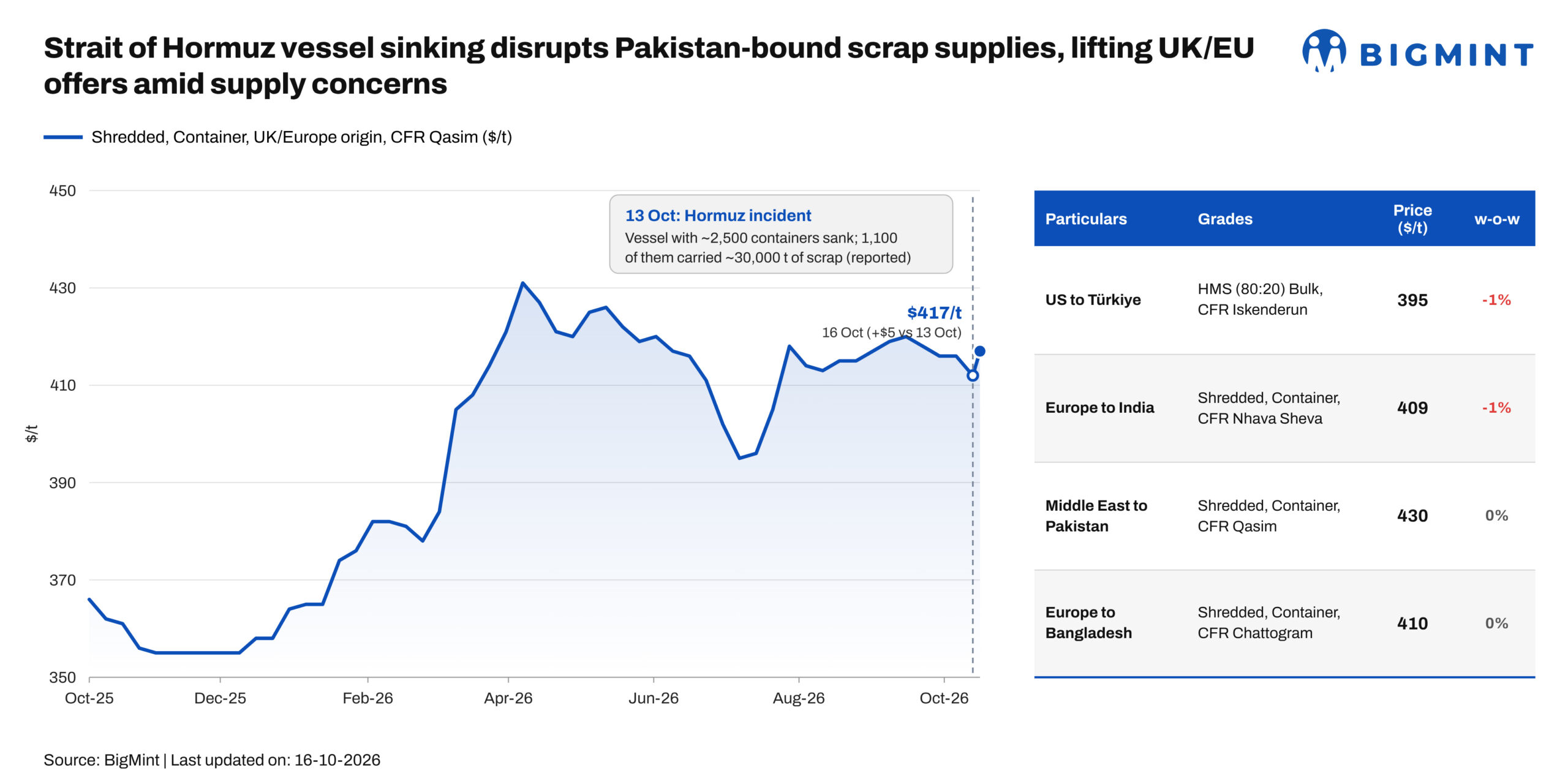
- Around 30,000 t of scrap reportedly lost, including 1,100 containers
- UK/EU shredded offers rise to $415/t as buyers seek alternatives
The sinking of a Dubai-operated, Singapore-flagged container vessel in the Strait of Hormuz has disrupted shipments of steel scrap destined for Pakistan. Market sources estimated that around 30,000 tonnes (t) of scrap were loaded in approximately 1,100 containers aboard the vessel. The disruption has raised concerns over the availability of Middle-East origin material in Pakistan and prompted some buyers to consider alternative supply sources.
UK/EU shredded scrap offers have climbed to $417-418/t CFR Qasim from $410-412/t last week following the vessel sinking.
Operated by Dubai-based Global Feeder Shipping (GFS), the vessel was deployed on the Gulf-Pakistan route and was scheduled to call at Port Qasim after stops at Fujairah, Jebel Ali, and Al Jubail. The 2,824 TEU vessel sank on 13 October after sustaining damage and catching fire while transiting the Strait of Hormuz.
UAE suppliers face financial losses
UAE’s domestic HMS 80:20 (processed) assessment fell by AED 6/t ($2/t) w-o-w to AED 1,026/t ($279/t) as sluggish demand and lower-priced bookings weighed on the market. Imported rebar prices remained unchanged, while billet prices increased amid tighter availability of Asian material, with regional security risks disrupting trade and raising concerns over delivery timelines.
Market participants cited weak construction demand and uncertainty over whether mills could pass on higher production costs. Escalating security risks around the Strait of Hormuz have also raised concerns over supplies of iron ore pellets, direct-reduced iron (DRI) and hot-briquetted iron (HBI) to electric arc furnace (EAF) mills. However, subdued real estate activity and developers’ limited ability to absorb higher construction costs may constrain further price increases.
Domestic rebar prices may remain under pressure if construction demand stays sluggish and buyers continue to limit procurement. Billet prices, meanwhile, may retain support from constrained Asian availability and elevated shipping risks. The extent of further price movement is likely to depend on regional security developments, raw material availability and the ability of mills to pass on higher production costs.
 If Pakistan-bound shipments remain disrupted, surplus material could build up in the UAE, putting further pressure on domestic prices.
The sinking also exposed the scale of supplier losses. A UAE-based market insider estimated that around 30,000 t of scrap was aboard the vessel, including 90 full container loads (FCLs), or about 2,500 t, from their own company.
The losses extended to smaller traders. A UAE-based yard owner said nearly 50 containers, equivalent to around 1,400-1,500 t of scrap, were lost among traders in their network. An international trader added that many suppliers faced financial losses because most cargoes were sold on a cash-against-documents (CAD) basis, although individual losses and payment statuses remain unclear.
Shipping concerns have further clouded market sentiment. One source alleged that the shipment was carried illegally, a claim that has not been independently verified. Another market participant pointed to a separate vessel carrying billets that was reportedly experiencing difficulties at sea.
“The vessel carrying 1,100 containers sank the day before yesterday, and today a vessel carrying billets is facing difficulties at sea. Given these developments, I don’t see much chance of improvement in the scrap market,” the source said.
UK/EU offers strengthen after the incident
UK/EU shredded scrap offers have risen to around $416-417/t CFR Qasim, up from $409-412/t before the incident. A UK-origin shredded scrap cargo of 2,000 t was reportedly sold at $415-416/t CFR Qasim on 15 October.
Current offers are $3-6/t above last week’s levels, while the concluded deal is $4/t above the European-origin shredded scrap benchmark of $412/t CFR Qasim in BigMint’s assessment earlier this week. The increase points to higher replacement costs for Pakistani buyers as they look to cover supply gaps following the disruption.
Market sources reported that Pakistani importers booked more than 20,000 t of replacement scrap from the UK and Europe within three days to cover supply gaps, boosting buying pressure and strengthening sellers’ pricing positions.
A Peshawar-based mill-side source said, “There were many offers in the market three days before this incident. Since yesterday, most have been sold, and sellers are now showing a firmer attitude. Demand from the UK and Europe will rise now, and we are expecting market prices to jump by $5-10/t in the coming days.”
Pakistan domestic prices: The local scrap price in Punjab stood at PKR 133,000-135,000/t ($481-488/t), largely stable week on week, based on an exchange rate of PKR 276.8/$.
Market outlook
The disruption has left UAE suppliers facing reported losses, while Pakistani buyers are looking for alternative scrap supplies to cover delayed shipments. Buyers are likely to turn more towards the UK and Europe, potentially tightening availability and giving sellers greater pricing power.
UK/EU shredded scrap offers have already increased, although some market participants remain cautious due to ongoing shipping risks and uncertainty over market conditions. Prices will depend on how quickly buyers secure replacement cargoes, whether higher offers translate into more deals, and when shipments from the UAE to Pakistan resume.
In UAE, domestic rebar prices may remain under pressure if construction demand stays sluggish and buyers continue to limit procurement. Billet prices, meanwhile, may retain support from constrained Asian availability and elevated shipping risks. The extent of further price movement is likely to depend on regional security developments, raw material availability and the ability of mills to pass on higher production costs.
Leave a Reply