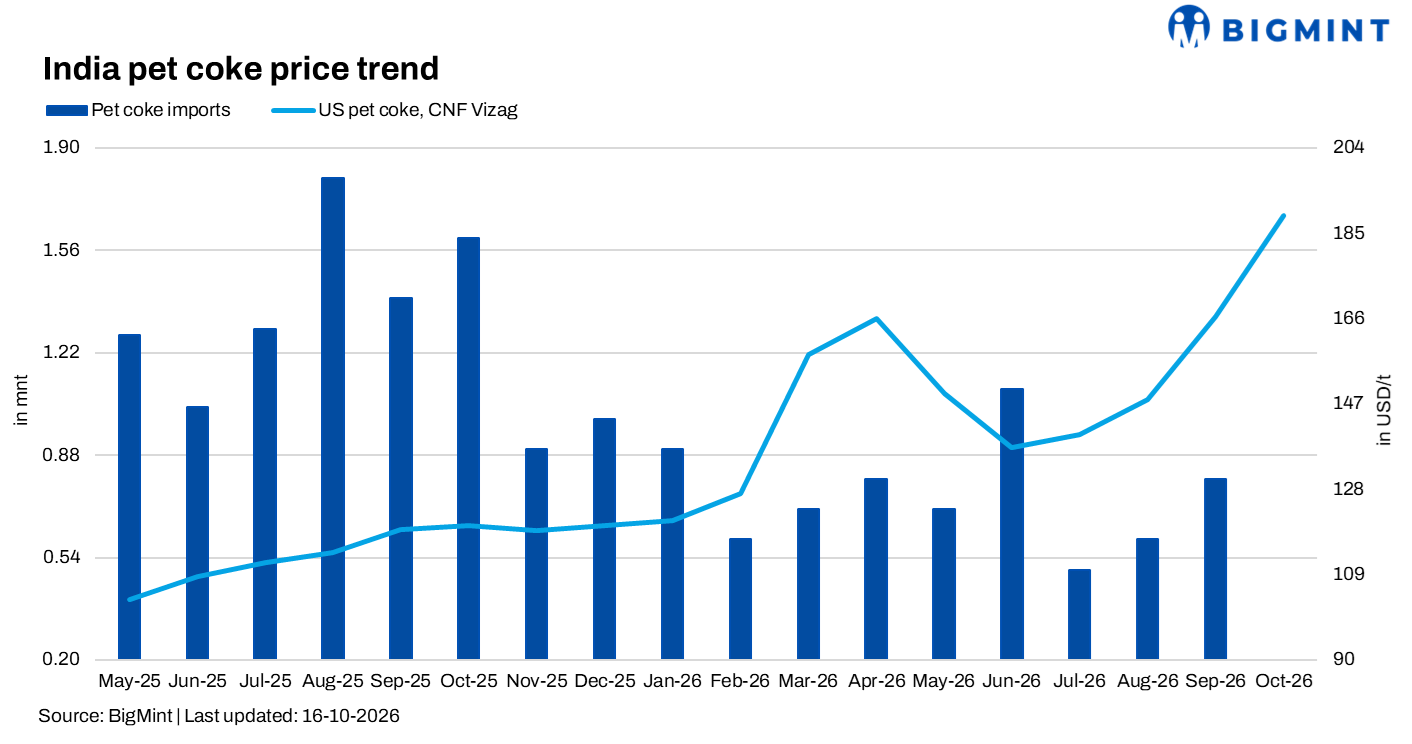
- Cement producers explore cheaper coal blends as US prices surge by $40/t in 4 months
- Incoming cargoes may improve availability, but replacement costs remain high
Global fuel-grade petroleum coke prices strengthened further in mid-October, supported by higher competing coal prices and expensive freights. Indian cement producers are responding by using existing inventories, increasing domestic coal consumption, and evaluating alternative imported fuels.
The difficulty is that US North Appalachian (NAPP) coal, an important petcoke substitute, is also expensive. Switching between imported fuels therefore offers limited savings unless buyers adjust their blends and quality requirements.
US prices extend their rally
US Gulf Coast 6.5% sulphur petcoke reached $115/t FOB on 14 October, up $5/t w-o-w. Prices have increased for 12 consecutive weeks, gaining approximately $41/t over four months.
Lower-sulphur grades also strengthened. US Gulf 5.5% sulphur material reached $120/t FOB, while 4.5% sulphur coke increased to $125/t.
Turkiye and Brazil remain competing outlets for US supply. Turkish 5.5% sulphur petcoke was assessed near $160/t CIF, while Brazilian 6.5% sulphur material stood at $150/t CFR.
These delivered prices reflect different specifications, freight distances, and shipment terms. Nevertheless, they illustrate the alternative markets available to US sellers.
Freight amplifies Indian replacement costs
US Gulf-east coast India petcoke freight stood at approximately $57.75/t on 14 October, around $20/t above a year earlier. That increase adds approximately $1.10 million to the freight bill for a 55,000-t shipment.
Indian 6.5% sulphur petcoke was assessed at $185/t CFR east coast on 14 October. Market feedback through 16 October placed offers generally around $185-190/t, with some proposals higher.
Buyer expectations remained lower. November-loading enquiries included bids around $184-185/t against offers of $188-190/t. Some cement producers sought approximately $180/t CFR western India.
Reported transactions in the mid-to-high $180s indicate that some business remains possible, although individual deal reports have not been independently confirmed.
Cement producers reassess fuel blends
Industry feedback shows consumers using older petcoke inventories and domestic coal while reviewing fresh imports. Domestic coal can reduce purchase costs, but its higher ash content limits the proportion that some kilns can accommodate. Low-ash imported coal remains useful for blending, while sulphur, moisture and other characteristics influence suitability.
On an illustrative energy basis, petcoke at $185/t and 7,500 NAR costs approximately $24.67/Gcal. Coal at $131.10/t and 5,500 NAR costs approximately $23.84/Gcal. This suggests petcoke’s energy-only advantage has narrowed or disappeared against that coal benchmark. Actual kiln economics also depend on grinding, handling, sulphur balance and the contribution of fuel ash to the raw mix.
Strong cement production supports fuel requirements, but does not guarantee equivalent petcoke growth. BigMint’s provisional September cement output estimate of 40.23 mnt was approximately 12.7% higher y-o-y, while the supplied petroleum consumption series shows first-half petcoke consumption falling 25.4% to 7.71 mnt.
The divergence makes substitution an important consideration, although its precise contribution requires plant-level fuel data.
Oct’26 petcoke import visibility approaches 1 mnt
The vessel dataset records 428,247 t of imports through 11 October and 537,272 t outstanding through 12 October, giving combined visibility of 965,519 t.

Source: BigMint vessel data. Recorded imports cover cargoes marked “sailed” through 11 October. Outstanding quantities reflect the position through 12 October.
All outstanding petcoke was listed as US-origin. The total comprised 60,500 t at anchorage and 476,772 t expected. UltraTech was the largest identified receiver. Its outstanding volume included 60,500 t at Vizag, 55,000 t at Gangavaram, and 54,164 t at Kandla. Rain CII and Sanvira serve the calcining segment and should be distinguished from cement fuel demand. Vedanta represents a separate industrial requirement.
Additionally, these are dated vessel positions. An expected arrival date that has passed does not establish that discharge is complete.
BigMint assessment
Indian cement producers are balancing expensive imports against domestic coal, alternative imported grades and existing inventories. The import pipeline provides meaningful replenishment potential, but incoming cargoes may already be committed to consumers. Their arrival can improve availability without immediately reducing replacement costs.
The next adjustment will depend on competing coal prices and buyers’ ability to sustain lower-cost blends without compromising kiln performance.
Leave a Reply