- Domestic PE and PP prices rise selectively, while import prices remain stable
- Oil eases, but Middle East supply risks and high tanker freight sustain uncertainty
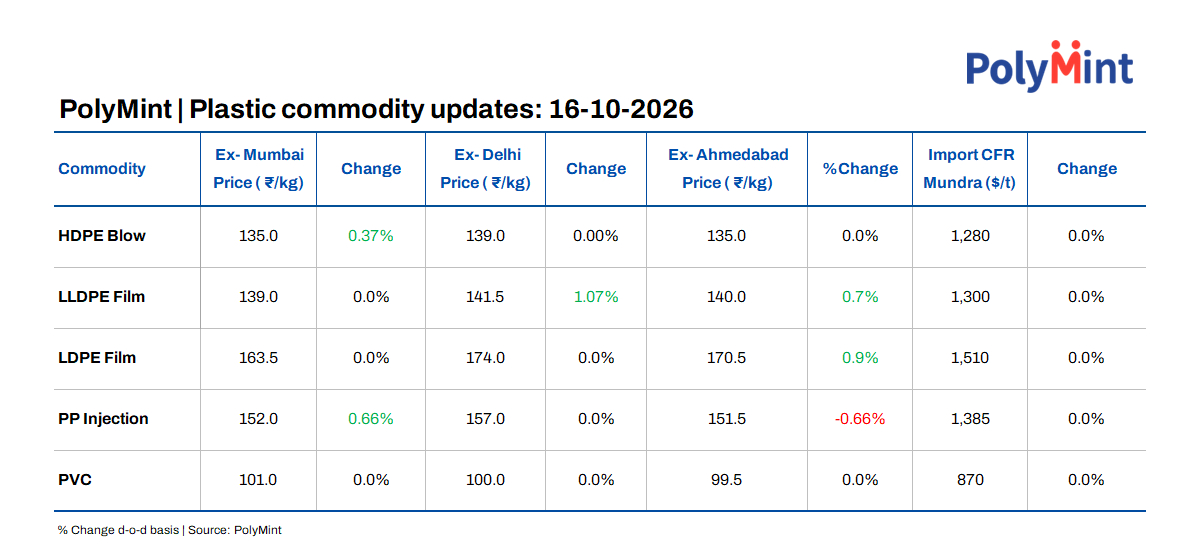
India’s polymer market recorded selective domestic price increases on 16 October, while import prices at CFR Mundra remained unchanged. High-density polyethylene (HDPE) blow moulding held at USD 1,280/t, linear low-density polyethylene (LLDPE) film at USD 1,300/t and low-density polyethylene (LDPE) film at USD 1,510/t. Polypropylene (PP) injection remained at USD 1,385/t and polyvinyl chloride (PVC) at USD 870/t.
Meanwhile, Brent crude fell 0.42% to USD 105.40/barrel and West Texas Intermediate (WTI) declined 1.75% to USD 95.79/barrel. Naphtha prices rose 0.5% to USD 1,000.75/t, while natural gas eased 1.62% to USD 3.18/MMBtu. Despite softer crude, Middle East supply uncertainty and shipping disruptions continued to support market concerns.
Domestic Market Overview
Domestic polymer prices recorded selective increases across regions. In Mumbai, HDPE blow moulding rose by INR 0.50/kg to INR 135/kg, while PP injection increased by INR 1/kg to INR 152/kg. In Delhi, LLDPE film climbed by INR 1.50/kg to INR 141.50/kg. In Ahmedabad, LLDPE film increased by INR 1/kg to INR 140/kg and LDPE film rose by INR 1.50/kg to INR 170.50/kg. However, Ahmedabad PP injection declined by INR 1/kg to INR 151.50/kg.
Other prices remained stable. Delhi HDPE blow moulding held at INR 139/kg and LDPE film at INR 174/kg. PVC remained at INR 101/kg in Mumbai, INR 100/kg in Delhi and INR 99.50/kg in Ahmedabad. Buying remained selective.
Reliance Industries reduced monoethylene glycol (MEG) prices by INR 7/kg to INR 71.70/kg and ex-Hazira mixed xylene prices by INR 2/kg to INR 128/kg, effective 16 October. The cuts could affect feedstock costs across the polyethylene terephthalate (PET) value chain.

Other Updates
Oil prices ease as supply risks persist
Oil prices declined on 16 October but remained on track for weekly gains amid uncertainty over US-Iran negotiations and attacks on regional shipping. The International Energy Agency agreed to release more than 20 million barrels of diesel. Potential easing of restrictions on some Russian tankers could improve supply flexibility and reduce freight costs, although Hormuz disruptions remain a major risk.
India gains importance in regional naphtha sourcing
South Korea’s Ulsan Port has diversified naphtha sourcing towards India, North America and Europe as shipments from Persian Gulf ports declined following the escalation of the Middle East conflict. Chennai, Mumbai and Vadinar emerged as important Indian loading points, while Houston became a major alternative supply hub. The shift highlights India’s growing role in regional feedstock logistics, although longer routes and higher freight costs could affect delivered economics.
Ship sinkings and record freight raise logistics concerns
The container ship GFS Pride and bulk carrier Cape Dao were confirmed sunk near the Strait of Hormuz following separate attacks. Another container ship was damaged but reached a safe anchorage. Meanwhile, VLCC freight for an Asia-Pacific-bound tanker from the US Gulf Coast reportedly reached a record USD 81 million. Higher freight and security risks could increase landed costs and delivery uncertainty for Indian importers.
Leave a Reply