- Subdued investor sentiment, declining futures weigh on trades
- Sellers withhold inventories amid lower price realisations
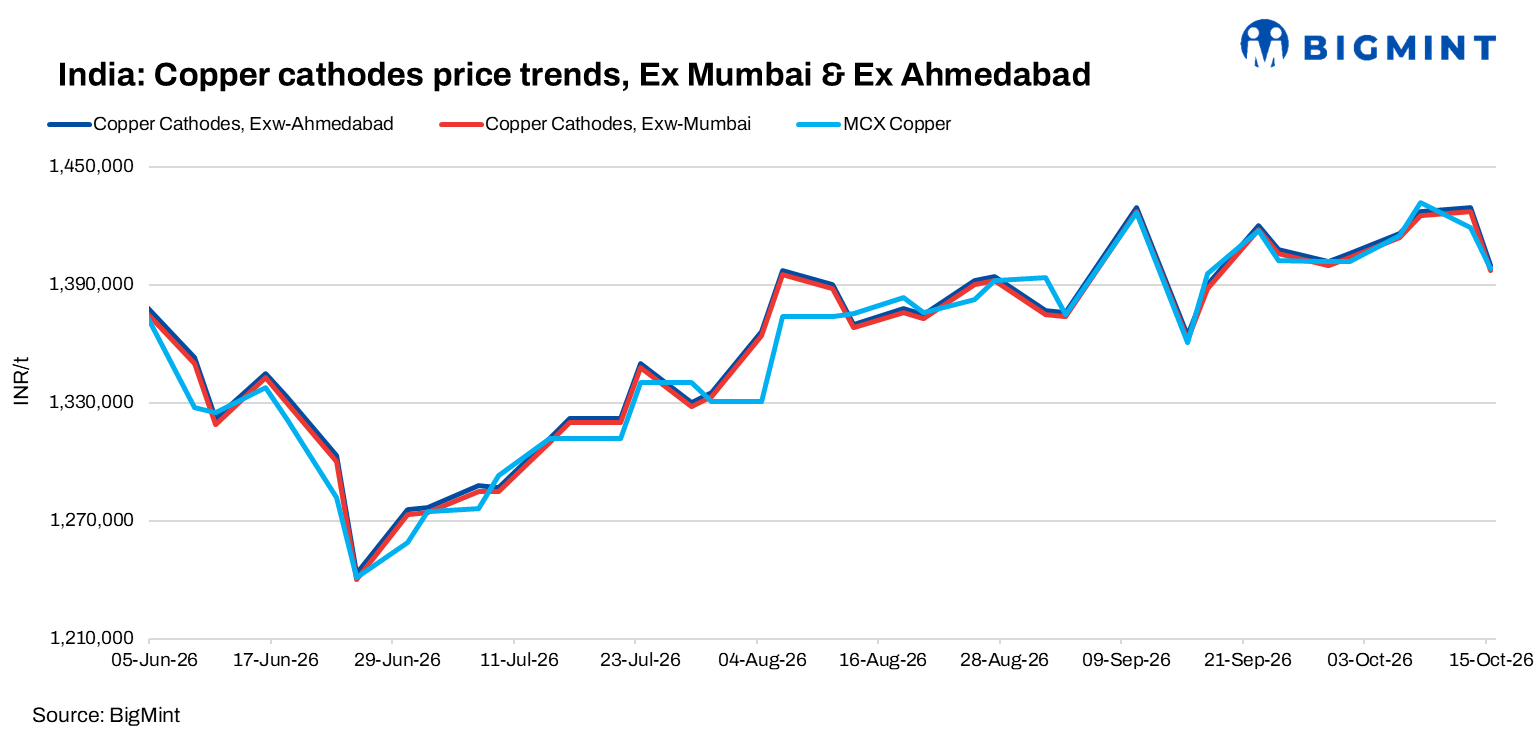
India’s copper cathode market weakened in the week ended 15 October 2026 as subdued investor sentiment and declining domestic futures prices weighed on trading. LME copper edged up 0.1% w-o-w to $14,491/t, while exchange inventories declined 5.5% to 229,650 t from 242,975 t.
According to BigMint’s assessment, ex-Ahmedabad cathode prices fell by INR 27,000/t (1.9%) w-o-w, to INR 1,400,000/t. Ex-Mumbai prices declined by INR 28,000/t (2%), to INR 1,397,000/t. Meanwhile, primary copper CC wire rod (CCR) prices, exw-Delhi, decreased by INR 10,000/t (0.7%), to INR 1,455,000/t.
Weaker global sentiment and supply expectations weigh on prices
Copper prices faced pressure from a stronger US dollar. The dollar reached an 18-month high on 14 October. Technology shares also sold off, with the Nasdaq Composite falling 1.88%. Investors grew concerned about the sustainability of AI and data centre spending. Consequently, LME three-month copper fell $228/t to $14,391/t between 13 and 15 October. MCX copper futures also dropped INR 20.85/kg to INR 1,398.45/kg.
Expectations of higher refined copper supply also weighed on sentiment. New capacity is coming online at Adani Enterprises’ Kutch Copper complex in India and PT Amman Mineral’s smelter in Indonesia. Aurubis is expanding its refinery in Bulgaria, while China’s Chifeng Jintong commissioned a 300,000 t/year smelting line in August. However, concentrate shortages and weak smelting economics continue to constrain output. These factors could limit the near-term impact of new capacity additions.
Domestic sellers hold inventories amid falling prices
In the domestic market, sellers have become reluctant to release inventory at lower prices, as reduced realisations could erode margins or crystallise losses on material procured at higher levels. This has limited spot availability and widened the gap between buyers’ bids and sellers’ expectations, keeping trading activity subdued as market participants await greater price stability.
Leave a Reply