- Flats trade remains selective amid liquidity constraints
- Longs demand softens amid approaching festive season
India’s stainless steel finished market recorded divergent trends across flats and longs segments during the week ended 14 October 2026. Demand for flat products remained selective ahead of Diwali, with liquidity constraints and shortages in certain grades affecting market activity. Meanwhile, the longs segment continued to face weak downstream demand, limiting buying interest and keeping prices under pressure.
Finished flats
India’s stainless steel flat products market witnessed need-based but decent demand ahead of Diwali, while import activity remained subdued. Market participants reported shortages in certain grades, alongside liquidity constraints that continued to affect procurement. Buyers remained selective, with purchasing largely driven by immediate requirements despite expectations of improved demand during the festive period.
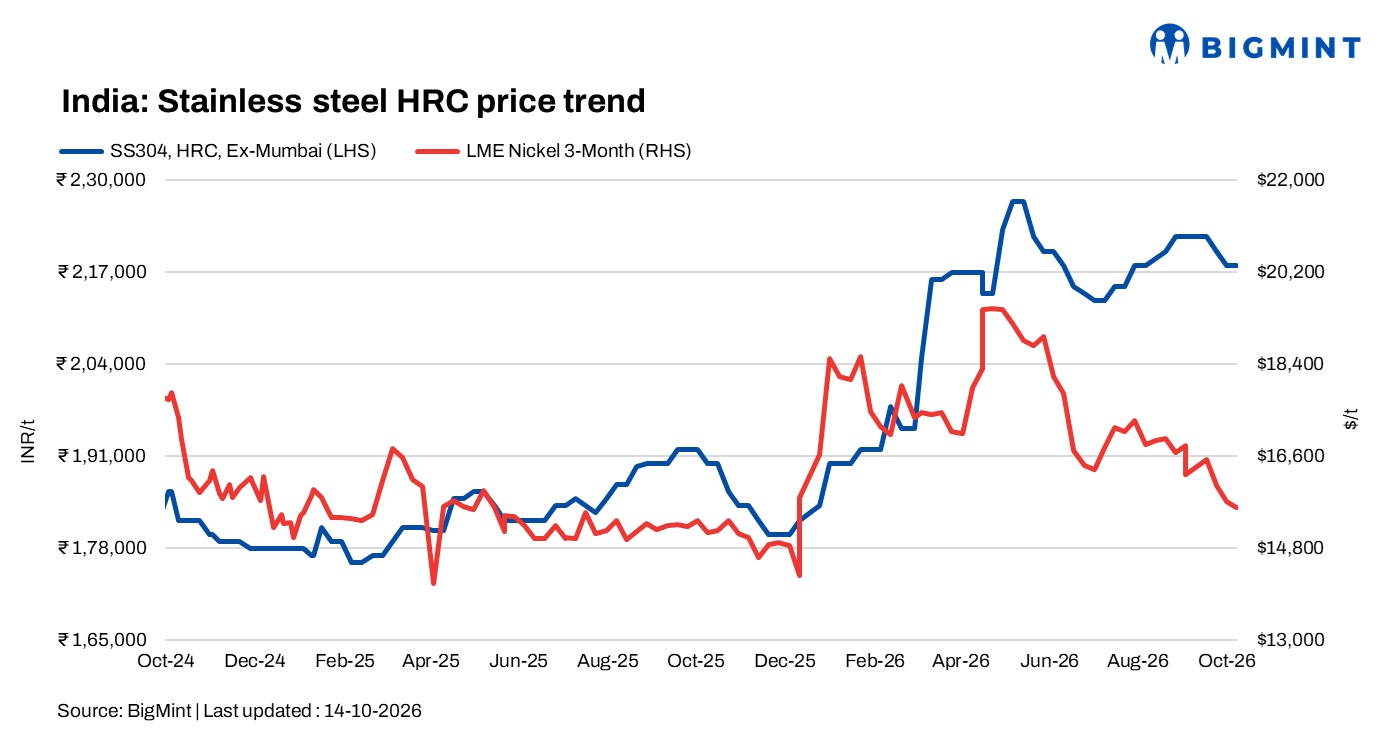
BigMint assessed 304 hot-rolled (HR) coil prices at INR 218,000/t exw-Mumbai, unchanged w-o-w. Meanwhile, 316 HR coil prices declined by INR 5,000/t to INR 450,000/t. Despite softer nickel prices, tight availability of 316-grade material and elevated molybdenum costs continued to provide some price support, although the grade witnessed a decline during the assessment week.
Additionally, a leading Indian stainless steel producer increased prices of its 304 and 316-grade hot-rolled (HR) and cold-rolled (CR) products by INR 2,000/t and INR 3,000/t, respectively, effective 11 October 2026. This marked the producer’s first price revision of the month, while prices of N7-grade HR and CR products remained unchanged.
However, the recent price increases have yet to be fully absorbed by the market, as liquidity constraints continue to limit buyers’ ability to accommodate higher prices.
Finished longs
India’s stainless steel longs market remained subdued during the assessment week, with weak downstream demand limiting buying interest. Although mills largely maintained their prices, retail rates softened amid slow purchasing activity ahead of Diwali.
BigMint assessed 304 black bar prices at INR 200,000/t exw-Mumbai, unchanged w-o-w. In contrast, 316 black bar prices declined by INR 5,000/t to INR 370,000/t.
Market participants continue to monitor festive-season demand for signs of improvement. However, weak consumption and liquidity constraints are likely to keep procurement cautious in the near term.
Global market
Taiwan’s import prices of 300-series hot-rolled stainless steel increased for the seventh consecutive month in August, surpassing TWD 70,700/t (approximately $2,200/t). Prices rose by around TWD 2,550/t ($79/t) from July, taking the cumulative increase over seven months to nearly TWD 15,970/t ($497/t). The latest level marked the highest since April 2023.
Market participants attributed the increase to price hikes by Indonesia’s Tsingshan, driven by curtailments in Indonesian nickel ore output, which raised import costs for Taiwanese buyers.
Higher procurement costs weighed on import activity. Taiwan’s 300-series hot-rolled stainless steel imports declined by 19.5% m-o-m to 21,800 t in August, marking the lowest monthly volume since January 2021. The decline highlights the pressure of rising import prices on procurement by domestic steelmakers.
Meanwhile, Taiwan’s Ministry of Economic Affairs (MOEA) concluded a preliminary injury investigation on 12 October 2026, finding reasonable indications of material injury to domestic producers from imports of certain cold-rolled stainless steel flat products from Vietnam. The case will proceed to the Ministry of Finance (MOF) for preliminary and final dumping investigations, potentially paving the way for provisional anti-dumping duties.
Separately, Vietnam is reviewing an anti-dumping petition targeting cold-rolled stainless steel imports from China, Indonesia and Taiwan. The application was confirmed complete on 29 September 2026, with authorities reviewing evidence of dumping and injury before deciding whether to initiate a formal investigation. The outcome of both cases could influence regional stainless steel trade flows and import competition across Asia.
Raw material

Outlook
India’s stainless steel flats market could receive support from pre-Diwali demand and inventory replenishment, although liquidity constraints and shortages in certain grades may continue to influence buying patterns. In contrast, weak downstream consumption is likely to keep the longs market subdued in the near term.
Elevated alloy costs, particularly for molybdenum, may continue to support sellers’ price expectations, although limited purchasing capacity could restrict the pass-through of price increases. Globally, rising import costs and trade remedy developments are expected to remain important factors influencing stainless steel trade flows across Asia.
Leave a Reply