- Crude steel output falls 3% y-o-y in Sep; weak mill margins weigh on iron ore demand
- Cumulative Jan-Sep iron ore imports increase by 4% y-o-y despite Sep decline
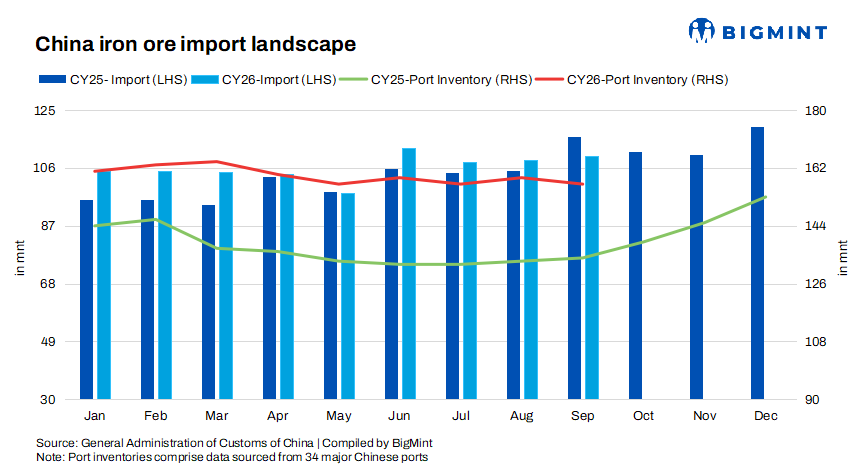
China imported 109.82 million tonnes (mnt) of iron ore and concentrate in September 2026, down 6% y-o-y but up 1.2% m-o-m, according to the General Administration of Customs of China (GACC). The y-o-y decline reflected subdued steel production, elevated port inventories, and cautious procurement by mills amid weak finished-steel demand.
Despite the monthly contraction, cumulative imports during January-September 2026 reached 954.97 mnt, up 4.1% y-o-y, indicating that overall import volumes remained higher than in the corresponding period last year.
Key factors weighing on imports
- Lower steel production curbs raw material demand: China’s crude steel production declined 3% y-o-y in September. Production at member mills of the China Iron and Steel Association (CISA) also weakened during 11-20 September, with daily pig iron and crude steel output falling 7.4% and 7.3% y-o-y, respectively. Lower production reduced mills’ immediate requirement for imported iron ore, limiting fresh procurement.
- Weak steel consumption and margins discourage fresh purchases: The slower-than-expected seasonal recovery in finished-steel demand, coupled with rising steel inventories, constrained mills’ production incentives. Weak finished-steel realisations and pressure from raw material costs further squeezed steelmaking margins, prompting mills to adopt a cautious procurement strategy and prioritise immediate requirements over inventory accumulation.
- Freight uncertainty adds to sourcing challenges: Elevated freight rates and concerns over potential disruptions to Brazilian low-grade fines shipments (due to some miners being adversely impacted by the surge in shipping costs) added uncertainty to delivered costs and sourcing decisions. However, these factors failed to generate sufficient buying momentum to offset the impact of weaker steel production, ample port inventories and cautious purchasing.
- Elevated port inventories reduce reliance on fresh arrivals: Iron ore inventories across 34 major Chinese ports stood at approximately 157 mnt in September, up 18% from 133 mnt a year earlier. The substantial stock overhang provided mills with a buffer against near-term supply requirements, reducing the urgency to secure additional seaborne cargoes amid subdued steelmaking activity.
Import prices rise despite lower volumes
China’s monthly average iron ore import price rose around 2% m-o-m to approximately $97/tonne (t) in September, despite a decline in import volumes. The increase may reflect changes in the grade composition of imported cargoes, shipment timing and contract pricing, rather than stronger underlying demand. Meanwhile, subdued steel production, elevated port inventories and pressure on mill margins continued to weigh on fresh procurement.
The average import unit value also differs from spot benchmark prices, which weakened during September, as the two measures capture different pricing and shipment dynamics.
Outlook
China’s iron ore import demand will depend on the pace of recovery in steel production and finished-steel consumption, alongside the extent of inventory drawdowns at major ports. Persistently high stocks and weak steelmaking margins could continue to limit fresh seaborne purchases, while improved mill profitability and renewed restocking may support import volumes.
Freight volatility and changes in the quality mix of imported ore could influence sourcing decisions. However, a sustained recovery in import demand will likely require stronger steel production, improved consumption and a more meaningful reduction in port inventories.
Leave a Reply