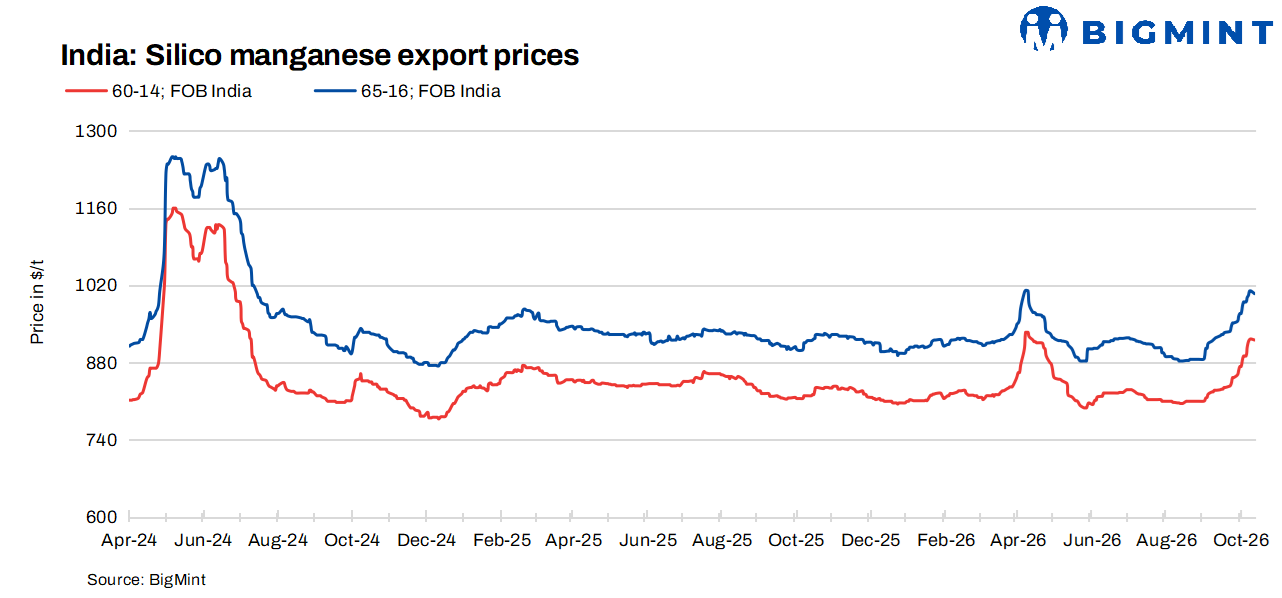
- Regional supply disruptions and cost pressures support export prices
- Oversupply and weak overseas demand limit further price gains
Indian silico manganese export prices moved higher in the week ending 12 October 2026, despite a decline in manganese ore prices.
As per BigMint index, export prices rose by an average of $22/t w-o-w, with both major grade. The 60-14 grade increased by $29/t to $921/t FOB Vizag/Haldia. Meanwhile, 65-16 grade prices climbed up by 15/t to $1,005/t FOB Vizag/Haldia.
The increase came amid supply uncertainty in Southeast Asia, elevated energy and reductant costs across parts of Asia, and firm export offers. However, subdued demand and persistent oversupply continued to cloud the sustainability of the rally.
Buyers resist higher offers on weak steel fundamentals
Silico manganese buyers remained cautious about accepting higher offers amid subdued steel market conditions in India. Billet prices declined by INR 1,750/t ($18/t) w-o-w to INR 44,000/t ($459/t) from INR 45,750/t ($488/t) on 6 October. The decline weakened the near-term price outlook for steelmaking raw materials and limited buyers’ willingness to absorb higher alloy costs. Consequently, despite firmer export assessments, subdued downstream demand and pressure on steel prices continued to constrain the scope for further silico manganese price increases.
Key sellers from eastern India told BigMint that no silico manganese export deals have been concluded above $1,000/t FOB, despite sellers quoting higher offers. Buying interest remains cautious, with buyers reluctant to accept elevated price levels. However, rising global crude oil prices and higher ocean freight costs are increasing the landed cost of competing origins, potentially improving the competitiveness of Indian material. Unless buying interest strengthens, the lack of deals above $1,000/t FOB is likely to limit further price gains, while production curtailments and tighter spot availability may provide downside support.
Export offers rise despite softer ore prices
The increase in export prices, despite softer manganese ore values, points to a possible lag between raw material movements and finished alloy offers. Producers may continue quoting against previously incurred production costs, existing orders and shipment commitments rather than immediately adjusting prices to reflect lower ore values. However, this does not establish that production costs increased or that buyers accepted higher offers. The price rise should therefore be viewed as a movement in export assessments, rather than definitive evidence of stronger underlying demand.
- Australian high-grade manganese ore (Mn 46%) prices edged down marginally by $0.02/dmtu w-o-w to $5.40/dmtu CNF Haldia/Vizag.
- Gabonese high-grade manganese ore (Mn 44%) prices declined slightly by $0.03/dmtu w-o-w to $5.02/dmtu CNF Haldia/Vizag.
- South African manganese ore lumps (Mn 37%) prices remained stable at $4.65/dmtu CNF Haldia/Vizag, with no significant w-o-w change.
Higher energy and reductant costs support offers
Across Asia, elevated energy and reductant costs had limited producers’ willingness to reduce alloy offers despite subdued consumption. In China, higher coke and semi-coke prices had increased production costs for ferro alloy smelters, while Indian producers had also reported more expensive replacement supplies of imported coke and coking coal. These pressures helped sustain firmer offer levels across the wider regional market.
Outlook
Silico manganese export prices are expected to remain volatile in the near term, as limited buyer acceptance at elevated offers may restrict fresh bookings and constrain further price increases. However, strategic production curtailments by Indian smelters and controlled spot availability could limit downside pressure. Export price direction will largely depend on overseas buyers’ willingness to absorb higher offers, the availability of competing material from Malaysia and other origins, and whether supply discipline can offset subdued buying interest.
Leave a Reply