- Critical power-plant inventories may limit downside, subject to restocking demand
- Indonesian thermal coal prices may soften amid weak buying interest, adequate port stocks and lower offers
Indian portside prices of Indonesian thermal coal softened marginally week-on-week (w-o-w) in the week ended 9 October, as subdued industrial demand, adequate spot availability and cautious procurement weighed on market sentiment. While prices witnessed minor gains early in the week, they subsequently retreated amid persistent buying resistance and softening offers from Indonesian suppliers, reflecting uncertainty over near-term price direction.
Prices of 5,000 GAR coal remained stable at around INR 11,800/t at Kandla and INR 11,700/t at Vizag. Similarly, 4,200 GAR coal dropped marginally by INR 50/t at INR 9,850/t and INR 9,750/t, respectively, while 3,400 GAR coal at Navlakhi also declined by INR 50/t to around INR 7,850/t.
Market participants reported limited trading activity, with buyers largely adopting a wait-and-watch approach amid unclear price trends and limited immediate replenishment requirements. Softening Indonesian offers further reinforced expectations of near-term price moderation, although sellers remained cautious about making significant downward revisions.
Tight power stocks offer underlying support despite weak spot demand
Declining coal inventories at domestic thermal power plants are providing underlying support to imported coal prices, limiting the scope for a sharper correction. Power-plant coal stocks fell by around 2% w-o-w to 20.62 million tonnes (mnt) as of 8 October, equivalent to approximately seven days of consumption, while nearly 87 plants were reportedly operating at critically low inventory levels.
However, the impact of tightening power-sector inventories on imported coal demand remains uncertain, as procurement requirements, coal quality preferences and the availability of domestic supplies influence buying decisions. Consequently, inventory concerns may provide a price floor, but stronger spot demand would be necessary to sustain a meaningful upward movement.
Port inventories rise, easing immediate supply concerns
Coal inventories at Indian ports covered by BigMint’s Week 40 assessment increased by 0.09 mnt, or 0.5%, to 18.44 mnt during 27 September-3 October 2026. Non-coking coal stocks edged up by 0.2% to 13.07 mnt, recovering part of the previous week’s decline.
The marginal increase in port inventories, combined with limited spot buying, is reducing immediate supply-side pressure on consumers and weakening sellers’ bargaining power. Although lower power-plant stocks could encourage replenishment in the coming weeks, adequate port availability may allow buyers to defer purchases until clearer price signals emerge.
Mixed Indonesian benchmarks reflect diverging market signals
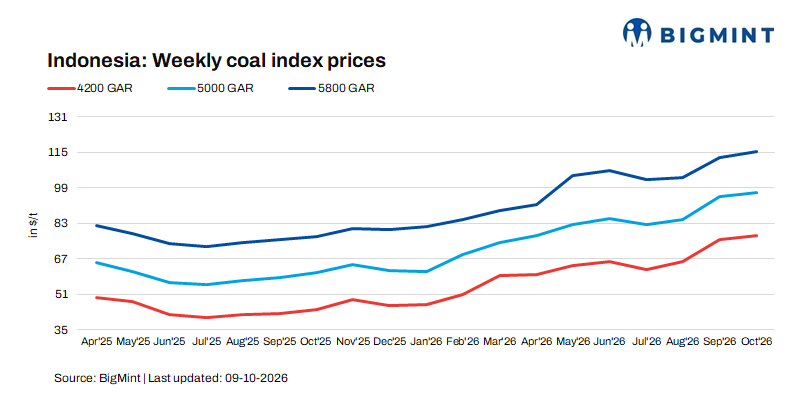
Weekly Indonesian thermal coal benchmarks delivered mixed signals. FOB prices for 4,200 GAR coal increased by around $1-2/t, while 5,800 GAR prices edged up by approximately $0.1-0.2/t. In addition, 3,400 GAR prices rose by around $0.1-0.5/t.
Indonesian coal benchmarks strengthen across grades
Weekly Indonesian thermal coal benchmarks edged higher across grades, with FOB prices for 4,200 GAR coal rising by around $1-2/t, while 5,800 GAR and 3,400 GAR prices increased by approximately $0.1-0.2/t and $0.1-0.5/t, respectively. The gains indicate modest support in the Indonesian export market, although the extent of price firmness will depend on demand trends and buying activity in key importing markets.
Outlook
Indian portside prices of Indonesian thermal coal are likely to remain range-bound with a slight downward bias in the near term, as cautious industrial procurement, adequate port inventories and softening Indonesian offers continue to weigh on sentiment. However, critically low power-plant stocks and the potential for inventory-led restocking could limit further declines.
A sustained recovery will depend on stronger buying interest from industrial consumers and power utilities, alongside firmer Indonesian export offers. Until these factors materialise, prices are likely to remain under pressure, with market participants closely monitoring power-sector inventory levels, port stocks and changes in Indonesian FOB benchmarks.
Leave a Reply