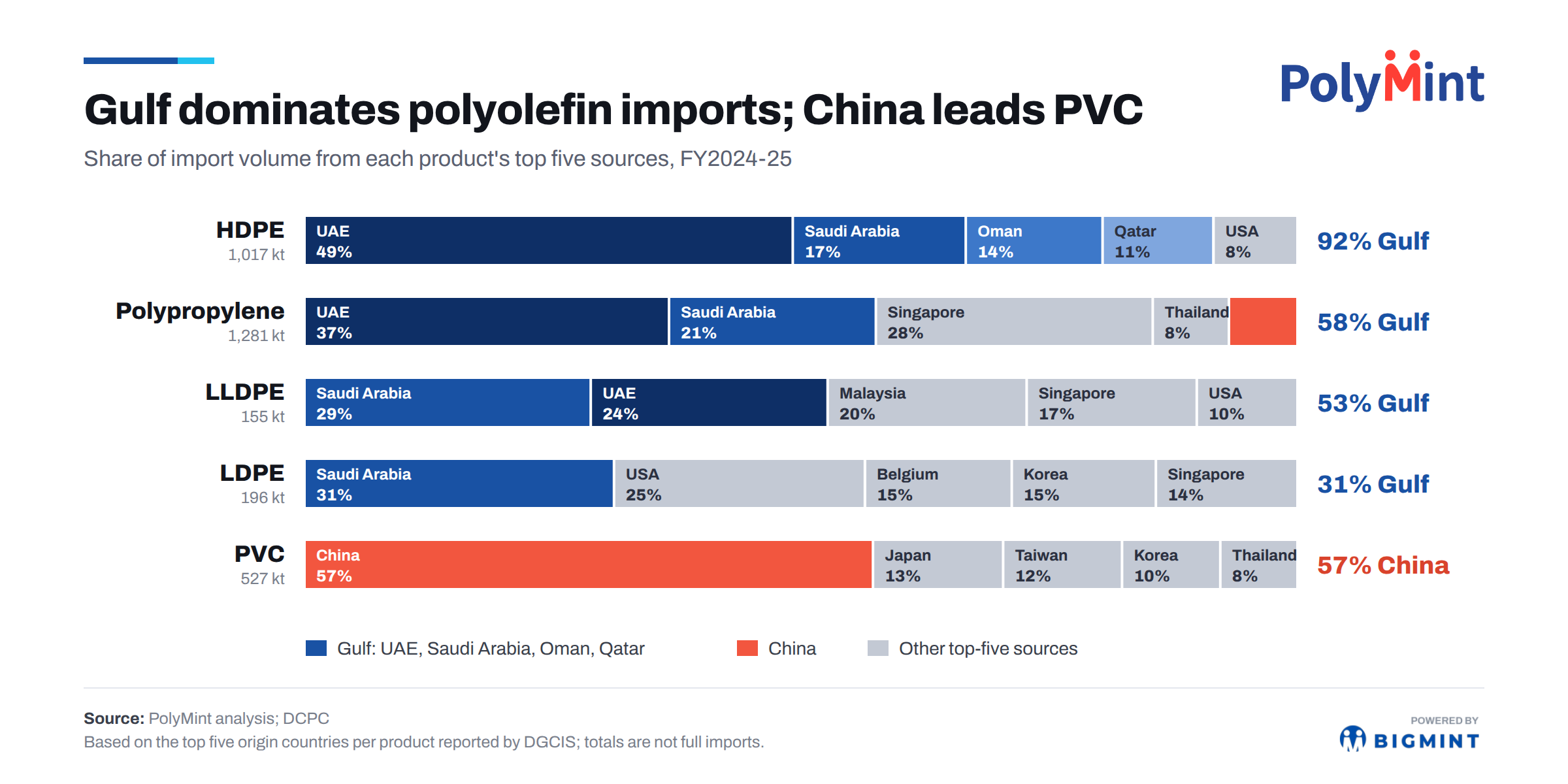
- Gulf countries account for 92% of India’s HDPE imports from top five origins
- India imports 30% of chemical demand but exports just 11.5% of output
India relies heavily on Gulf producers for polyethylene and polypropylene, while China dominates PVC imports, creating two distinct supply chains for the country’s polymer market. Four Gulf countries, the UAE, Saudi Arabia, Oman and Qatar, account for most polyolefin supplies, while most of these resins enter India through the West Coast.
The first infographic maps the origins of India’s major polymer imports, while the second highlights the limited buffer in the wider chemicals and petrochemicals sector. Imports account for 30% of domestic consumption, while exports represent just 11.5% of domestic production.
2026 puts both corridors to the test
The conflict that began in the Middle East in late February 2026 disrupted shipping through the Strait of Hormuz and drove Indian polyolefin prices sharply higher within weeks. In response, the government announced a temporary customs duty exemption on petrochemical imports, including polyethylene, polypropylene and PVC, on 2 April.
As Gulf cargoes slowed, Chinese material helped fill the gap. Trade data show that India’s PP imports reached a record of around 202,000 tonnes in May, driven by arrivals from China. Prices eased following the interim ceasefire in June, but buyers gained a clearer understanding of the risks associated with dependence on a single supply corridor.
Of the 1,017 kt of HDPE imported by India from its top five sources in FY25, 92% came from the Gulf, led by the UAE at 49%. The Gulf also supplied 58% of polypropylene and 53% of LLDPE imports, with Singapore serving as the main non-Gulf source of PP.
China supplied 57% of the 527 kt imported from India’s top five PVC origins, followed by Japan, Taiwan and South Korea. The different sourcing patterns expose Indian buyers to different risks. Polyolefin procurement is exposed to Gulf freight costs, regional disruptions and producer pricing, while PVC buyers are more sensitive to Chinese export pricing and India’s trade-remedy measures.
For Indian processors, understanding these supply corridors is increasingly important when planning procurement, managing price volatility and diversifying sourcing strategies.

Limited buffer against global supply surpluses
Across India’s major chemicals and petrochemicals sector, imports have remained close to 30% of domestic consumption since FY18, while exports have declined from 18.6% of production to 11.5%. The gap between the two has widened from 13.9 to 18.7 % points.
Domestic demand has absorbed volumes that were previously exported, leaving less production available for overseas markets. At the same time, India’s reliance on imported chemicals and petrochemicals leaves the domestic market exposed to global supply disruptions and changes in international trade flows.
Western India, in particular, could become an important destination for additional supplies as China’s expanding capacity drives export growth or Gulf cargoes are redirected to alternative markets. Such shifts could influence domestic availability, import parity and price competition, creating both opportunities and challenges for local producers and buyers.
Will Gulf disruptions and China’s export push redraw India’s polymer supply map and reshape resin prices, sourcing costs, and margins?
At PLAST.CONNECT 2026 — Ahmedabad, PolyMint will bring together industry stakeholders to discuss Middle East supply disruptions, China’s export push, shifting trade flows, and India’s evolving polymer demand-supply dynamics.
The “The new polymer supply map: Global shifts & India’s west coast” panel will examine how Gulf supply risks, Chinese capacity expansion, and India’s import dependence could reshape resin availability, landed costs, and sourcing decisions, with a focus on West India.
Join us on 22 October in Ahmedabad and be part of the conversation shaping the polymer market.

Leave a Reply