- Improved buying interest, elevated import premiums lift prices
- LME prices increase by 1% w-o-w amid tight availability
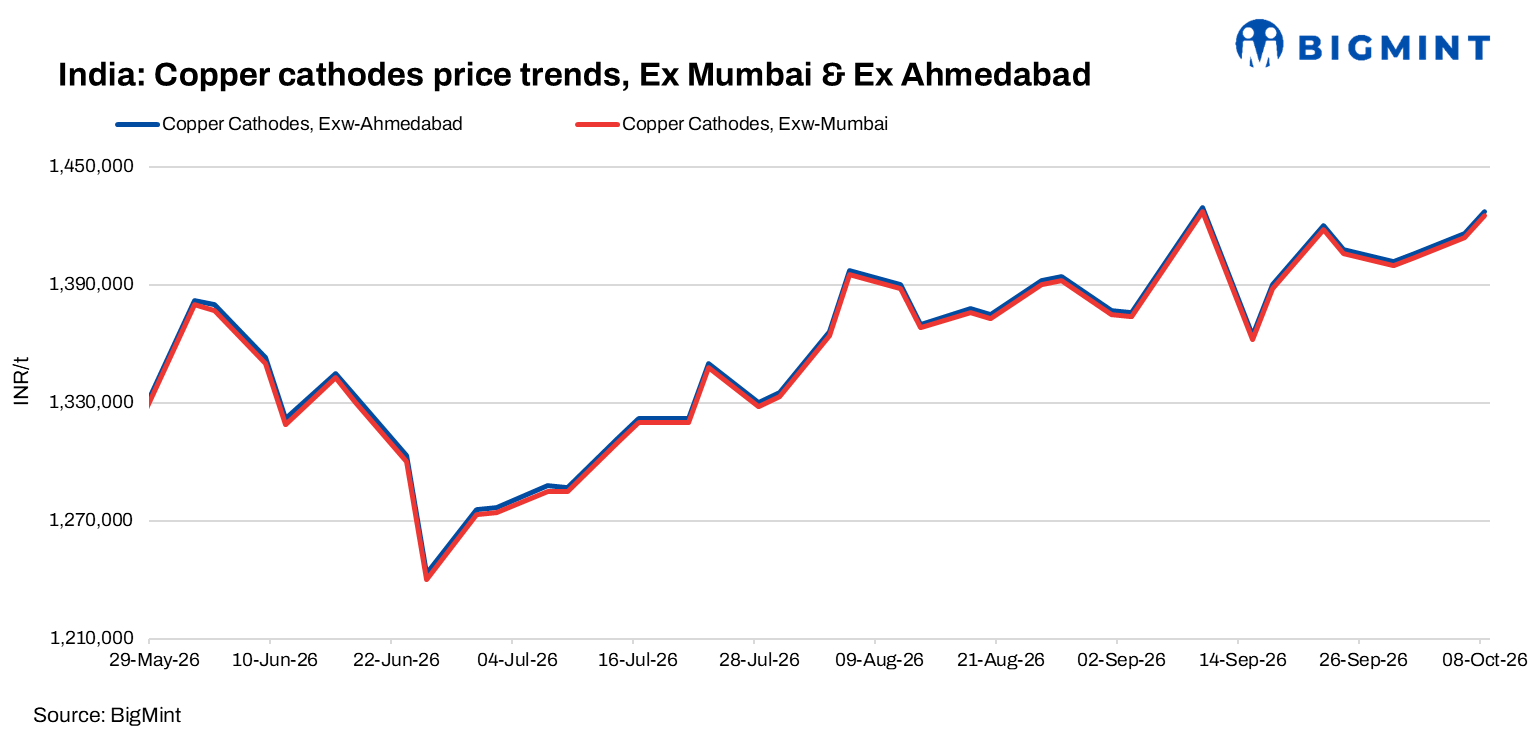
India’s copper cathode market remained firm in the week ended 8 October 2026 as higher global benchmarks and improving domestic demand supported prices. London Metal Exchange (LME) copper rose 1.3% to $14,476/tonne (t), while LME stocks declined 2% w-o-w to 242,975 t from 248,075 t. Despite the inventory build, tight physical availability continued to support the market.
According to BigMint’s assessment, ex-Ahmedabad cathode prices rose by INR 19,000/t, or 1.35%, w-o-w, to INR 1,427,000/t from INR 1,408,000/t. Ex-Mumbai cathode prices also increased by INR 19,000/t, or 1.35%, to INR 1,425,000/t from INR 1,406,000/t.
Meanwhile, copper primary CC wire rods (CCR) prices, exw-Delhi, increased by INR 3,000/t, or 0.2% w-o-w, to INR 1,465,000/t from INR 1,462,000/t.
Domestic demand remains firm, but buyers resist high prices
Indian refined copper prices remained firm through the first week of October, supported by higher import parity costs and pre-festive manufacturing runs. MCX refined copper futures advanced steadily from INR 1,401,000/t on 2 October to above INR 1,419,500/t on 8 October. The domestic rally was anchored by active pre-Diwali procurement from cable manufacturers, power distribution equipment fabricators, and automotive wiring harness producers.
However, downstream converters actively resisted elevated replacement costs. Buyers have shifted predominantly to a hand-to-mouth procurement strategy, refusing to build speculative buffer stocks at current price points.
The trend suggests that underlying consumption remains healthy, but high copper prices are limiting inventory accumulation. This is likely to remain a feature of the Indian market in the near term.
Domestic refined copper production reaches 2026 high
India’s primary refined copper sector is undergoing a major expansion to reduce import dependence. However, output remains constrained by imported concentrate availability.
Vedanta is seeking legal approval to restart its 400,000 t/year Thoothukudi smelter. The company estimates a $250 million refurbishment could restore 250,000 t/year of domestic cathode output. The restart could take 8-9 months after clearance.
Vedanta’s copper segment showed mixed results. Its Indian copper business recorded a 9% increase in first-half sales volumes to 105,000 t, supported by strong demand at its Silvassa plant, while second-quarter sales rose by 16% to 52,000 t. In contrast, sales at the Fujairah smelter declined by 64% y-o-y to 16,000 t as operations were affected by the disruption resulting from the closure of the Strait of Hormuz.
Meanwhile, Adani Enterprises’ Kutch Copper logged record high sales in Q1FY’27. Tight global concentrate availability could limit the plant’s utilisation. The smelter continues to rely on ad-hoc concentrate parcels from BHP, Glencore and Hudbay.
Hindustan Copper Ltd (HCL) is also expanding domestic concentrate supply. Its INR 7,200 crore Vision 2030 programme targets a rise in ore production from 3.67 mnt/year in FY’26 to 12.2 mnt/year by FY’30. The expansion covers its Malanjkhand, Khetri and Jharkhand operations.
Import premiums remain elevated
Imported copper continues to command a substantial premium in India. Japanese cathode premiums remain around $350-400/t CIF India, keeping imported units expensive relative to LME benchmarks.
During LME Week (1-6 October 2026), Codelco and Aurubis tabled multi-year-high 2027 term cathode premiums, underscoring that elevated surcharges are structural. Codelco opened offers at $325-345/t for Europe and around $350/t CIF Asia, while Aurubis announced $315/t for European buyers. These firm benchmarks confirm that primary producers will not discount physical units amid acute global concentrate deficits.
The structural change is also visible in the balance between primary and secondary copper. India’s copper demand reached 1.8 mnt in FY’25, while domestic cathode production increased and net cathode imports declined. However, secondary copper already accounted for a significant share of overall consumption.
Global concentrate shortage keeps pressure on refined supply
The global copper market remains tight as smelting capacity outpaces mine supply. China’s antitrust regulator is seeking concentrate supply commitments from Anglo American for merger approval, highlighting severe feedstock shortages among Chinese smelters.
The shortage is increasingly affecting refined output. Seven major Chinese smelters have scheduled 30- to 60-day maintenance in October-November, removing around 80,000 t of cathode production. Spot TCs have fallen below -$220/dmt, while sulphuric acid realisations declined 11%, squeezing smelter margins and reducing merchant deliveries.
Meanwhile, workers at Chile’s Centinela mine began an indefinite strike on 7 October, following strike authorisation at BHP’s Escondida. Supply disruptions and smelter cuts are tightening concentrate and cathode availability, potentially keeping physical premiums and replacement costs elevated in the near term.
Outlook
Indian copper cathode prices are expected to remain firm in the near term as tight global supply and elevated replacement costs support the market. However, high absolute prices may keep buyers cautious and limit further gains unless supply disruptions intensify.
Over the medium term, prices may remain supportive owing to the upcoming festive seasons.
Leave a Reply