- Producers raise gauge parities across regions amid rising iron ore, coal costs
- Market sentiment improves as construction activity resumes with retreat of monsoon
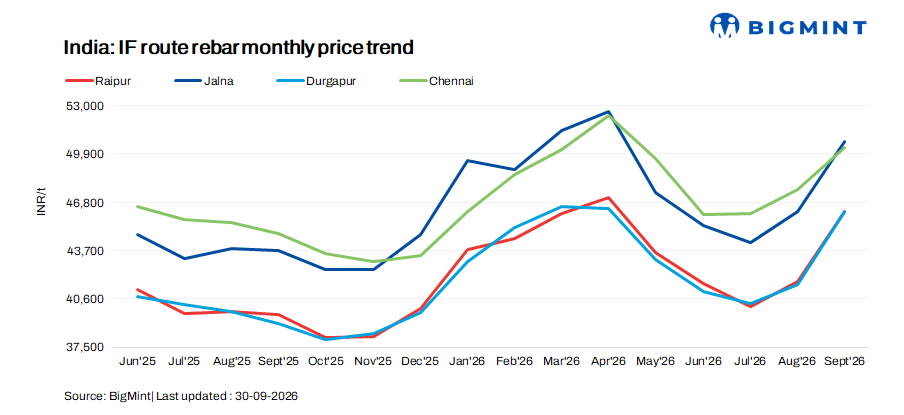
India’s induction furnace (IF)-route rebar prices rose by INR 2,000-4,900/t m-o-m across major markets in September, with Raipur recording the sharpest increase at INR 4,900/t. A broad-based increase in gauge parity across most major markets in mid-September also supported the price recovery, leading to higher effective offers for various rebar sizes. The increase was further supported by rising iron ore, non-coking coal and pig iron prices, which raised producers’ input costs and prompted firmer rebar offers. Stable melting scrap prices provided limited relief to producers.
Market sentiment improved following the end of the monsoon, with construction and project activity gradually resuming. Buying activity remained moderate, although traders and end-users stepped up purchases amid expectations of further price increases. With construction activity expected to gain momentum in October, demand could provide additional support to finished steel prices.
Mill inventories across major markets stood at around 7-10 days, while order bookings were at around 4-5 days. Higher primary mill prices also supported secondary producers, allowing them to raise offers while maintaining the prevailing price differential.
Region-wise price movements
In the central region, rebar prices witnessed a sharp increase in September, with Raipur recording the highest hike of INR 4,900/t, followed by Raigarh at INR 3,800/t m-o-m. Sentiment strengthened following the Chhattisgarh Rebar Association’s mid-month gauge parity revision, which supported a firming trend in rebar offers. However, demand remained below sellers expectations, while the billet-to-rebar conversion spread hovered around INR 2,800-2,900/t. Higher iron ore and coking coal costs remained key price drivers despite continued margin pressure.
In the Northern region, rebar prices across Delhi, Muzaffarnagar and Jaipur maintained an upward trend in September, supported by firm seller sentiment, earlier bookings and limited sales pressure, although demand remained subdued. Gauge parity was revised in Delhi and Jaipur, while most Delhi mills retained the INR 1,000/t differential, with only a few revising it to INR 1,500/t. Mandi Gobindgarh rebar prices increased by around INR 1,600/t m-o-m to INR 52,400/t. Despite limited demand, higher iron ore and coal costs and tight billet availability supported further price hikes. Scrap availability remained comfortable in Mandi Gobindgarh, with large mills operating at around a 90:10 scrap-to-sponge iron ratio, while medium-sized mills maintained around 70:30. Buying activity improved towards the month-end amid expectations of further increases. Overall, the price rise was largely raw-material- and supply-driven rather than demand-led.
IF-route rebar prices increased by around INR 3,000-4,000/t m-o-m across major south Indian markets. The increase was mainly driven by higher sponge iron and melting scrap costs, prompting sellers to raise offers to protect conversion spreads. Market sentiment improved moderately from the previous month as buying activity picked up, although higher input costs continued to pressure margins. Sellers in Chennai also implemented parity/gauge adjustments to support profitability.
Rebar prices increased by INR 2,000-3,000/t across western markets, with Mumbai and Ahmedabad rising by INR 3,000/t, followed by Goa and Jalna at INR 2,000/t. Prices remained supported by earlier bookings and limited sales pressure. However, trading activity slowed in the middle of the month, particularly amid the Ganesh Chaturthi festival and weaker finished steel buying. Mills adjusted trade discounts as traders offered material at lower rates, while tight availability of sponge iron, scrap and coal prompted further offer increases in the final week. Buying activity subsequently improved as expectations of higher prices strengthened.
Eastern Indian rebar prices also strengthened in September. Durgapur IF-route rebar increased by INR 2,000/t m-o-m to INR 47,400/t, while BF-route rebar rose by INR 4,350/t to INR 59,000/t, widening the BF-IF price gap to nearly INR 11,600/t. Sentiment turned bullish after the Durgapur Rebar Association revised gauge parity, supporting fresh buying, particularly towards eastern and northern markets. However, demand remained below sellers’ expectations, while the billet-to-rebar conversion spread narrowed to around INR 2,000-2,350/t. Higher iron ore and coking coal costs remained the key support for prices despite continued margin pressure.

Raw material price trends
Higher raw material costs remained the primary driver of the September rebar price recovery, with iron ore, non-coking coal and pig iron recording increases, while melting scrap remained stable.
Iron ore: Iron ore fines, Odisha Index, 0-10mm, Fe 62%, increased by INR 500/t m-o-m to around INR 5,550/t. The increase raised the input cost for sponge iron and other iron-bearing metallics, supporting higher rebar offers.
Non-coking coal: Domestic non-coking coal, ex-Bilaspur, increased by INR 1,050/t m-o-m. Imported non-coking coal at Paradip also rose by INR 1,050/t for both RB2 (5,500 NAR) and RB3 (4,800 NAR), South Africa. Higher domestic and imported coal costs added to the production cost of IF-route producers.
Pig iron: In the benchmark Durgapur market, steel-grade pig iron prices increased by INR 2,300/t m-o-m, adding further pressure to metallic input costs and supporting higher finished steel offers.
Melting scrap: In contrast, the Mandi Gobindgarh index for melting scrap (HMS 80:20) remained stable m-o-m, with the latest assessment on 30 September placing prices at INR 39,300/t. The stability in scrap prices provided limited cost relief against increases in other key inputs.
BF-Route rebar sentiment
India’s BF-route rebar prices rose by INR 1,000/t w-o-w to INR 63,000/t ($655/t) ex-Mumbai on 30 September, taking the September increase to around INR 6,500/t. The rise was supported by tight availability, lean inventories, improving project enquiries and festive-season restocking. Project prices were reported at INR 62,000-64,000/t landed. A leading steelmaker raised rebar list prices by INR 1,500/t for early-October deliveries, taking its cumulative September-early October increase to INR 6,000/t.
Outlook
Rebar prices are likely to remain firm in October as elevated iron ore, coal and pig iron costs continue to support producers’ offers. However, further price increases could face resistance if construction-led buying does not strengthen sufficiently to absorb higher offers.

Leave a Reply