- Rebar prices surge amid lower production, higher secondary steelmaking costs
- HRC prices rise on tight availability; higher exports and weaker rupee support market
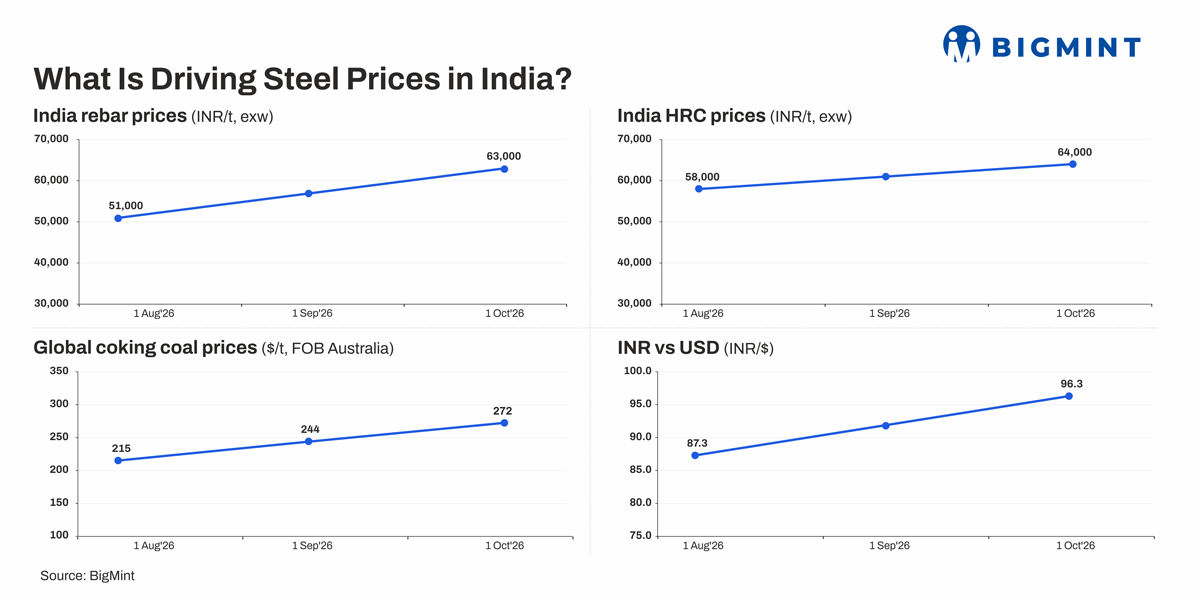
Data Deep Dive: Indian steel prices rose sharply between 1 August and 1 October 2026, with BigMint’s benchmark HRC prices reaching their highest levels in around four years, while BF-route rebar prices are at over three-and-a-half year highs. Rebar prices increased by INR 12,000/t, from INR 51,000/t to INR 63,000/t during the two months under review, a rise of 23.5%, while HRC prices increased by INR 6,000/t, from INR 58,000/t to INR 64,000/t, gaining 10.3% over the same period.
The rally has been driven by a combination of lower finished steel availability, rising raw material and energy costs, increased export allocations and currency depreciation.
Key factors behind price rise
Lower rebar production from RINL and Jindal Steel
India produced approximately 53.70 mnt of rebar in FY’26 comprising 13 mnt (24.2%) from the primary producers and 40.70 mnt (75.8%) from the secondary producers. With around 55% of blast furnace-based rebar production supplied directly to project customers, disruptions at major mills can have a significant impact on open market availability.
India’s rebar production declined by 21.4%, from 5.09 mnt in March to 4 mnt in August, partly reflecting lower production at Jindal Steel and RINL. Their combined output fell by approximately 0.20 mnt (64.1%), from 0.32 mnt to around 0.12 mnt.
Jindal Steel’s rebar production declined from 0.19 mnt to 0.09 mnt, down 52.6%, while RINL’s output fell from 0.13 mnt to around 0.025 mnt, a decline of 80.8%.
Jindal Steel’s production was affected by the ramp up and stabilisation of its new Angul blast furnace, while RINL’s operations were constrained by the June ladle accident, financial pressures and BOF stabilisation.
The reduction in production from these major suppliers tightened open market availability and provided strong support to rebar prices.
Sponge iron producers selling more power

Several mid-sized sponge iron producers equipped with waste heat recovery boilers (WHRBs) have been selling surplus electricity on power exchanges amid attractive power market realisations.
With estimated generation costs of around INR 3/unit, compared with exchange prices reaching around INR 10/unit, selling surplus electricity has become commercially attractive for producers.
Some producers are understood to have committed available surplus power through October, which could limit their flexibility to redirect electricity towards captive steelmaking and potentially constrain production at integrated sponge iron and steel facilities.
The Ministry of Power’s directive asking captive power plants above 50 MW to make excess electricity available to the grid could further support this trend.
Separately, IEX reported record electricity trading volumes of 13.94 billion units in August, up 20.2% y-o-y, reflecting strong activity in the power market. However, the figure does not directly represent power diversion by steel producers.
Higher global coking coal prices
Coking coal prices FOB Hay Point, Australia, increased by $57/t (26.5%), from $215/t on 1 August to $272/t on 1 October, adding significantly to raw material costs for blast furnace-based steelmakers.
Safety-related restrictions at Chinese coal mines following the Shanxi accident tightened domestic supply and increased Chinese mills interest in seaborne coking coal, particularly Australian material. Logistics constraints affecting Mongolian coal supplies added to the pressure.
Meanwhile, Premium HCC CNF Paradip prices increased by approximately 25% from early-August levels, averaging around $300/t in September.
Stronger Chinese buying increased competition for Australian cargoes, while Australian coking coal shipments to India declined in August, adding to procurement pressures for domestic mills.
Higher non-coking coal prices
Non-coking coal procurement costs also increased amid tighter auction availability, stronger industrial buying and logistical constraints.
CIL’s average e-auction premium over notified prices increased from 59% in August to 94% in September, a rise of 35 percentage points. At the same time, offered volumes declined by 38.2% from 21.07 mnt to 13.02 mnt.
Prioritisation of railway rakes for thermal power plants also delayed domestic coal deliveries to some sponge iron producers, increasing their dependence on relatively costlier alternative and imported supplies.
The combination of higher coal prices and power costs raised production costs for coal-based sponge iron and secondary steel producers, providing additional support to rebar prices.
Lower HRC availability
Domestic HRC availability tightened amid maintenance shutdowns at major eastern Indian mills and lower material arrivals reported by traders and distributors.
Net HRC production declined by 15.7% from 2.67 mnt in July to 2.25 mnt in August. In contrast, net CRC output increased by 17.7% from 1.30 mnt to 1.53 mnt during the same period.
This trend indicates stronger downstream conversion requirements alongside a smaller pool of HRC available for merchant market sales.
Separately, BigMint’s steel rake dispatch figures declined by 15.2% from 4.93 mnt in August to 4.18 mnt in September. While the data covers broader steel dispatches rather than HRC alone, it is consistent with reports of reduced material movement and tighter availability.
Lower mill supplies have supported HRC prices, with availability expected to remain relatively tight in October.
Government demand ahead of UP elections
Government-linked infrastructure activity could provide additional support to steel demand over the coming months.
With the Uttar Pradesh Assembly elections expected in early 2027, procurement for and execution of ongoing infrastructure and development projects may accelerate before the Model Code of Conduct comes into effect. This could provide incremental demand for steel and other construction materials, particularly in northern India.
However, its contribution to the current price rally will depend on the actual pace of procurement and project execution.
Higher steel exports

India’s steel exports increased by approximately 37.5% from around 0.80 mnt to 1.10 mnt per month over the past two-to three months.
Greater clarity following the EU’s revised quota announcement in July encouraged mills to commit export volumes after earlier uncertainty over market access. Indian mills also increased their focus on semi-finished steel exports.
Higher export allocations reduced incremental volumes available to domestic buyers, adding to existing supply tightness and supporting domestic steel prices.
Weakening Indian rupee
The depreciation of the Indian rupee has further reinforced domestic steel prices. The currency closed at approximately INR 96.32/$ on 1 October amid higher crude oil prices, rising US bond yields and foreign portfolio outflows.
A weaker rupee raises the domestic cost of imported coking coal and other dollar-denominated raw materials. At the same time, it improves rupee realisations from steel exports and increases the landed cost of imported steel.
Currency depreciation has, therefore, supported domestic prices through higher input costs, stronger export economics and reduced import competitiveness.
It also changes the interpretation of the current rally. While HRC prices have reached around four-year highs in rupee terms, the corresponding price level in US dollar terms remains below an equivalent four-year high, as part of the increase reflects rupee depreciation.
Outlook
Indian steel prices are likely to remain firm in the near term, supported by elevated raw material costs and relatively tight finished steel availability. However, buyer resistance is emerging at current price levels, while domestic prices have risen faster than several international markets.
The completion of maintenance shutdowns, improved power availability and normalisation of production at major mills could gradually ease supply pressures. Further price movement will depend increasingly on whether domestic demand can absorb current levels as steel availability improves.
Leave a Reply