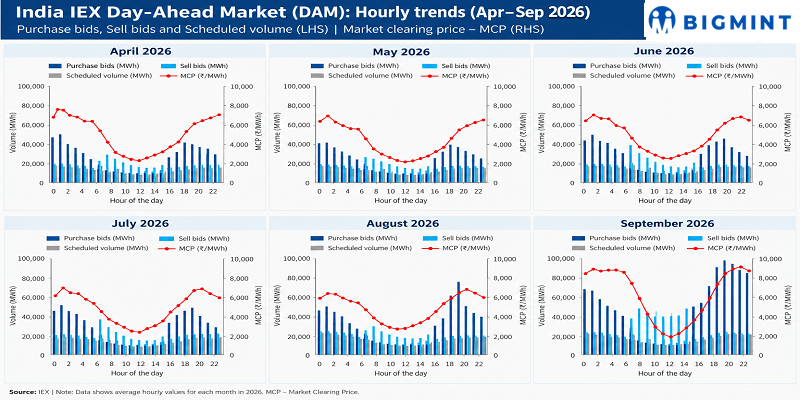
- Average market clearing price on DAM jumps 57% m-o-m in Sep’26
- Evening scarcity deepens despite persistent midday power surplus
India’s electricity market is developing an increasingly pronounced divide between abundant, low-priced power during solar hours and severe supply tightness after sunset, with September’s Day-Ahead Market (DAM) data providing the clearest evidence yet of this structural shift.
BigMint’s analysis of six months of hourly Indian Energy Exchange (IEX) data shows that the September price surge was not simply the result of higher electricity consumption. Instead, purchase bids increased dramatically just as available sell bids contracted, particularly outside solar-generation hours.
The result was an unusual combination: September’s average market clearing price (MCP) surged 56.5% m-o-m to INR 6,906/MWh from INR 4,412/MWh in August, even as average final scheduled volume declined slightly to 7,353 MWh from 7,479 MWh.
Sep marks structural tightening
The change in bidding behaviour was extraordinary.

Average purchase bids almost tripled from August to September, while sell bids declined around 23%. But scheduled volumes fell 1.7%.
This suggests September’s price escalation was principally a liquidity and availability problem: substantially more power was sought through the exchange, but additional supply did not emerge to meet it.
Two electricity markets within same day
Monthly averages, however, conceal the most important development. September effectively produced two distinctly different power markets.
Between 09:00 and 14:00, the MCP generally remained between INR 2,200-3,250/MWh as solar generation supported sell-side availability. At 13:00, for example, sell bids averaged 22,931 MWh against purchase bids of only 11,776 MWh, keeping MCP at INR 2,235/MWh.
The balance reversed dramatically as solar generation faded.

Between 15:00 and 19:00, purchase bids increased more than sixfold while sell bids dropped around 77%. Prices consequently more than doubled.
More strikingly, scheduled volume fell from 11,184 MWh at 15:00 to just 3,479 MWh at 19:00 despite the explosion in purchase bids. The exchange therefore faced a scarcity of available power precisely when buyers wanted it most.
The solar ‘duck curve’ is becoming unmistakable
The pattern is not unique to September.
Midday MCP has consistently remained depressed over the past six months. At 13:00, prices averaged INR 1,258/MWh in April, INR 1,782 in May, INR 1,733 in June, INR 1,262 in July and just INR 1,202 in August.
September’s INR 2,235/MWh was higher, but remained dramatically below evening prices.
This suggests India’s rapidly expanding renewable fleet is increasingly creating abundant electricity during daylight hours without eliminating the requirement for dispatchable generation once solar output declines.
Sep scarcity extends beyond evening peak
September’s tightness was particularly severe because it extended through most non-solar hours.
At midnight, purchase bids averaged 58,614 MWh against just 5,651 MWh of sell bids, producing an MCP of INR 8,979/MWh. By 06:00, purchases reached 56,648 MWh against 6,272 MWh of sells, with MCP at INR 9,267/MWh. Pasted markdown
Only from around 08:00, as solar availability increased, did the imbalance begin easing materially.
September was therefore not simply characterised by an evening peak. It experienced a broad non-solar-hours supply squeeze interrupted by a daylight surplus.
Storage economics become increasingly visible
The widening intraday spread also provides a powerful economic signal for storage.
In August, average MCP at 13:00 was just INR 1,202/MWh compared with INR 8,275/MWh at 19:00 — a spread exceeding INR 7,000/MWh. Pasted markdown
September produced a similarly large differential: INR 2,235/MWh at 13:00 versus INR 9,618/MWh at 19:00. Such spreads do not automatically translate into battery profitability after efficiency losses, charging costs and other commercial considerations. But they demonstrate the increasing market value of technologies capable of shifting inexpensive daytime electricity into high-value evening hours.
Pumped storage, batteries, hydro and flexible thermal capacity therefore become increasingly important as the renewable share expands.
Coal’s role is also changing
The hourly data carry an important implication for India’s thermal generation fleet.
The value of coal-fired generation may increasingly depend not simply on how many units of electricity it produces annually but on its ability to remain available and ramp during the hours when renewable output declines.
September’s combination of strong power demand, weaker hydro generation, and tightening thermal coal stocks coincided with precisely this type of stress in the exchange market.
The IEX data alone cannot establish how much of September’s price increase was caused by any individual generation source. But they clearly demonstrate the underlying system requirement: India needs substantially more dispatchable electricity outside solar hours than the exchange was able to offer during September.
The implication is significant. Adding renewable generation can continue lowering daytime electricity costs, but without corresponding growth in storage and flexible dispatchable capacity, the value — and potentially the scarcity — of non-solar power will rise.
India’s emerging power market is therefore increasingly defined by a paradox: surplus electricity in the middle of the day and scarcity only a few hours later.
Leave a Reply