- Indian aluminium prices weaken on subdued demand
- Domestic copper gains on tight supply, pre-festive buying
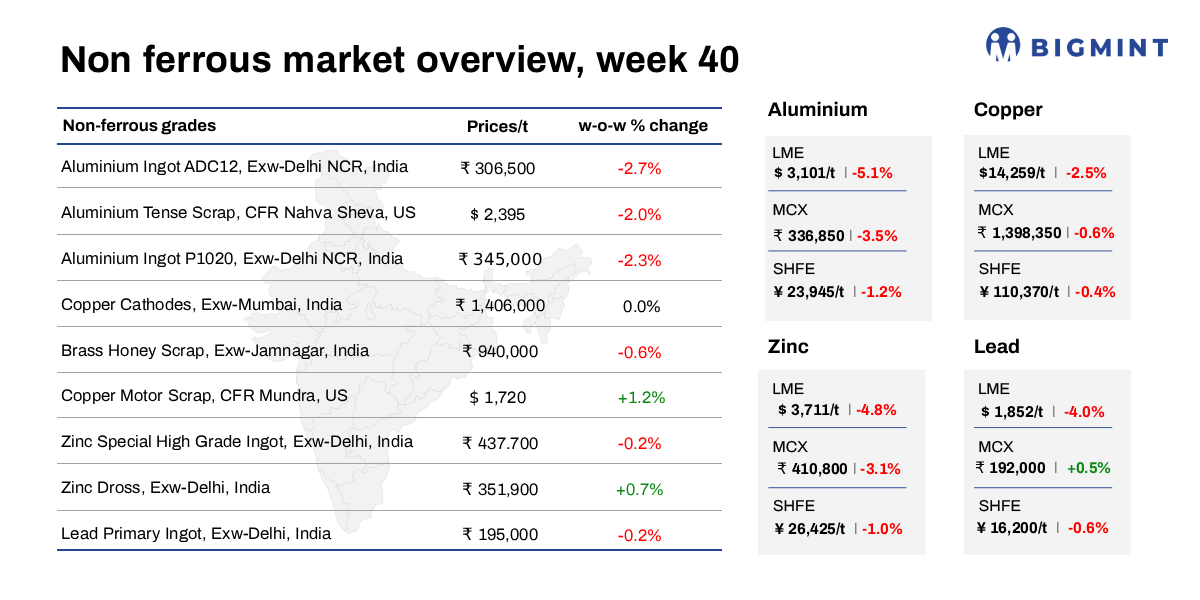
LME base metals declined during the week ended 2 October. Aluminium led losses, falling 5.1% to $3,101/t, followed by zinc at $3,711/t, down 4.8%. Lead declined 4.0% to $1,852/t, while copper fell 2.5% to $14,259/t.
Indian physical markets remained mixed, with aluminium facing weak demand and lower replacement costs, while copper stayed supported by tight scrap availability and festive buying. Zinc secondary prices strengthened on firm domestic replacement costs and nearby market conditions, whereas lead remained under pressure from weaker global benchmarks.
Aluminium
India’s aluminium scrap market remained subdued during the week, with imported and domestic prices declining w-o-w. Lower LME aluminium prices and weak local demand continued to weigh on buying interest.
According to BigMint’s assessment, UK-origin Zorba 95-5 scrap prices fell by $45/t, or 1.6%, w-o-w to $2,695/t from $2,740/t. P1020 aluminium ingot prices in Delhi NCR declined by INR 8,000/t, or 2.3%, to INR 345,000/t.
The decline in aluminium prices was also reflected on MCX, where aluminium futures fell 3.5% w-o-w to INR 336,850/t.
Domestic demand remained weak, with buyers maintaining a wait-and-watch approach. Ganesh Chaturthi holidays had reduced trading activity and spot enquiries, while subdued consumption limited fresh procurement. Imported scrap prices also weakened as lower replacement costs reduced seller flexibility, prompting buyers to focus on immediate requirements rather than inventory building and keeping spot activity subdued.
Domestic aluminium prices could find support in the coming weeks as inventories are being depleted. Potential curbs on EU scrap exports may tighten availability and encourage buyers to rely more on imports. Prices could strengthen from mid-October to November as manufacturers ramp up production ahead of the festive season.
Copper
India’s copper scrap market remained relatively firm during the week despite a decline in international prices. Tight availability and improving domestic procurement ahead of the festive season continued to support the market.
According to BigMint’s assessment, copper armature scrap prices ex-Delhi increased by INR 5,000/t, or 0.4%, w-o-w to INR 1,350,000/t from INR 1,345,000/t. Copper cathode prices ex-Mumbai remained unchanged at INR 1,406,000/t.
Domestic buying interest improved ahead of the festive season, particularly for high-recovery grades, as recyclers and secondary manufacturers increased purchases amid tighter imported availability. However, elevated copper prices kept buyers price-sensitive, with higher working-capital requirements limiting inventory building and favouring smaller, requirement-based purchases. Meanwhile, strong Chinese demand continued to tighten regional availability, with China’s copper scrap imports rising 8.3% y-o-y to 1.24 mnt in H1CY26, increasing competition for higher-recovery material across Asian markets.
Indian copper scrap prices are expected to remain largely stable in the near term. Festive-season buying may support domestic demand, while high LME levels and competition from overseas buyers could limit aggressive import procurement.
Zinc, lead
India’s zinc and lead market showed firmer secondary-market trends during the week, while primary zinc and lead assessments remained softer. The wider LME cash-to-three-month backwardation indicated relatively firm nearby market conditions despite higher exchange inventories.
According to BigMint’s assessment, zinc dross prices ex-Delhi increased by INR 2,500/t, or 0.7%, w-o-w to INR 351,900/t from INR 349,400/t. Zinc oxide (99% Zn) prices rose by INR 1,300/t, or 0.4%, to INR 333,000/t.
HZL increased its benchmark SHG zinc ingot price by INR 3,800/t to INR 429,300/t, from INR 425,500/t previously. Its lead ingot benchmark rose by INR 1,100/t to INR 218,000/t from INR 216,900/t.
Zinc dross and oxide prices may remain broadly stable to firmer in the coming week. Lead prices are likely to track movements in primary benchmarks, LME prices, and domestic buying activity.
Leave a Reply