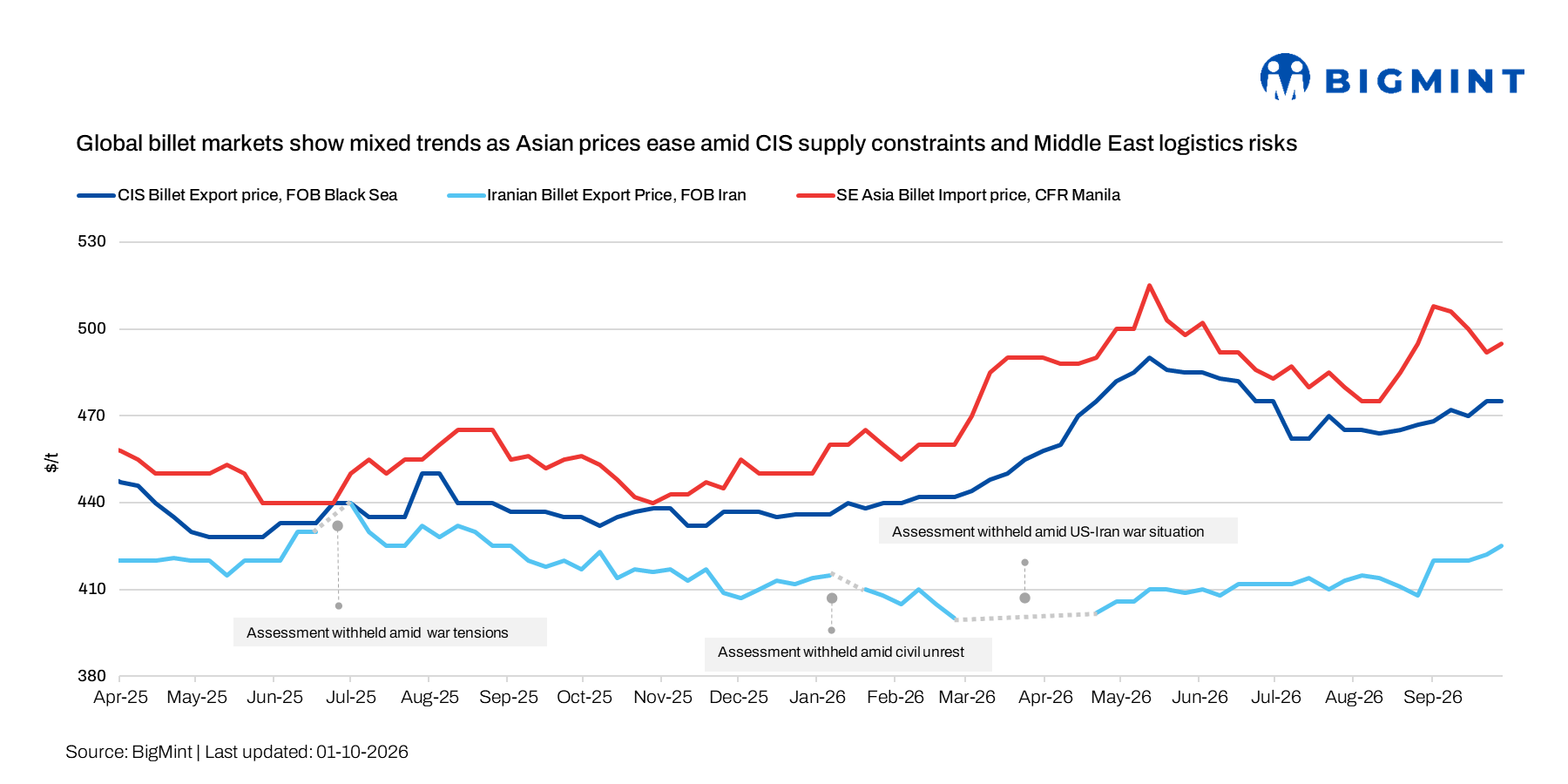
- CIS supply tightens as Middle East freight costs rise
- China billet prices ease as Golden Week curbs buying activity
Global billet markets remained mixed during the week ended 3 October. Asian prices edged lower amid subdued demand and China’s upcoming Golden Week holidays, while tight Black Sea supply and logistics disruptions influenced CIS markets. In the Middle East, Iranian prices remained stable, while higher freight costs supported Saudi import offers. Security concerns and elevated shipping costs continued to limit regional trade.
In Turkiye, the deep-sea scrap market remained stable amid limited trading and cautious mill buying. US HMS 80:20 was assessed at $404/t CFR, unchanged w-o-w, while billet was indicated at $545/t FOB Turkiye and $515/t CFR Turkiye.
Domestic rebar stood at $630-650/t exw and exports at $620-630/t FOB, keeping the scrap-rebar spread at $220-222/t. Weak rebar demand and cautious restocking continued to limit fresh scrap bookings despite firm replacement costs.
Asian billet market
Asian export billet prices edged lower during the week as trading activity remained subdued ahead of China’s Golden Week holidays. Weak market sentiment and declining raw-material prices limited buying interest, although Chinese mills remained reluctant to make significant price cuts ahead of the 1-7 October holiday period.
Chinese 3SP billet was offered at $462-468/t FOB for November-December shipment, down from $465-470/t FOB a week earlier. Despite weaker sentiment in both domestic and export markets, mills maintained relatively firm offer levels, limiting the downside.
In the domestic market, Chinese billet prices fell by RMB 20/t ($3/t) w-o-w to RMB 2,980/t ($444/t). Weak demand from construction and other end-use sectors, combined with holiday-related inactivity, kept buyers and sellers cautious and weighed on domestic billet prices.
In Indonesia, major steel mills lowered base-grade billet offers by $3/t w-o-w to $475/t FOB for January shipment, while overseas buying remained limited amid competition from Chinese material. Chinese 3SP billet was offered at $485-490/t CFR, below around $495/t CFR for Indonesian billet.
Water supply disruptions at Indonesian mills affected production, potentially limiting regional availability and providing short-term price support. In Southeast Asia, 5SP billet offers were heard at around $495/t CFR early in the week, although no fresh indications emerged by mid-week as buyers remained cautious ahead of China’s holiday period.
Overall, Asian billet sentiment remained cautious to stable, with weak demand, holiday-related inactivity and lower raw-material prices limiting upside. However, firm Chinese offers and Indonesian production constraints provided some downside support.
CIS billet market
Limited availability of Russia- and CIS-origin billet due to Black Sea disruptions continued to support scrap demand and add uncertainty to the Turkiye market. Russian billet offers to Turkiye declined to $515-520/t CFR from $525-530/t previously, while China-origin billet was offered at $520-525/t CFR.
Despite lower billet offers, buying interest remained limited amid weak downstream demand and poor finished-steel sales. Market participants noted that Turkish mills were facing margin pressure at current scrap prices, while continued billet shortages could keep scrap prices supported until availability improves.
CIS-origin billet was assessed at $475/t FOB Black Sea, up from $465-468/t a month earlier. Russian HRC offers to Turkiye rose to $570-580/t CFR as exporters increasingly targeted overseas markets, while Ukrainian mills continued to face production and export challenges due to war-related disruptions.
Middle East billet market
Middle Eastern billet markets showed mixed trends during the week. Iranian export prices remained stable amid cautious buying, while higher freight costs supported Saudi import offers. In the UAE, prices narrowed slightly as security concerns and elevated shipping costs limited Asian-origin supply and kept activity subdued.
Iranian billet export prices remained unchanged at $400-410/t delivered to the borders and $420-425/t FOB ports. Some indications were heard at $410-415/t delivered to the border, particularly at the Iraqi border, but buyers continued to seek lower levels.
Easing power restrictions improved production and supply availability, while new tenders from two major steel mills for 55,000 t of November-delivery billet emerged. However, sales remained uncertain amid maritime and logistics constraints, with some vessels reportedly stuck in the Gulf. The Strait of Hormuz remained a key export risk, while sanctions and regional uncertainties continued to weigh on demand.
Iranian long steel demand remained weak, with rebar offers at $430-440/t exw and wire rod at $450-460/t exw. Buyers continued to monitor possible Iraqi trade restrictions.
In the UAE, GCC-origin billet was indicated at $645-650/t CPT Jebel Ali, while Chinese material was offered at $590-595/t CPT. Asian offers remained largely nominal and commercially unworkable due to security concerns and high delivery costs. No major deals were reported, with the Jebel Ali import range narrowing to $590-640/t CPT from $600-650/t a week earlier.
Saudi Arabian billet import prices rose in late September as higher freight costs lifted seller offers despite weak demand. The monthly import indication increased to $550-560/t CFR Saudi Arabia, up $15-20/t from $540-545/t a month earlier. Chinese offers were earlier heard at $570-575/t CFR.
Domestic rebar was indicated at SAR 2,650-2,800/t ($707-747/t) DAP Saudi Arabia, largely stable w-o-w.
Higher oil prices, Red Sea tensions, vessel congestion and longer discharge times continued to raise freight and demurrage costs. However, weak rebar demand limited buyers’ willingness to accept higher billet prices.


Leave a Reply