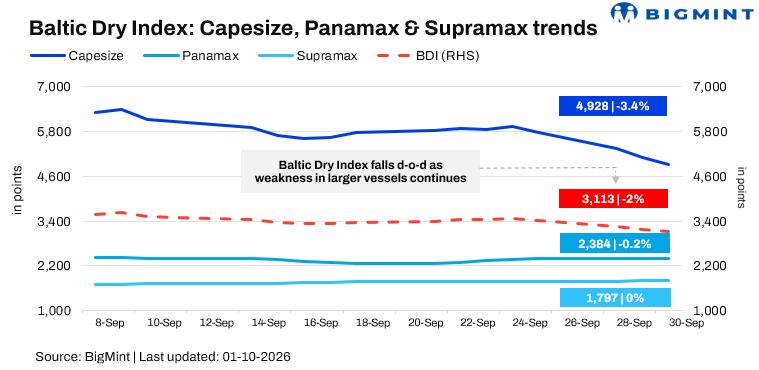
- Capesize declines by 3% d-o-d, hits 5-week low
- Panamax edges lower; Supramax remains firm
The Baltic Dry Index (BDI) fell d-o-d by 65 points, or 2.05%, to 3,113 on 30 September, from 3,178 on 29 September, marking its fourth consecutive session of decline and its lowest level since 27 August. The decline was primarily driven by another sharp correction in the Capesize segment, while Panamax also edged lower. Supramax remained unchanged, maintaining its highest level since August 2022.
The broader dry bulk market remained mixed, with continued weakness in the larger-vessel segment weighing on the overall index, while smaller vessels showed greater resilience.
Segment-wise performance
- Capesize declines sharply: The Baltic Capesize Index (BCI) fell d-o-d by 175 points, or 3.43%, to 4,928, from 5,103. The index reached its lowest level since 25 August, extending the recent downward trend in the larger-vessel segment amid softer freight sentiment and weaker support from iron ore-related activity.
- Panamax slips marginally: The Baltic Panamax Index (BPI) declined by 6 points, or 0.25%, to 2,384, from 2,390. The marginal decline indicates relatively stable but slightly softer conditions in the Panamax market, with coal and grain demand providing some underlying support.
- Supramax remains firm: The Baltic Supramax Index (BSI) was unchanged at 1,797, remaining at its highest level since August 2022. The stability highlights comparatively stronger fundamentals in the smaller-vessel segment despite the broader weakness across dry bulk freight.
Outlook
The BDI may remain under pressure in the near term, with Capesize performance continuing to be the key driver of overall market direction. Iron ore cargo availability, vessel-fixing activity and China-related demand will remain important indicators for the larger-vessel segment. Meanwhile, steady coal, grain and minor-bulk demand could provide support to Panamax and Supramax markets and help cushion the impact of continued Capesize weakness.
Leave a Reply