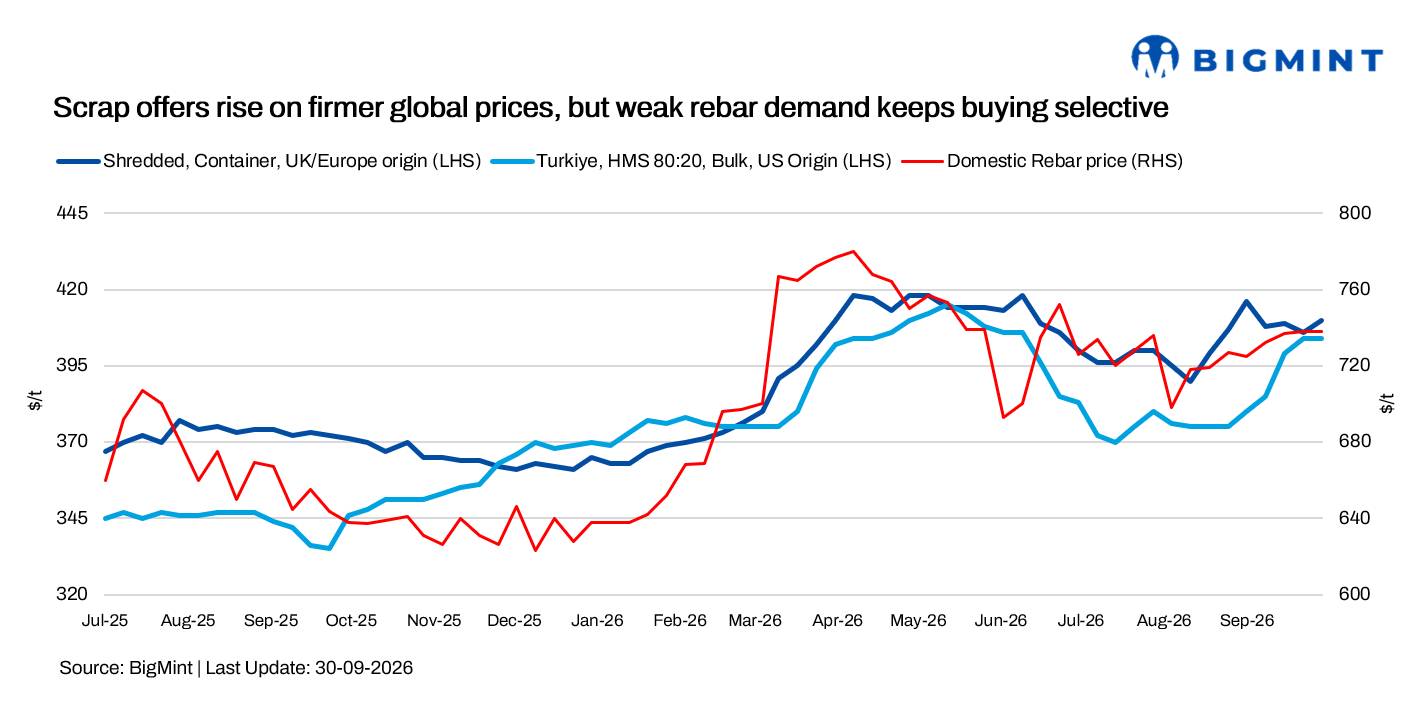
- Weak rebar sales keep mills cautious on scrap procurement
- Higher freight costs raise replacement costs for mills
Bangladesh’s imported ferrous scrap market firmed on the offer side during the week ended 30 September, as higher global scrap prices and freight costs raised replacement costs. However, actual import activity remained subdued, with weak rebar sales and cautious mill procurement limiting fresh bookings.
Buyers remained reluctant to accept higher offers, while rising freight and oil costs continued to lift suppliers’ replacement costs. Electricity-related disruptions and elevated input costs also weighed on mill operations, keeping procurement focused on competitively priced cargoes.
BigMints weekly assessments, CFR Chattogram
- European-origin containerised HMS 80:20: $373/t, up by $1/t w-o-w
- European-origin containerised shredded: $410/t, up by $4/t w-o-w
- Japanese-origin bulk H2: $395/t, stable w-o-w
- US-origin bulk HMS 80:20: $402/t, up $1/t w-o-w
Market scenario
In the container market, Brazil-origin HMS 80:20 was offered at $380/t CFR, with workable levels at $375-378/t CFR. Australian HMS 80:20 was offered at $390-395/t CFR, with workable levels around $390/t. Shredded scrap offers were heard at $410/t CFR, while buyers were bidding around $395-400/t CFR.
A Chattogram-based mill-side source said, “There is no serious demand for shredded scrap. The latest Malaysian PNS offers were around $415/t CFR, but lower bids were not matching seller expectations. Chilean HMS 90:10 was indicated at $390/t CFR, which was the bid level.”
A recent trade involved 1,000 t of Australian PNS at $405/t CFR Chattogram. Australian HMS 90:10 was offered at $400/t CFR, but this level was considered too high by buyers.
Malaysian PNS was offered at $410/t CFR, with offers around $415/t. US HMS 80:20 was indicated at $400-405/t CFR, while buyers were targeting $390-395/t CFR, and no fresh bulk bookings were reported.
Deep-sea bulk HMS 80:20 offers increased to $405-408/t CFR Chattogram, while bids were heard at $395-396/t CFR. Workable levels were reported around $392-395/t, with no fresh deep-sea deals heard during the week. Japan-origin H2 was offered at $395-400/t CFR, while HS was offered at $425-430/t CFR.
Singapore-origin HMS 80:20 was offered at around $405/t CFR, with no deals reported.
“Suppliers are looking to raise prices as overall costing has increased, but buying interest remains limited,” another SEA origin supplier said. Bulk HMS offers were also indicated at around $410/t, supported by demand from Southeast Asia and Bangladesh, along with higher bunker costs.
Domestic market: Bangladesh’s domestic scrap market remained relatively stable. PNS-grade scrap was assessed at BDT 55,000-57,000/t ($447-463/t), while LMS stood at BDT 51,000-51,500/t ($415-419/t).
Billet prices were around BDT 69,000-70,000/t ($561-569/t) exw, while rebar prices were assessed at BDT 85,000-86,000/t ($691-699/t) exw Dhaka and BDT 90,000-91,500/t ($732-744/t) exw Chattogram
Outlook
The Bangladesh scrap market is expected to remain firm on the offer side, with higher global scrap prices, freight costs, and strong regional demand keeping replacement costs elevated. However, weak rebar sales and cautious mill procurement are likely to limit fresh bookings, as buyers remain reluctant to absorb higher scrap costs without corresponding improvement in finished-steel prices.
Market participants expect scrap prices to remain supported, but the persistent gap between seller offers and buyer bids could keep transaction volumes limited. Mills are likely to remain focused on competitively priced cargoes and prompt requirements, rather than actively chasing higher-priced material.
Leave a Reply