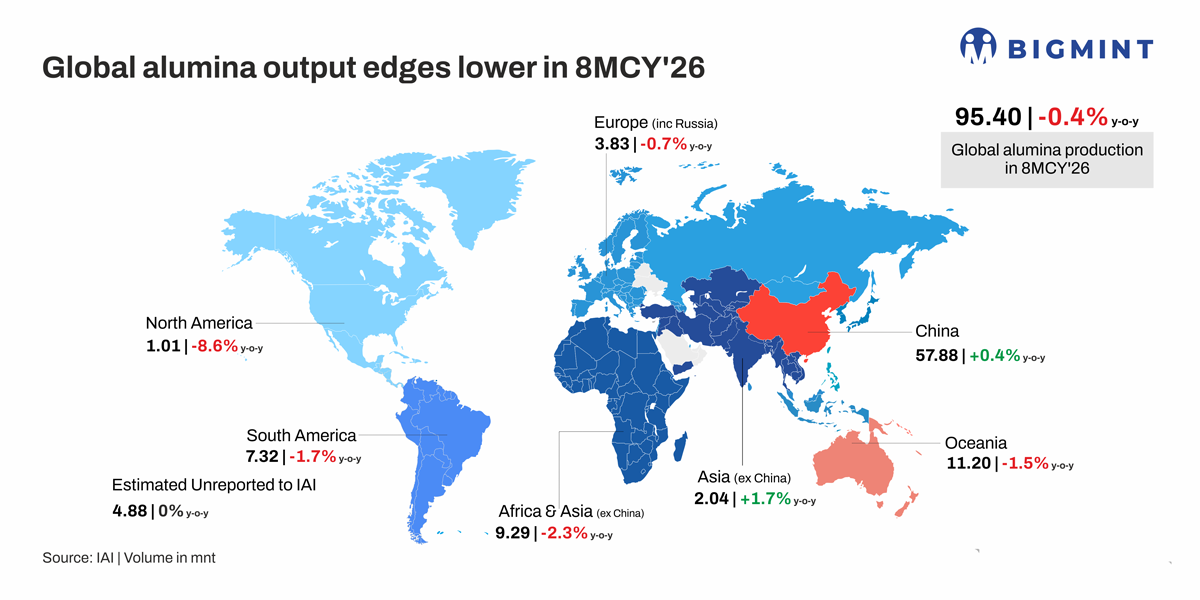
- North America records sharpest output decline
- China growth partly offsets wider regional declines
Global metallurgical-grade alumina production edged down 0.4% y-o-y to 95.40 mnt in 8MCY’26. Production stood at 95.78 mnt in 8MCY’25, according to the International Aluminium Institute (IAI).
China was the only major region to record annual growth. However, its 0.4% increase could not offset declines elsewhere. Lower output across other regions pulled global production slightly lower.
On a monthly basis, global output rose 0.8% to 12.38 mnt in August. It stood at 12.29 mnt in July. Higher output in China and Africa & Asia excluding China offset declines in South America and Oceania. However, August production was still 1.7% lower y-o-y.
Regional drivers shaping global metallurgical alumina output
China produced an estimated 57.9 mnt in 8MCY’26, up 0.4% y-o-y. Higher refinery utilisation and restarts supported production. Stronger Guinea bauxite arrivals also improved raw material availability. However, elevated inventories kept the market well supplied and weighed on alumina prices.
Production in Africa and Asia excluding China fell 2.3% y-o-y to 9.3 mnt. August output rose 10.1% m-o-m to 1.23 mnt. It remained 2.6% below the year-ago level. Lower operations at EGA’s Al Taweelah refinery continued to weigh on supply. New capacity in India and Indonesia provided some relief. NALCO is adding refinery capacity in 2026. Indonesia’s Mempawah refinery also started commercial operations with 1 mnt/y capacity in February.
North American output declined 8.6% y-o-y to around 1 mnt. This was the steepest regional decline. Lower operating rates and work at Atalco’s Gramercy refinery weighed on production. August output was more stable at 134,000 tonnes. It was down only 0.7% y-o-y. Atalco’s additional $350 million financing also improved sentiment around the facility’s revival.
South American production fell 1.7% y-o-y to 7.3 mnt in 8MCY’26. The region also posted the sharpest monthly decline. August output fell 17.2% y-o-y to 0.84 mnt. Norsk Hydro cut Alunorte output to around 50% on 11 August. The move followed natural gas supply disruptions. Production began recovering two days later after temporary terminal access was secured. Hydro estimated lost output at 100,000-120,000 tonnes.
European output, including Russia, declined 0.7% y-o-y to 3.8 mnt. August production, however, rose 3.8% y-o-y to 497,000 tonnes. The monthly recovery followed weaker output in the first half. Energy and logistics disruptions had affected regional refinery operations. Supply concerns eased after Al Taweelah restarted. However, import availability and freight costs remained key concerns.
Oceania produced 11.2 mnt in 8MCY’26, down 1.5% y-o-y. August output fell 6.4% m-o-m to 1.45 mnt. It was broadly stable y-o-y. Earlier disruptions at Alcoa’s Pinjarra refinery contributed to the cumulative decline. Alcoa has also lowered its 2026 alumina production guidance by 200,000-300,000 tonnes.
Outlook
The global alumina market is likely to remain balanced to well supplied through the rest of CY’26. Higher Chinese refinery output and additional Indonesian capacity should keep supply ample. However, regional disruptions could create temporary tightness.
China’s alumina surplus and softer domestic prices are likely to limit further price gains. Meanwhile, recovering output at Alunorte and Al Taweelah should improve non-Chinese supply. Strong Guinea bauxite availability should also support refinery operations, although higher freight costs will keep production costs elevated.
Overall, the market is expected to remain volatile rather than structurally tight. Unexpected refinery outages, weather disruptions or bauxite supply constraints could briefly tighten availability. However, continued Chinese and Indonesian supply growth should limit the risk of a prolonged deficit.
Leave a Reply