- Naphtha holds firm as logistical hurdles persist even as supply rises
- Indian PP, PVC prices increase despite mixed feedstock movement
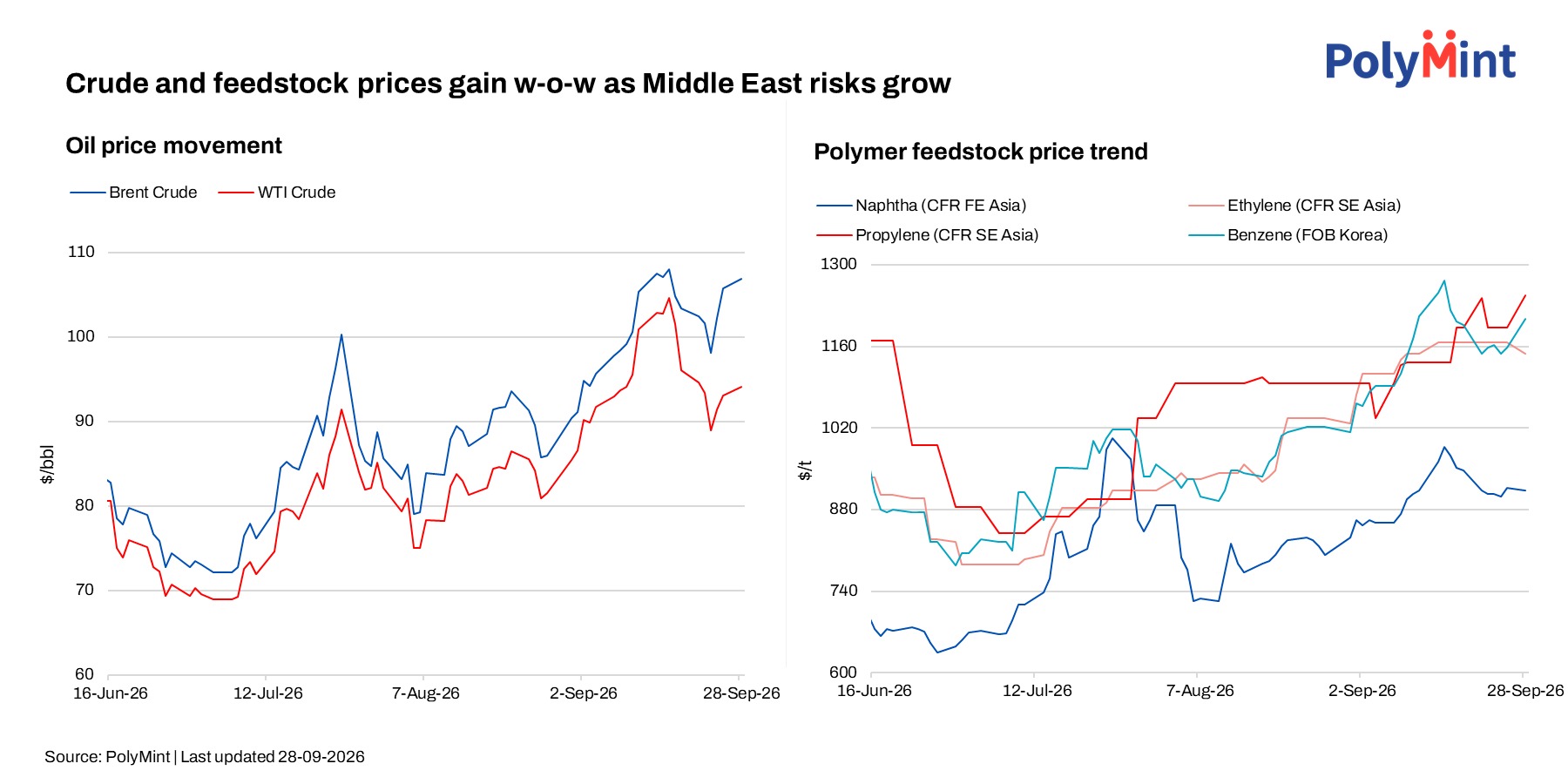
The global petrochemical complex remained divided as of 28 September, with Brent recovering while several feedstocks remained largely stable, according to PolyMint assessments. Brent rose 4.4% w-o-w, while naphtha was broadly unchanged and benzene strengthened. Indian polymer markets showed selective increases, with polypropylene (PP) and Polyvinyl chloride (PVC) moving higher while polyethylene terephthalate (PET) and high-density polyethylene (HDPE) remained stable, reflecting uneven cost pass-through and improving festive-season demand.
Crude oil and feedstocks
Brent recovered during the week as concerns over Middle East supply security remained despite improving regional crude flows. Saudi Arabia increased exports through Gulf terminals after disruptions to its Red Sea route, while Hormuz movements gradually recovered. However, vessel traffic remained well below normal levels, and alternative routing continued to absorb tanker capacity.

Naphtha held broadly steady as recovering Middle East crude exports offset continued shipping constraints. The physical market remains sensitive to freight and vessel availability, with longer routing and greater reliance on ship-to-ship transfers increasing logistics costs even as crude flows improve. Elevated tanker rates have been driven primarily by restricted vessel availability rather than underlying cargo demand.
The feedstock complex remained uneven, with aromatics firmer while olefins were more subdued. In India, RIL raised Purified terephthalic acid (PTA) to INR 106.50/kg, while Monoethylene glycol (MEG) remained unchanged, keeping PET replacement costs supported despite stable PET import indications.
Indian polymer market
Indian CFR polymer markets showed selective strengthening, led by PP and PVC. PET and HDPE remained largely stable, suggesting that higher upstream costs have not translated uniformly across polymers. Improved festive-season consumption expectations are providing some demand support, although inventory build-up ahead of the season remains a factor to watch.

Domestic pricing remained supported by selective producer increases and replacement-cost considerations. India’s crude supply position remained manageable, with refiners diversifying sourcing toward Iraq and other Middle Eastern barrels while also looking to the spot market for upcoming requirements.
Market implications
For Indian producers, the key issue is no longer simply the direction of crude but the divergence between feedstocks, freight and polymer pricing. Higher benzene and PTA costs are supportive for selected chains, while softer ethylene and stable naphtha limit broad-based cost inflation. The rupee’s move toward 96.11/$ also raises landed replacement costs for import-dependent buyers.
Shipping remains a significant cost variable. Saudi Arabia’s shift toward Gulf exports has increased Very Large Crude Carrier (VLCC) requirements, while ship-to-ship transfers around the Gulf of Oman have approached capacity. Reuters reported that buyers were also examining alternative Ship-to-Ship (STS) locations in India and Malaysia, highlighting the continuing logistical constraints even as crude availability improves.
For converters, the stronger PP and PVC indications coincide with improving festive-season consumption across automotive, FMCG, packaging and consumer durables. However, rising dealer inventories and selective rural demand suggest that buying is likely to remain measured rather than translating immediately into aggressive restocking.
Outlook
The near-term outlook remains dependent on whether improving Middle East crude flows translate into normalized tanker availability and lower freight, rather than crude supply alone. Saudi export recovery should reduce outright supply concerns, but constrained Hormuz traffic, elevated vessel utilization and war-risk costs could keep delivered feedstock costs firm. For polymers, PP and PVC may retain support if logistics remain tight, while stable naphtha and softer ethylene could limit broader increases. Indian demand ahead of the festive period will determine how much of the upstream cost pressure can be passed through.
Leave a Reply