- Right capital structure can unlock MSME growth
- Technology and productivity will shape extrusion competitiveness
India’s aluminium extrusion industry is entering a new phase of growth, with rising demand creating opportunities for MSMEs to expand capacity, adopt advanced technologies and improve productivity. However, access to the right financing, rising energy and conversion costs, working-capital requirements and the economics of technology investments remain critical challenges for the sector.
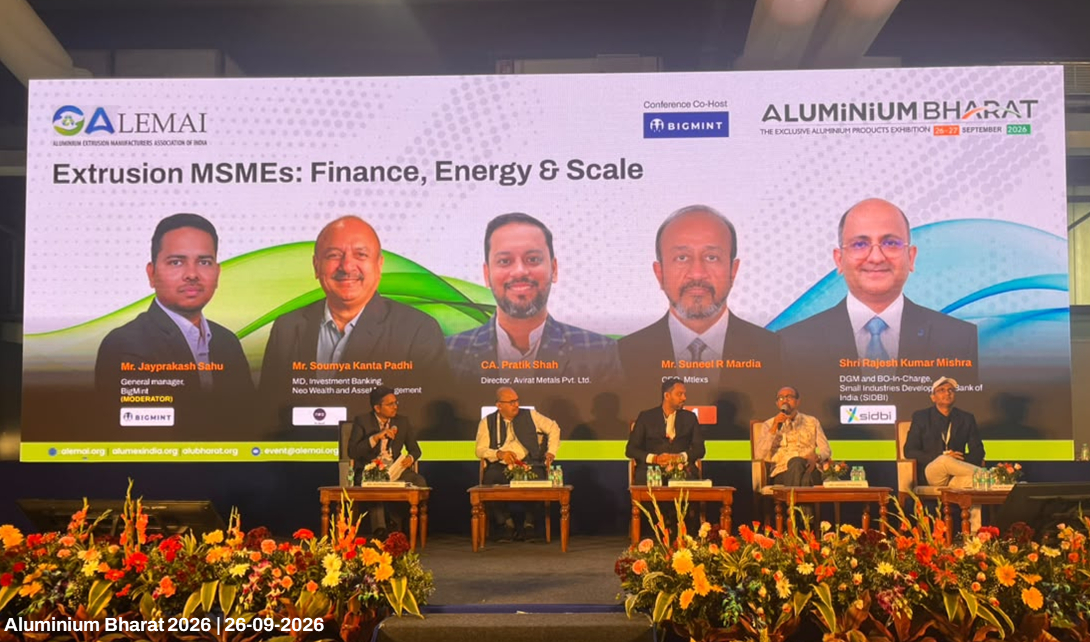
The “Extrusion MSMEs: Finance, Energy & Scale” session on Day 1 (26 September 2026) at Aluminium Bharat 2026, organised by the Aluminium Extrusion Manufacturers Association of India (ALEMAI) and conference co-hosted by BigMint, brought together industry experts to examine the financing and operational challenges facing extrusion MSMEs. The session focused on working-capital and inventory finance, energy and conversion costs, automation CAPEX and ROI, productivity, scale economics and technology adoption, with emphasis on building the right capital structure to support sustainable growth.
The session highlighted that as extrusion MSMEs move from survival to expansion, their financing requirements are also changing. While traditional bank finance remains important, businesses increasingly need to evaluate alternative funding avenues, strengthen financial discipline and ensure that every investment contributes to improved productivity and returns.
Moving beyond collateral-based finance
Shri Rajesh Kumar Mishra, DGM and BO-In-Charge, Small Industries Development Bank of India (SIDBI), identified the cost of capital and availability of collateral as some of the key challenges facing MSMEs.
As businesses expand, their requirement for working capital and growth capital increases. However, once existing collateral is exhausted, accessing additional finance through conventional lending channels can become more difficult.
Mishra highlighted the emergence of alternative financing options that can supplement traditional lending, including factoring and other market-based financing avenues. He also stressed that businesses need to understand their funding requirements and choose the appropriate financing channel rather than relying on a single source of capital.
For extrusion MSMEs, this diversification of funding could become increasingly important as companies look to invest in capacity, technology and market expansion.
Capital requirements change as businesses scale
Soumya Kanta Padhi, MD, Investment Banking, Neo Wealth and Asset Management, highlighted the fundamental shift that takes place when an MSME moves from the survival stage to the scale-up phase.
At the initial stage, businesses may rely largely on promoter capital, internal accruals or support from friends and family. However, expansion into new markets, technology upgrades and capacity enhancement require a more structured approach to financing.
Padhi emphasised the importance of developing a balanced capital structure combining debt and equity according to the company’s growth requirements. He also pointed to the growing importance of corporate governance, statutory compliance and transparency as businesses become more institutionalised and seek larger pools of capital.
For MSMEs aspiring to attract institutional investors or eventually access the capital markets, these factors can play an important role in establishing investor confidence.
Raising capital is only half the challenge
While access to finance is important, CA. Pratik Shah, Director, Avirat Metals Pvt. Ltd., stressed that the more critical question is how effectively the capital is utilised.
Investments in machinery, automation and capacity expansion need to be evaluated against the additional revenue and margins they are expected to generate. A capital-intensive investment may not necessarily improve profitability if the incremental returns are insufficient to offset the cost of financing.
This makes ROI assessment, cash-flow planning and capital allocation particularly important for extrusion MSMEs. Businesses also need to ensure that the tenure of their financing matches the nature of the requirement.
Using short-term funding for long-term assets can create pressure on cash flows, while long-term borrowing for short-term working-capital requirements can increase financing costs unnecessarily. A carefully planned capital structure is therefore essential for sustainable expansion.
Alternative financing can strengthen working capital
Suneel R Mardia, CEO, Mtlexs, highlighted the importance of alternative financing mechanisms in addressing the working-capital requirements of MSMEs.
Supply-chain finance and the Trade Receivables Discounting System (TReDS) can provide businesses with additional avenues to unlock working capital against receivables. However, wider adoption requires greater participation from buyers and suppliers, along with transparency across transactions.
For extrusion manufacturers, efficient working-capital management is particularly important given the need to finance raw-material inventories, production cycles and receivables. Improving the speed at which businesses convert receivables into usable funds could release capital for capacity expansion, technology adoption and other growth initiatives.
Technology adoption must deliver measurable returns
Beyond financing, the discussion brought attention to the economics of technology adoption. For extrusion MSMEs, investments in automation, energy efficiency and modern production systems can help improve productivity and reduce conversion costs. However, these investments need to be assessed carefully against their expected returns.
As energy and conversion costs remain important components of extrusion economics, improving operational efficiency could become an important competitive lever. MSMEs therefore need to evaluate not only the availability of finance but also whether the technology or equipment being financed can generate sufficient productivity gains.
This becomes increasingly relevant as Indian extrusion manufacturers seek to compete in a market where cost efficiency, quality and scale are becoming more important.
Building financially stronger extrusion MSMEs
The discussion highlighted that financing the next phase of growth will require a broader shift in how extrusion MSMEs approach capital. Access to funds alone cannot guarantee successful expansion. Businesses need stronger financial planning, appropriate debt-equity structures, transparent governance and disciplined investment decisions.
As India’s aluminium extrusion demand expands, MSMEs will have opportunities to scale across construction, automotive, renewable energy, electrical and electronics, transportation and other emerging applications. Converting this demand into sustainable business growth, however, will depend on how effectively companies manage their capital and operating costs.
For the extrusion sector, the next stage of growth is therefore not simply about raising more capital, but raising the right capital and converting it into greater productivity, efficiency and value.
Leave a Reply