- Pre-holiday restocking offers limited support
- Rising inventories highlight supply-demand imbalance
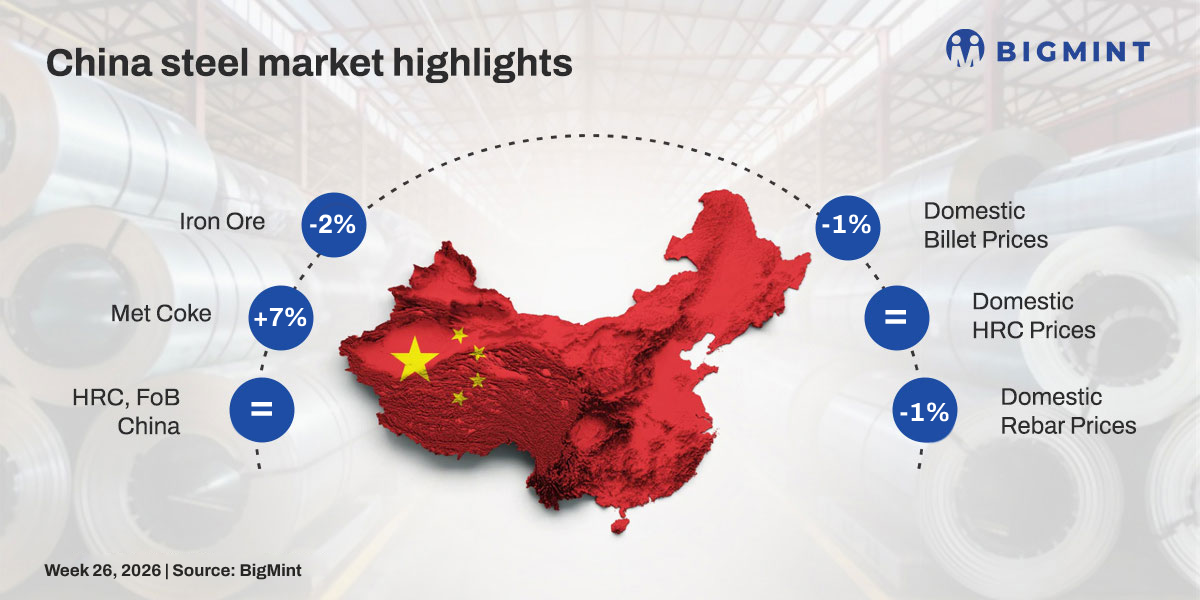
China’s domestic steel market remained subdued during the week ended 24 September, with weak downstream demand and cautious buying continuing to weigh on prices. Rebar prices declined, while HRC prices remained stable as lower production and falling inventories provided some support. However, elevated mill inventories, subdued steel consumption and cautious sentiment continued to limit a meaningful price recovery. Softer raw material costs added further pressure to the market.
Inventories in mid-September
The China Iron and Steel Association (CISA) reported that total steel inventories at key CISA-affiliated mills stood at around 17.08 million tonnes (mnt) during mid-September (11-20 September 2026), marking an increase of 0.56 mnt or 3.4% from 16.52 mnt in early September. Moreover, y-o-y, inventories increased by 1.79 mnt or 11.7% compared with 15.29 mnt recorded in mid-September 2025.
The increase in inventories reflected a slower-than-expected recovery in steel demand. Mills continued to roll and produce finished steel, but end-user demand was insufficient to absorb the additional supply. This widened the supply-demand gap and resulted in inventory accumulation at mills, keeping stock levels elevated.
Steel price trends
Domestic HRC prices remain stable: China’s domestic HRC prices remained unchanged w-o-w at around RMB 3,230/t ($481/t) as of 24 September. Meanwhile, SHFE HRC futures for the October 2026 contract edged down by RMB 4/t ($1/t) w-o-w to RMB 3,298/t ($491/t), from RMB 3,302/t ($492/t) in the previous week.
The HRC market remained stable in the week, as steel mill losses led to production cuts and lower overall output. Pre-holiday restocking also supported the pace of inventory reduction, although stock levels remained high compared with the same period in previous years, indicating that the supply-demand imbalance has yet to improve significantly. Meanwhile, end-users remained cautious ahead of the National Day and Mid-Autumn Festival holidays, with essential demand showing no significant pickup. Overall, lower output and declining inventories provided some support, while subdued demand continued to limit the scope for a meaningful price recovery.
However, Chinese HRC export offers remained stable w-o-w at around $510/t FOB Rizhao, amid cautious overseas buying activity.
Rebar prices decline w-o-w: China’s domestic rebar prices were down by RMB 30/t ($4/t) w-o-w to around RMB 3,160/t ($471/t) on 24 September from RMB 3,190/t ($475/t) in the previous week. However, SHFE rebar futures for the October 2026 contract rose by RMB 14/t ($2/t) w-o-w to RMB 3,118/t ($464/t), from RMB 3,104/t ($462/t) in the previous week.
Rebar prices declined as subdued downstream demand and weak market transactions continued to pressure steel mill margins. In response, some small and medium-sized mills scheduled maintenance and reduced output to limit losses, while phased environmental controls kept some blast furnaces offline.
As losses persisted across regions, steelmakers increasingly adopted production cuts and maintenance plans. Meanwhile, inventories held by traders and distributors declined during the week, providing some support to the market. Overall, sentiment remained cautious as weak demand continued to weigh on prices despite tighter supply and lower inventories.
However, Shagang steel has raised its long steel prices by RMB 50/t ($7/t) for sales during 21-30 September 2026. The producer increased its rebar (16-25 mm) price by RMB 50/t ($7/t) to RMB 3,350/t ($500/t), while coiled rebar (8-10 mm) and wire rod (6-10 mm) prices were also raised by RMB 50/t ($7/t) each to RMB 3,480/t ($519/t) and RMB 3,390/t ($506/t), respectively.
The increase comes amid elevated coking coal and coke costs, which have raised steelmaking expenses. Buying activity has also improved ahead of China’s National Day holidays, but selective procurement suggests the pickup is mainly driven by pre-holiday restocking rather than a broad demand recovery.

Raw materials prices
Iron ore spot prices fell down w-o-w: Iron ore fines benchmark prices for Fe 61% declined by $2/dmt w-o-w to $95/dmt CFR China on 25 Sep’26, pressured by weak physical trading activity and reduced steel mill production. Trading remained limited as market participants prepared for the 25-27 September holiday period, with most Chinese mills having completed pre-holiday replenishment.
Sentiment remained subdued amid unverified reports that elevated freight costs could disrupt shipments of low-grade Brazilian fines. With port availability comfortable relative to near-term demand, buyers and sellers remained cautious, while most buyers preferred to stay on the sidelines and monitor price movements before committing to fresh purchases amid expectations of limited near-term demand and subdued market liquidity.
a) Spot pellet premium edges up w-o-w: Spot pellet premium for Fe 65% grade pellet rose marginally by $0.2/t w-o-w to $26.05/t CFR China on 23 September.
b) Spot lump premium rangebound w-o-w: Spot lump premium remained largely stable w-o-w at $0.2260/t CFR China on 25 September.
Coking coal, coke prices slide: Chinese coke prices remained broadly stable as lower coking coal costs improved producer margins, supporting a modest recovery in operating rates, although most coke plants continued to operate with 20-40% production cuts. Demand remained subdued amid weak steel demand, low mill profitability and planned steel production cuts, keeping steelmakers cautious on coke procurement and inventory building. With lower input costs and weak demand, expectations of an initial coke price cut have strengthened, which could weigh on regional coke trade flows and put further pressure on Indian met coke prices.
The global coking coal market also weakened during the week. Australian premium hard coking coal (PHCC) FOB prices declined by $7/t w-o-w to around $274/t, while BigMint’s PHCC index fell by $5/t w-o-w to $300/t CNF Paradip on 25 September, amid subdued spot demand and cautious buying. Prices continue to decline amid China holidays and resistance from Chinese mills. However, the market direction will become clearer once the holidays are over. But market participants indicated that there are inventories with Indian mills, hence they resisted bookings.
Billet prices stable w-o-w amid cautious buying: Chinese billet prices remained stable w-o-w, supported by pre-holiday stocking, declining social inventories and limited selling pressure. Standard billet prices at Tangshan Qian’an stood at RMB 3,000/t ($447/t) on 25 September, unchanged from 18 September.
Billet export offers were assessed at around $465/t FOB China, up $2/t from $463/t on 18 September. Higher freight costs and firm mill base prices continued to support export levels, while softer raw-material costs, particularly coking coal, limited further upside.
Market sentiment remained cautious ahead of the holiday, with subdued downstream demand partly offset by relatively better rebar performance and lower inventories.
Outlook
With the National Day and Mid-Autumn Festival holidays approaching, pre-holiday restocking may provide some support to steel buying activity in the coming week. However, subdued downstream demand, cautious procurement and elevated mill inventories are likely to limit any meaningful improvement in market sentiment. Production cuts and maintenance at steel mills are gradually reducing supply pressure, but softer iron ore and coking coal prices are weakening cost support. Steel prices are therefore likely to remain under pressure, with rebar facing greater downside risk while HRC may remain relatively stable as lower output and inventory drawdowns provide some support.
Leave a Reply