- Prices hold firm on tight supply despite muted steel demand
- Limited met coke availability boosts PCI demand, prices
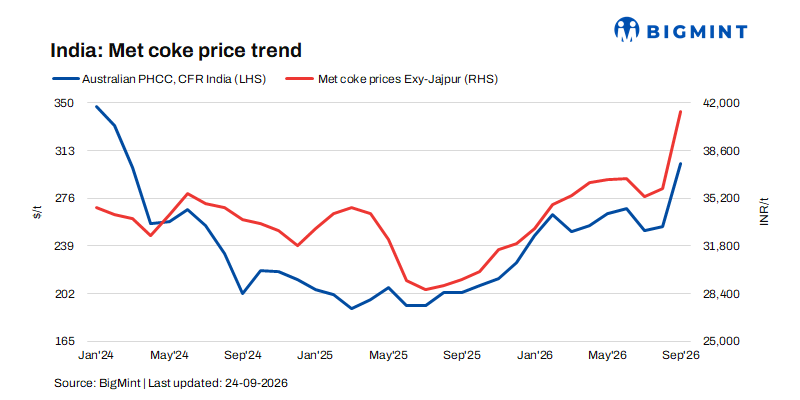
India’s metallurgical coke (met coke) market remained broadly stable in the assessment week ended 24 September, with prices largely holding at elevated levels despite a gradual softening in coking coal prices. The market continued to receive support from relatively tight availability of met coke, while subdued steel demand and easing raw-material costs limited further price gains.
Domestic met coke prices remain near multi-year highs
BF-grade met coke prices in eastern India remained unchanged w-o-w at INR 42,000/t ex-Jajpur, while prices in western India declined marginally by INR 200/t w-o-w to INR 38,000/t ex-Gandhidham. Despite the slight correction in western India, prices in both regions remained around 3.5-year highs, indicating that the market continues to be supported by relatively constrained availability.
Foundry-grade met coke prices in Rajkot also remained stable at INR 39,500/t ex-Rajkot, maintaining levels close to a 2.5-year high. The stability in domestic prices, despite softer coking coal prices, reflects the lag between changes in raw-material costs and coke prices, as well as continued supply constraints.
Market participants noted that coking coal prices have started to decline gradually, which could eventually translate into lower met coke prices if the downward trend persists. However, the extent of any correction is expected to depend on the availability of domestic and imported coke and the purchasing requirements of steel producers.
Softer coking coal prices could limit further upside
Coking coal prices have recently started to soften after remaining elevated, reducing the cost pressure faced by coke producers. Lower input costs could improve coke-plant margins and encourage higher operating rates, potentially increasing coke availability over time.
However, the impact on met coke prices is unlikely to be immediate. Existing supply commitments, relatively tight availability and elevated replacement costs continue to provide support to the market. In addition, buyers are likely to remain cautious in committing to large volumes until the direction of coking coal prices becomes clearer.
Imported met coke remains firm amid limited availability
India’s imported met coke market also remained broadly stable during the week. Indonesian BF-grade met coke with 65/63 CSR was assessed at around $370/t CFR India.
Market participants indicated that Indonesian met coke has already been booked through mid-November, suggesting limited availability for prompt delivery. This is providing support to imported coke prices despite relatively cautious buying interest from Indian consumers.
The limited availability of imported met coke is particularly relevant for Indian blast-furnace operators, as it restricts the scope for domestic buyers to switch to imported material in response to any increase in domestic prices.
Rising PCI demand provides additional support
The shortage of met coke has also increased interest in pulverised coal injection (PCI), which can partially substitute for coke in blast-furnace operations. Market participants reported stronger PCI demand, resulting in an increase in PCI prices.
Higher PCI demand indicates that steel producers are actively seeking alternative fuel inputs amid constrained met coke availability. This could provide additional support to the broader blast-furnace fuel market in the near term.
Chinese coke margins improve, but demand remains weak
Chinese coke prices remained broadly stable as lower coking coal prices improved the margins of coke producers. The improvement in profitability encouraged a modest recovery in operating rates, although most coke plants continued to maintain 20-40% production cuts.
On the demand side, the outlook remains subdued. Weak steel demand, mill profitability below 10%, and planned reductions in steel production are limiting coke procurement requirements. Steel producers therefore remain cautious about building inventories, restricting the scope for a sustained recovery in coke demand.
With raw-material costs declining and demand remaining weak, expectations of an initial coke price cut have increased. Any reduction in Chinese coke prices could subsequently influence regional coke trade flows and add pressure to Indian met coke prices.
Australian coking coal prices decline further
The global coking coal market also weakened during the week. Australian premium hard coking coal (PHCC) FOB prices declined by $8/t w-o-w to around $275/t.
The decline in Australian PHCC prices, together with softer Chinese coking coal prices, is reducing the international cost benchmark for coke production. If the correction persists, Indian coke producers may face lower replacement costs, potentially encouraging buyers to seek lower prices.
Pig iron prices decline amid subdued downstream demand
The decline in pig iron prices further reflects the cautious sentiment in the downstream steel market. Durgapur steel-grade pig iron prices decreased by INR 800/t w-o-w to INR 41,000/t ex-works.
Lower pig iron prices suggest subdued buying interest from downstream consumers and indicate limited room for steelmakers to absorb higher raw-material costs. Continued weakness in pig iron and finished-steel demand could consequently constrain coke procurement in the coming weeks.
Outlook
India’s met coke prices are expected to remain largely stable in the near term, with a mild downward bias. Softer coking coal prices and weaker steel-sector demand could gradually reduce coke production costs and purchasing appetite, while the possibility of lower Chinese coke prices may add further pressure.
However, tight domestic availability, limited imported met coke availability until mid-November, and rising PCI demand are likely to provide a floor to prices. Any correction is therefore expected to be gradual rather than sharp, unless domestic coke availability improves significantly or steel demand weakens further.
Leave a Reply