- Conventional BF steel carbon costs could exceed EUR 200/t by 2031
- EUROFER urges slower phase-out of free EU ETS allowances
The European steel industry’s total annual carbon costs could more than double from around EUR 3.4 billion ($3.86 billion) in 2026 to approximately EUR 8.2 billion ($9.32 billion) in 2031 under the proposed revision of the EU Emissions Trading System (ETS), even if ongoing decarbonisation projects are fully implemented, according to the European Steel Association (EUROFER).
Carbon cost for conventional steelmaking could exceed EUR 200/t
EUROFER estimates that the carbon cost per tonne of conventionally produced steel could roughly double to around EUR 100/t ($113/t) by 2030 and rise above EUR 200/t ($227/t) from 2031. The association said such costs would make conventional steel production economically unviable.
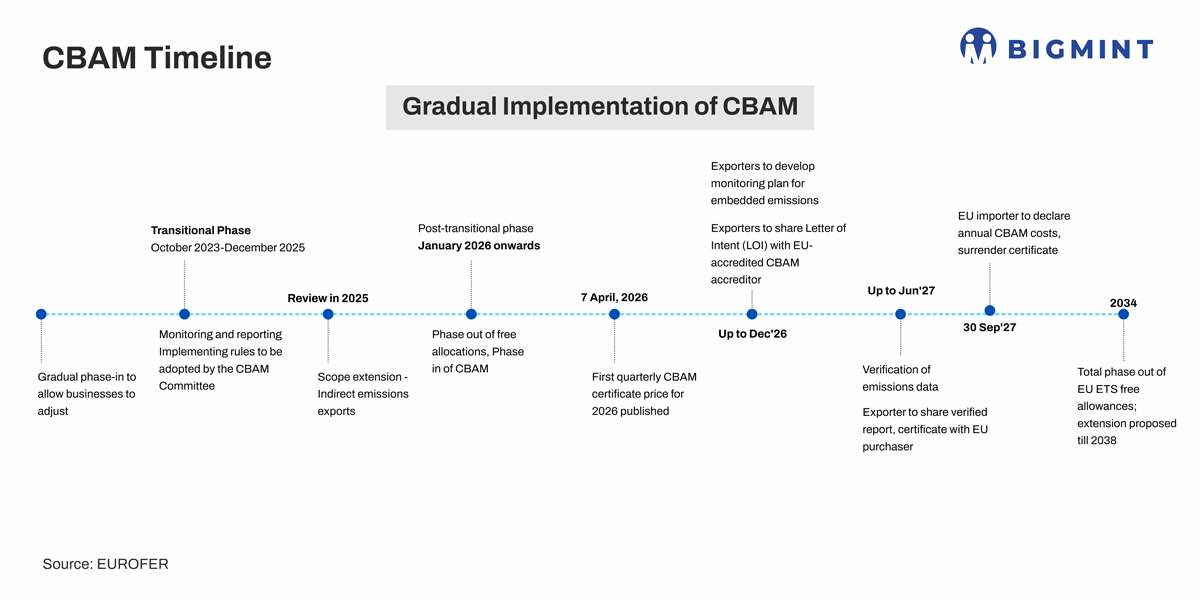
Under the ETS, European steelmakers pay for their carbon emissions while receiving benchmark-based free allowances that provide partial protection against competitors that do not face comparable carbon costs. These allowances are being gradually withdrawn as the EU’s Carbon Border Adjustment Mechanism (CBAM) introduces carbon costs on imports.
EUROFER calls for slower phase-out of free ETS allowances
EUROFER is calling for a slower phase-out of free allowances over the next five years, followed by a faster withdrawal once the conditions required for industrial decarbonisation are in place.
According to the association, the current timetable would result in benchmark-based free allocation declining sharply by 2030, faster than the development of the conditions needed to support the steel industry’s transition.
EUROFER said a smoother transition between the ETS and CBAM is necessary to maintain effective carbon-leakage protection while supporting investment in decarbonisation.
More than 10 mnt of low-carbon steel projects stalled
EUROFER said investment decisions have already been taken for around 35 million tonnes (mnt) of low-carbon steel projects in Europe, while projects representing more than 10 mnt of steelmaking capacity have stalled as their business cases have deteriorated.
Axel Eggert, EUROFER director general, said the association remains committed to the EU’s climate-neutrality target for 2050, but warned that withdrawing carbon-leakage protection too quickly could undermine the investments required for the industry’s decarbonisation.
EU steel exports remain exposed to carbon costs
EUROFER also highlighted an unresolved issue concerning European steel exports. While foreign producers face EU carbon costs only on products sold into the bloc, European steelmakers incur carbon costs regardless of where their products are ultimately sold.
According to the association, the EU currently lacks an effective structural mechanism to protect European steel exports and steel-intensive downstream industries from carbon leakage in international markets.
Competitive energy and low-carbon steel markets also needed
EUROFER stressed that carbon pricing alone will not be sufficient to drive the European steel industry’s transformation.
The association identified competitive low-carbon energy, effective trade and carbon-leakage protection, lead markets for low-carbon steel, access to ferrous scrap and sufficient investment support as key conditions required for low-carbon investments.
EUROFER also noted that these conditions will not become available simultaneously across all EU member states and regions, calling for solidarity during the transition.
Eggert said Europe needs an ETS that supports first movers without leaving behind companies and regions where the infrastructure and investment conditions required for the transition are not yet available.
Leave a Reply