- Post-consumer textiles offer untapped recycled fibre feedstock
- PET recycling provides established route into polyester
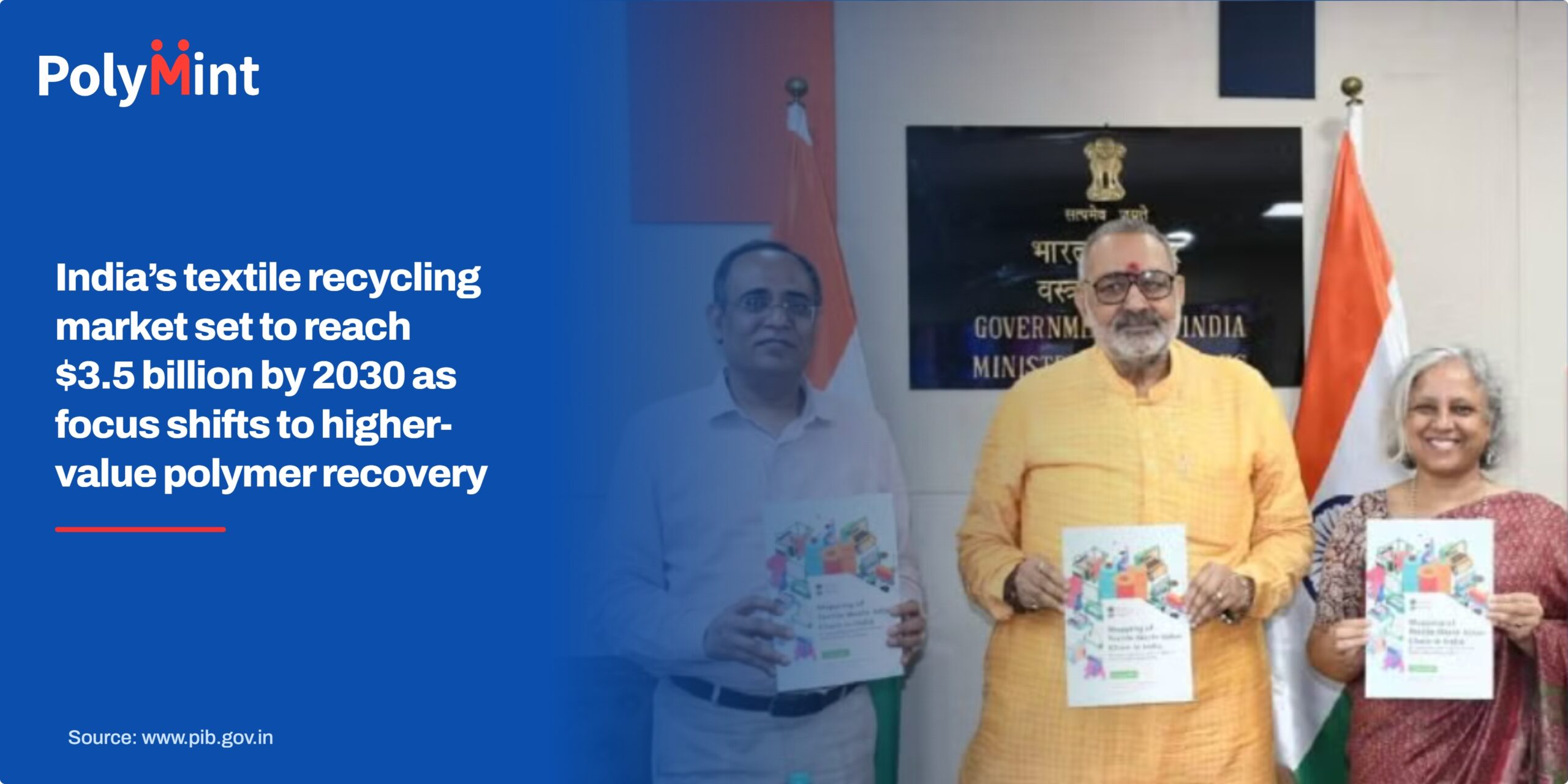
India’s textile recycling market is moving towards higher-value polymer recovery as rising waste generation creates opportunities beyond reuse and downcycling. The Ministry of Textiles estimates that India generates 7.07 million tonnes (mnt) of textile waste annually, with 42% from pre-consumer sources and 58% from post-consumer waste.
More than 70% is already recovered through recycling, reuse, upcycling and downcycling.
The ministry estimates India’s textile recycling market could reach $3.5 billion by 2030. For the polymer value chain, the opportunity lies in converting recovered material into consistent recycled fibre, particularly recycled polyester, for downstream textile applications.
Feedstock opportunity
India’s pre-consumer textile waste recovery rate is around 95%, while only about 55% of post-consumer waste is diverted from landfills. This leaves greater scope to improve collection, sorting and processing of discarded textiles into usable fibre feedstock.
The spinning industry has achieved near-100% in-situ reintegration of much of its homogeneous process waste. Further growth in recycled fibre availability is therefore likely to depend increasingly on post-consumer streams, where mixed fibre composition and sorting requirements make processing more complex.
PET provides established route
Alongside textile-to-textile recycling, PET-to-polyester recycling provides an established route for producing recycled polymer feedstock. Discarded PET bottles can be processed into flakes and converted into recycled polyester fibre and yarn.
For example, RSWM’s FibreGreen facility near Jaipur processes discarded PET bottles into flakes before converting them into polyester fibre in different deniers and cuts for yarn spinning. Similar PET-to-polyester recycling operations are being undertaken by major players such as Ganesha Ecosphere and Alliance Fibres, which process post-consumer PET bottles into recycled PET flakes and recycled polyester staple fibre. This growing ecosystem highlights the increasing integration of PET waste collection, mechanical recycling and fibre production within India’s textile value chain.
Market outlook
India’s recycled fibre market is likely to develop through two parallel feedstock routes: textile-to-textile recycling and PET-to-polyester recycling. The former depends on improving collection and sorting of discarded textiles, while the latter uses recovered PET bottles as feedstock for recycled polyester.
The estimated $3.5 billion textile recycling market by 2030 therefore represents both a textile-waste opportunity and potential growth in recycled polymer demand. Feedstock availability, collection and sorting efficiency, processing capacity and the ability to produce consistent recycled fibre at viable economics are likely to determine the pace of market development.
Leave a Reply