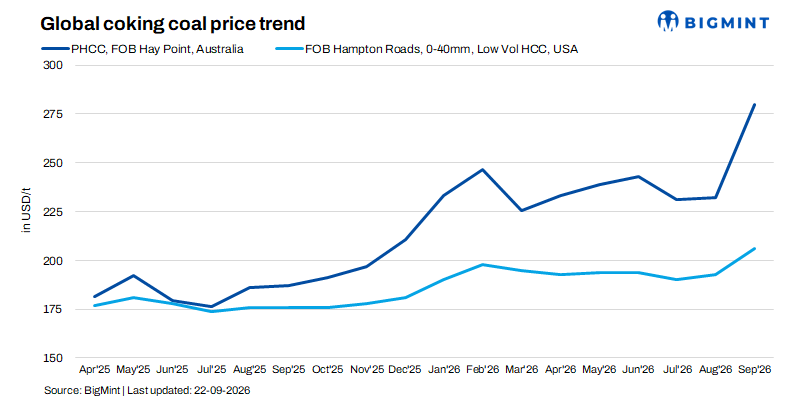
- Australian PHCC eases as Chinese buying slows, but tight spot availability and weak Mongolian flows limit downside
- Met coke remains elevated amid constrained Indonesian supply, while PCI prices hold firm despite pressure on steel margins
Global metallurgical coal markets entered a consolidation phase in mid-September after the sharp rally seen from late August. Australian premium hard coking coal (PHCC) eased as Chinese buyers resisted elevated prices, while expectations of higher Chinese mine production weakened sentiment in domestic and futures markets.
However, the correction remained limited. Australian spot availability was thin, Mongolian deliveries into China remained well below normal, and Chinese domestic supply had not yet fully recovered. In India, mills reduced purchases at higher prices and diversified towards Russian, US, Canadian and Mozambican coal.

China’s supply disruption drove the rally
The rally originated largely in China, where coking coal production fell following a fatal mining accident in May and the subsequent intensification of safety inspections. Mine closures and slow restarts reduced domestic availability, encouraging Chinese mills and traders to procure seaborne Australian cargoes.
China’s national raw coal production remained under pressure in August, falling 7.7% y-o-y to 361.82 mnt. Although this was an improvement from July’s 10.1% decline, it confirmed that supply had not yet normalised.
Mongolian flows compounded the shortage. Truck crossings at the Ganqimaodu border reportedly fell below 600/day by 16 September, compared with levels above 1,000/day required for a more meaningful recovery in supply. This kept buying interest firm for Australian and Canadian low-vol HCC even as demand for premium material softened.
Australian PHCC consequently climbed rapidly through late August and early September before easing to $280.80/t FOB on 17 September. CFR China remained above $300/t, reflecting both the earlier supply-led rally and firm Australia-China freight.
Mine restarts change China’s market psychology
The turning point came as Shanxi authorities instructed major provincial energy companies to accelerate mine restarts, subject to safety clearances. China’s sampled coking coal mine utilisation rose 2.9 percentage points w-o-w to 70.8% during 4-10 September, with output increasing and inventories building for the first time in several weeks.
The prospect of recovering production quickly affected market sentiment. China’s most-traded January coking coal futures contract closed at RMB1,588/t on 14 September, around 8% below its 31 August peak.
Physical buying also slowed. A sizeable portion of coking coal offered through domestic auctions remained unsold as coke plants and steelmakers resisted higher prices. The market is increasingly questioning whether the earlier supply deficit will persist into Q4.
However, a rapid supply recovery is not assured. Suspended mines must still pass safety inspections, and private mines facing scrutiny over production violations may take longer to restart. Chinese domestic coal therefore remains tight enough to prevent a steep correction in seaborne prices.
Steel margins emerge as the principal constraint
China’s raw-material rally has outpaced the improvement in finished steel prices, compressing blast-furnace margins. Mills have adequate near-term inventories and limited appetite for forward cargoes at prevailing prices.
Expectations have also shifted in the coke market. After successive increases in domestic coke prices, discussions have moved towards the possibility of price reductions as steelmakers resist further raw-material inflation and consider production cuts.
This margin pressure explains why PHCC weakened while lower-priced low-vol HCC remained comparatively stable. Mills still require coking coal, but are becoming more selective about quality premiums.
India retreats from Australian coal and diversifies
India imported 5.3 mnt of coking coal in August, down 22.1% from 6.8 mnt in July, although volumes remained 15.2% above August 2025.
Australian shipments fell 37.1% m-o-m to 2.2 mnt, reducing Australia’s share to about 42% from 51% in July. Russian arrivals declined to 1.6 mnt but were substantially higher y-o-y, while US shipments increased to 0.8 mnt. Mozambique supplied 0.6 mnt and Canada around 0.1 mnt.
The change reflects procurement timing and price resistance rather than weaker underlying steelmaking demand. Indian mills used inventories accumulated earlier and increased their reliance on alternative origins as Australian replacement costs rose.
If Chinese mine output and Mongolian flows recover, lower seaborne prices could bring Indian mills back into the Australian market. A slower Chinese recovery would keep Indian purchasing cautious and sustain diversification towards Atlantic and Russian supply.
Met coke rally encounters resistance
Indonesian 65 CSR coke transactions rose from $315/t FOB at the end of August to $350/t by 11 September. By 17 September, 65/63 CSR coke was assessed slightly lower at $349/t FOB, indicating that the rally had paused rather than reversed.
Dry weather and limited prompt Indonesian cargo availability kept replacement costs elevated. This encouraged Indian buyers to evaluate Chinese coke, with 65/63 CSR material offered at around $370/t CFR India for September-October loading.
However, Indian coke demand also faces resistance from blast-furnace operators dealing with elevated ore, coal and coke costs. Near-term prices are therefore supported by constrained supply but capped by weak steelmaking margins.
PCI remains firm but vulnerable to margin pressure
PCI prices were comparatively stable, with Australian low-vol PCI at $198.80/t FOB and mid-vol PCI at $193.80/t. CFR India mid-vol PCI stood near $205/t.
PCI retains support because higher injection rates allow blast-furnace operators to reduce expensive coke consumption. Nevertheless, weakening steel margins and the expected recovery in Chinese coal production could cap further gains.
Outlook
The market is shifting from a supply-driven rally towards consolidation. Chinese mine restarts are the main downside risk, but the recovery must be sustained before seaborne prices can correct materially. Weak Mongolian flows, tight Australian spot availability and constrained Indonesian coke supply continue to provide support.
PHCC and met coke prices may soften further at the margin, but a deep correction appears unlikely unless Chinese domestic production rises rapidly and steel mills implement broader output cuts.
Leave a Reply