- Higher freight and stronger JPY weigh on exports
- Selective buying limits further upside in Japanese scrap
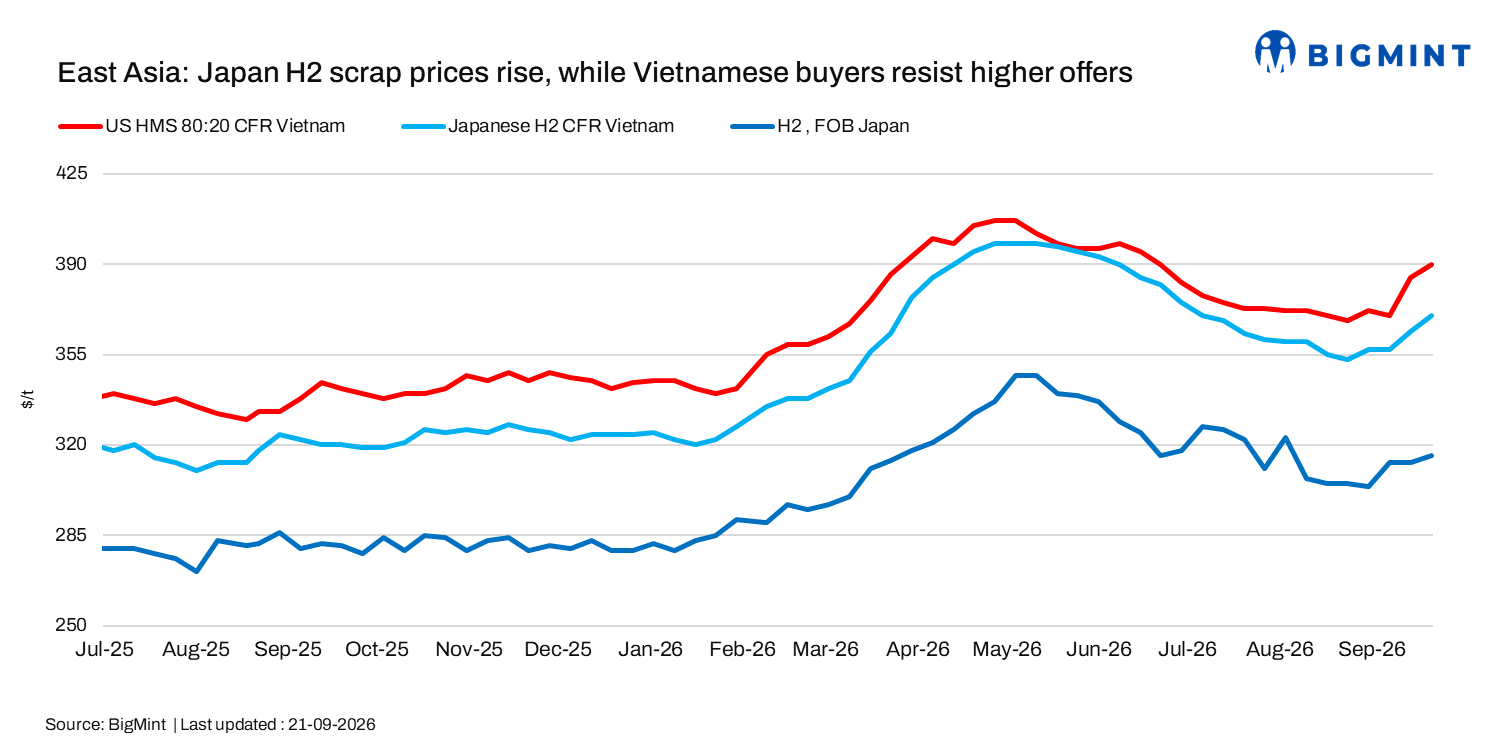
Japan’s H2 ferrous scrap export prices moved higher during the week ended 21 September, supported by higher freight costs, firmer overseas offers and expectations of further price increases. However, a stronger JPY and elevated freight continued to weigh on Japanese export competitiveness, while Vietnamese buyers remained cautious at higher price levels.
Weekly assessments
- JapaneseH2 scrap was at $370/t CFR Vietnam, up by $5/t w-o-w.
- Japanese H2 scrap was at JPY 49,000/t ($316/t) FOB Tokyo Bay, up by JPY 700/t ($4/t) w-o-w.
- US-origin HMS 80:20 bulk stood at $390/t CFR Vietnam, up by $5/t w-o-w.
Japan
Japan’s H2 ferrous scrap export prices strengthened, with H2 assessed at JPY 49,000/t ($316/t) FOB Tokyo Bay on 16 September, up JPY 700/t ($4/t) w-o-w. Meanwhile, domestic H2 FAS collection prices remained unchanged at around JPY 46,500/t.
The JPY weakened slightly to around JPY 157/$ from JPY 154/$ a week earlier, but remained stronger than at the beginning of September. This, along with higher freight costs, continued to limit Japanese scrap exports. Shortsea freight from Japan to Vietnam increased to around $50-55/t, with some 5,000-8,000-t cargoes reportedly attracting freight of $55-60/t. Shredded scrap offers also increased by JPY 500/t ($3/t) w-o-w to JPY 53,000-53,500/t ($337-340/t) FOB Japan, while bids remained around JPY 51,000-51,500/t ($324-328/t).
Vietnam
Vietnamese buyers remained cautious despite higher Japanese offers. H2 was offered at around $375/t CFR Vietnam, while indicative bids were heard at $360-365/t. Some H2 cargoes were reportedly purchased at around $367/t CFR Vietnam.
The deep-sea market also strengthened, with US-origin scrap offers reaching around $395/t CFR Vietnam. The rise was partly supported by stronger Turkish scrap prices and higher freight costs.
However, Vietnamese mills remained cautious at higher levels amid weak finished-steel demand and comfortable scrap inventories. High freight and currency movements also made Japanese material less competitive, with buyers largely purchasing only for immediate requirements.
Outlook
Japanese scrap prices are expected to remain supported by higher freight costs, firm supplier expectations and stronger overseas scrap markets, particularly Turkiye. However, the stronger JPY and cautious Vietnamese buying could limit further increases. Export activity may remain selective in the upcoming days, with mills likely to restock only when price levels become workable.
Leave a Reply