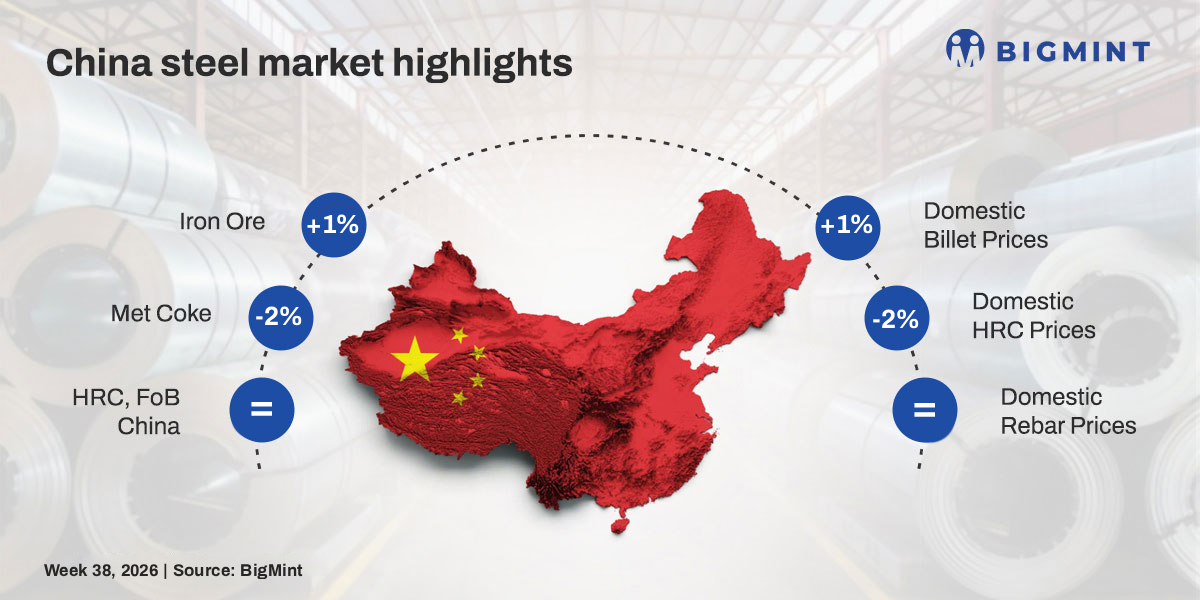
- HRC prices fall RMB 50/t ($7/t) amid weak buying
- Mill inventories rise 2% in early Sep as demand lags
China’s domestic steel prices fell during the assessment week ended 18 September as the expected seasonal recovery in steel demand failed to materialise. Hot-rolled coil (HRC) prices fell more sharply than rebar, while inventories at key mills increased despite lower crude steel production. Weak downstream procurement and cautious sentiment outweighed support from elevated raw material costs and expectations of production controls.
Inventories in early-September
The China Iron and Steel Association (CISA) reported that total steel inventories at key CISA-affiliated mills stood at around 16.52 million tonnes (mnt) during early September (1-10 September 2026), marking an increase of 0.27 mnt or 1.7% from 16.25 mnt in late August. Moreover, y-o-y, inventories increased by 0.70 mnt or 4.4% compared with 15.82 mnt recorded in early September 2025.
Despite lower crude steel production, CISA mill inventories rose in early September as the recovery in actual steel demand remained slower than expected. Repeated coke and coal price hikes supported speculative buying, but weak end-user demand limited restocking, leading to inventory accumulation at mills.
Steel price trend
Domestic HRC prices drop: China’s domestic hot-rolled coil (HRC) prices declined by RMB 50/t ($7/t) w-o-w to around RMB 3,210/t ($479/t) on 18 September, compared with RMB 3,260/t ($486/t) a week earlier. Furthermore, SHFE HRC futures (October 2026 contract) were down by RMB 16/t ($2/t) to RMB 3,302/t ($493/t) from RMB 3,318/t ($495/t) in the previous week.
China’s domestic HRC market came under pressure during the week, with prices falling w-o-w across major markets. The decline was largely driven by weak buying interest and subdued market sentiment, as the expected demand recovery during the peak consumption season remained slower than anticipated. Buyers continued to procure mainly for immediate requirements, while macroeconomic support has yet to translate into stronger steel demand. However, high raw material costs and reduced mill profitability limited the downside, preventing a sharper price correction.
However, Chinese HRC export offers remained stable w-o-w at around $510/t FOB Rizhao, amid cautious overseas buying activity due to continued weak demand.
Rebar prices decline w-o-w: China’s domestic rebar prices were down by RMB 10/t ($1/t) w-o-w to around RMB 3,180/t ($475/t) on 18 September from RMB 3,190/t ($476/t) in the previous week. However, SHFE rebar futures (October 2026 contract) were up marginally by RMB 2/t ($0.2/t) to RMB 3,104 /t ($463/t) from RMB 3,102/t ($462/t) in the previous week.
Domestic construction steel prices edged down marginally during the week as weak real estate activity continued to weigh on downstream demand. Market sentiment remained cautious despite a steady decline in social inventories across major regions, which helped ease some inventory pressure. Meanwhile, expectations around the Federal Reserve rate hike had largely been factored into the market, keeping price movements limited. On the raw material front, improving efforts to ensure coking coal supply led to continued declines in coking coal and coke futures, adding further pressure on steelmaking costs. Against this backdrop, rebar prices saw a marginal decline as weak demand and softer raw material prices outweighed the support from falling inventories.

Raw materials prices
Iron ore spot prices edged up w-o-w: Iron ore fines benchmark prices for Fe 61% increased by $1/dmt w-o-w to $97/dmt CFR China on 18 September 2026, supported by the onset of pre-holiday restocking by Chinese steelmakers. However, the gain remained limited as weak steel demand and a hawkish US Federal Reserve stance continued to weigh on market sentiment. Chinese integrated mills increased purchases of imported sintering fines mainly to cover production requirements during the upcoming National Day holidays.
The rise in procurement was largely inventory-driven, with mills’ immediate consumption needs showing only a marginal increase, indicating limited improvement in underlying iron ore demand.
a) Spot pellet premium stable w-o-w: The spot pellet premium for the Fe 65% grade pellet remained firm w-o-w at $25.85/t CFR China on 16 September.
b) Spot lump premium softens w-o-w: The spot lump premium edged lower by $0.022/t w-o-w to $0.2220/t CFR China on 18 September.
Coking coal market softens amid improved supply: China’s coking coal and coke markets eased w-o-w on improved supplies. Coking coal and coke prices are expected to remain stable at elevated levels in the near term.
Australian PHCC FOB prices declined by $4/t w-o-w to around $281/t, while BigMint’s PHCC index fell by $1/t w-o-w to $305/t CNF Paradip on 18 September, amid subdued spot demand and cautious buying by Indian buyers, which weighed on market sentiment despite relatively limited availability.
China billet prices stable amid mixed demand and cautious sentiment: Chinese billet prices remained stable w-o-w amid mixed demand signals and cautious market sentiment. Expectations of production cuts and capacity controls provided some support, while weaker raw-material costs and subdued downstream demand limited price gains.
Standard billet prices at Tangshan Qian’an stood at RMB 3,000/t ($420/t) on 18 September, unchanged from 11 September. China FOB billet prices were assessed at $463/t on 18 September.
Raw-material costs weakened, particularly coking coal, while higher freight costs and currency movements kept export offers relatively firm. Mills are expected to maintain cautious pricing ahead of the October demand outlook.
Outlook
With the approaching holidays and expectations of a seasonal pickup in demand, downstream buying and restocking activity could improve, offering some support to spot steel prices in the coming week. At the same time, production cuts and maintenance at steel and rolling mills are gradually easing supply pressure. However, softer raw material prices are weakening cost support for mills, while the broader supply-demand balance remains largely unchanged. Meanwhile, steel prices are likely to see limited upside and continue fluctuating within a narrow range in the near term.
Leave a Reply