- Virgin PET prices increased around 10–11% w-o-w across key Indian markets
- Major producers revised PET prices upward twice during the week
India’s polyethylene terephthalate (PET) market strengthened further, supported by higher feedstock costs, firmer import replacement values and repeated domestic producer revisions. Domestic virgin PET prices increased across major markets, while buying remained largely need-based. Converters are gradually preparing for October and festive demand, although broad-based inventory accumulation remains limited.

Crude oil and feedstock market
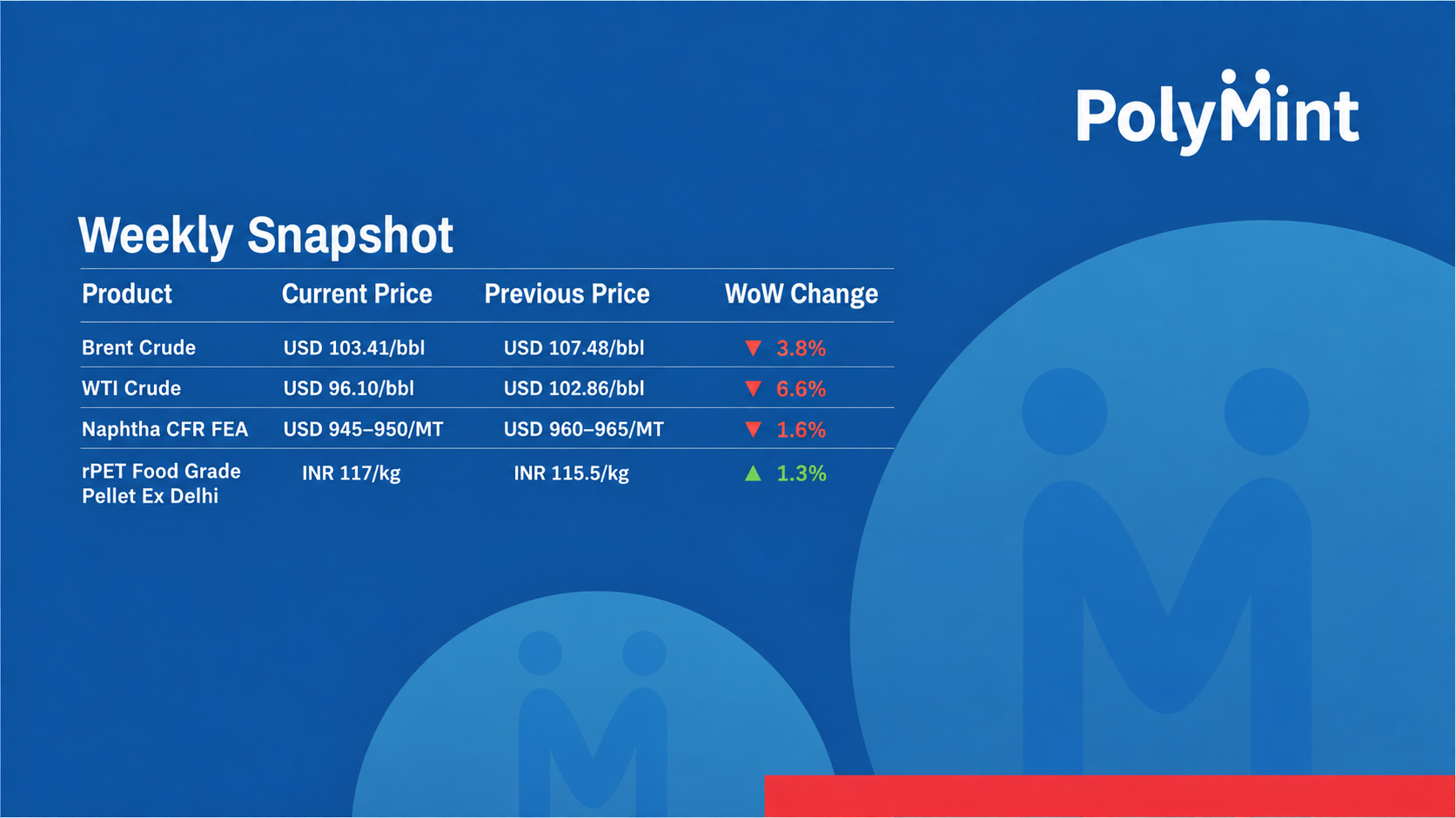
Brent crude eased 1.35% w-o-w to USD 103.41/barrel, while WTI declined 5.31% to USD 96.10/barrel. The Indian rupee strengthened marginally by 0.06% w-o-w to 95.81/USD.
Naphtha CFR Far East Asia increased to around USD 950-955/MT, from USD 910-915/MT a week earlier, adding to petrochemical replacement costs. The latest assessment indicated some easing in Northeast Asian naphtha market conditions, with the ANNA crack spread weakening to around USD 143.85/MT from USD 150.23/MT the previous day.
RIL raised PTA 5.4% w-o-w to INR 103/kg and MEG 9.4% to INR 83.70/kg. Mixed xylene prices also increased marginally, with Ex-Hazira and Ex-Patalganga rising 0.8% w-o-w each. The firmer feedstock complex continued to support PET replacement costs.
Global PET market
Global PET markets remained firm, supported by higher feedstock costs, firmer replacement values and uneven availability. PET bottle-grade resin on a CFR India basis increased 5.3% w-o-w to USD 1,295/MT, from USD 1,230/MT in the previous week.
On an FOB basis, China PET bottle-grade resin was indicated at around USD 1,170/MT, while Vietnam PET bottle-grade resin was assessed at around USD 1,220/MT FOB for September 2026, based on September 14 indications. Higher PTA and MEG costs continued to support seller offers.
Imported PET remained available, although arrivals were uneven. Logistics constraints and irregular shipments continued to influence effective availability and replacement costs in India. Buyers remained cautious on inventory commitments amid elevated import offers.
Domestic virgin PET market
Domestic virgin PET prices increased around 10–11% w-o-w across key Indian markets. PET bottle-grade resin, IV 0.80, rose to INR 141.5/kg ex-Mundra, INR 142.5/kg ex-Nhava Sheva, INR 144/kg ex-Mumbai and INR 147/kg ex-Delhi.
Major producers implemented two upward revisions during the week, with PET prices increased by INR 4.50/kg effective September 14 and a further INR 5/kg effective September 18. The successive revisions reflected higher replacement costs and provided additional support to domestic price levels.
A major West India trader stated that downstream demand has improved, but buying remains largely need-based. Some market participants are shifting toward lower-grade virgin resins and recycled products amid the significant increase in virgin PET prices. Many buyers are also anticipating relatively stable market conditions going forward.
Domestic producers appear to have material available, with a portion of production committed through regular and contract channels. Distributor inventories remain moderate, while sellers are less willing to offer large quantities at previous price levels amid higher replacement costs. No clear indication of significant domestic oversupply was reported.
Recycled PET market
The recycled PET market remained comparatively stable to firmer, with mixed movement across grades. Delhi PET bottle bale prices increased 5.4% w-o-w to INR 59/kg, while rPET flakes below 30 ppm remained unchanged at INR 87/kg.
rPET flakes below 50 ppm increased 1.2% to INR 83/kg, while flakes below 100 ppm remained unchanged at INR 77/kg. Food-grade rPET pellets increased 1.3% to INR 117/kg.
Higher PET bale prices indicate firmer scrap economics, while the relatively limited movement in flake prices suggests a more balanced recycled market. The sharp increase in virgin PET prices is encouraging some buyers to consider lower-grade virgin and recycled alternatives.
Outlook
Virgin PET prices are expected to remain firm in the near term, supported by elevated PTA and MEG costs, higher import replacement values and repeated producer revisions. However, need-based buying and increased substitution toward lower-grade and recycled material could limit further upside.
October and festive stocking, import arrivals, logistics and the pace of downstream consumption will remain key factors for the domestic PET market.
Leave a Reply