- Buyers step up procurement amid price concerns
- Mills maintain controlled spot material availability
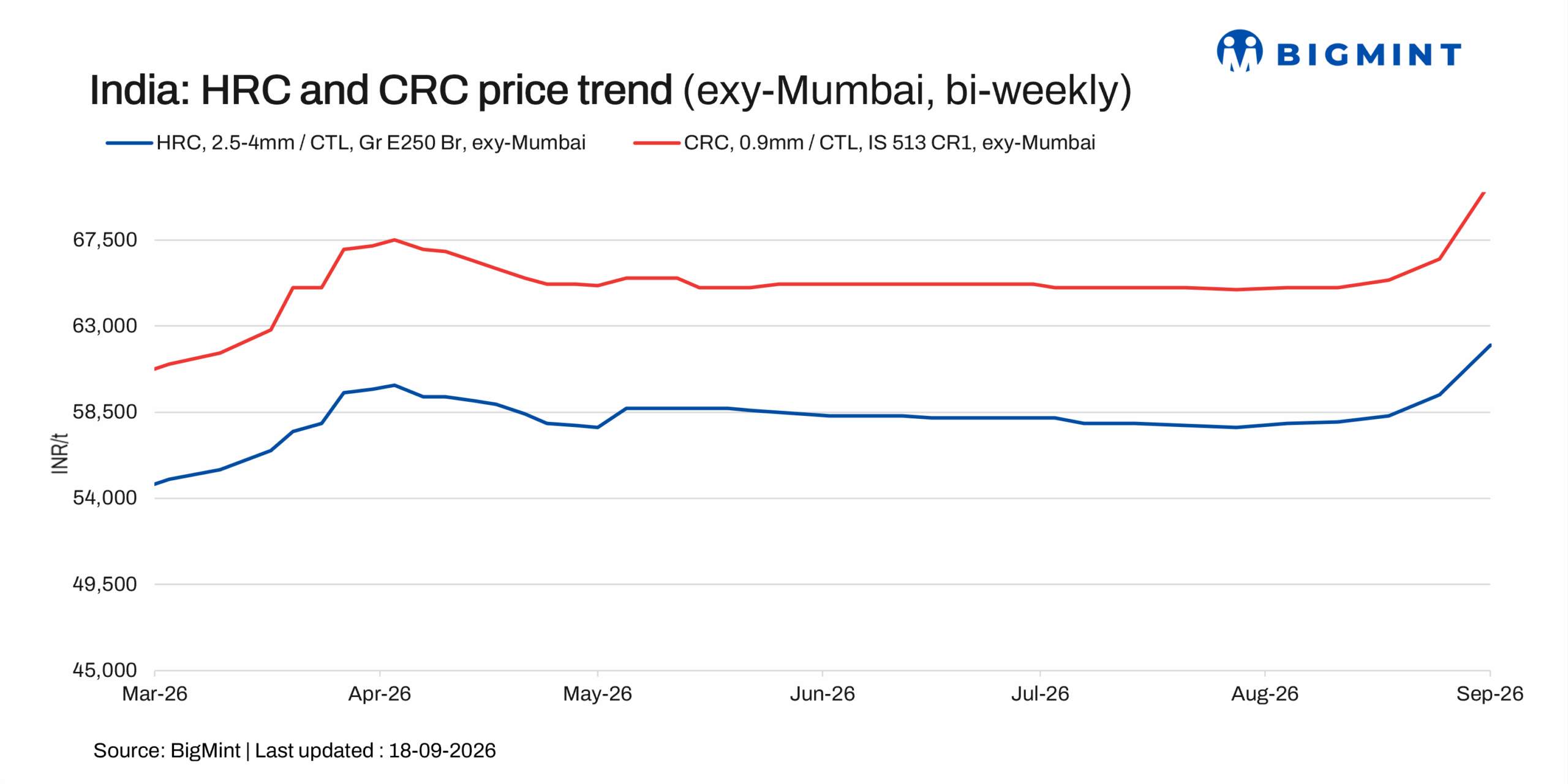
India’s hot-rolled coil (HRC) market strengthened further during the week ended 18 September 2026, with trade-level prices increasing by around INR 1,000-2,000/t across key markets. Domestic steel mills raised HRC prices by around INR 750-1,750/t in mid-September, while increasing CRC prices by around INR 1,500-2,250/t during the same period, which supported the upward movement in trade-level prices. Trade-level HRC prices were reported to have increased by around INR 1,000-3,500/t, but buying activity remained largely requirement-driven.
BigMint’s bi-weekly benchmark assessment for Mumbai HRC (IS2062, Grade E250, 2.5-8 mm/CTL) increased by INR 1,200/t from the previous assessment to INR 63,900/t ex-Mumbai.
Meanwhile, Mumbai cold-rolled coil (CRC) prices also increased by around INR 1,300/t, with BigMint’s benchmark assessment for Mumbai CRC (IS513, Grade O, 0.9 mm/CTL) rising to INR 73,500/t ex-Mumbai.
Overall, HRC and CRC prices have moved higher, supported by mid-month mill price revisions and the subsequent increase in trade-level prices. However, buying activity remains focused on immediate requirements.

Market update
The impact of recent price hikes by major domestic steel mills has become increasingly visible in the HRC market, with trade-level prices moving higher across key markets. Market enquiries have increased following the mill price revisions, as buyers are becoming more concerned about the possibility of further price increases in the near term.
This expectation of higher prices is encouraging buyers to bring forward their procurement requirements. Market participants are reporting increased purchasing and restocking activity, with some buyers preferring to secure material at current price levels rather than wait for potentially higher offers in the coming weeks. However, buying remains selective, with larger-volume purchases still being evaluated carefully.
On the supply side, major mills are managing material availability strategically rather than releasing large volumes into the spot market. Mills are maintaining controlled supplies and allocating material based on existing bookings and requirements, resulting in relatively limited availability in the spot market. This has reduced the scope for sellers to offer large quantities at lower levels and has provided additional support to trade prices.
The combination of controlled mill supplies, moderate market inventories and expectations of further price increases is encouraging procurement and restocking. While current buying activity has improved, the increase in demand is still gradual and remains less pronounced than the movement in prices.
Going forward, the market could see further improvement in demand if buyers continue to increase procurement and restocking activity. However, the pace of price movement will depend on the extent of demand recovery, mill supply availability and subsequent changes in mill offers.
Trade scenario
Imports: India’s bulk HRC imports volume of 32,474 tonnes (t) have already been arrived as of 11 September. Furthermore, another 59,451 t are expected arrive by end of this month.

Export: India’s bulk HRC exports stood at 233,027 t as of 11 September 2026. Furthermore, another 34,947 t are expected to shipped by end of this week.
Indian HRC export offers showed mixed trends w-o-w across key destinations in the week. Offers to the EU increased w-o-w, supported by stronger domestic realisations, while those to the Middle East and Vietnam remained on hold as mills continued to prioritise domestic sales and most export allocations were already committed. In the EU, selective Q1 CY’27 bookings were reported, although higher offer levels continued to limit additional booking activity.
Outlook
HRC prices are likely to remain supported in the near term as buyers continue to bring forward procurement amid expectations of further mill price increases. Restocking activity could gain momentum if buyers perceive current levels as more attractive than potential replacement costs later in the month. Market indications suggest that prices could move further higher in the coming month, primarily driven by further mill-led price hikes.
With mills continuing to manage dispatches selectively, spot availability may remain relatively constrained, limiting downward pressure on trade prices. At the same time, the gap between price increases and demand recovery could keep buyers cautious on larger-volume purchases.
Leave a Reply