- Atlantic rates remain firm on tighter tonnage, steady cargo activity
- Pacific weakness, cautious Chinese buying limit broader upside
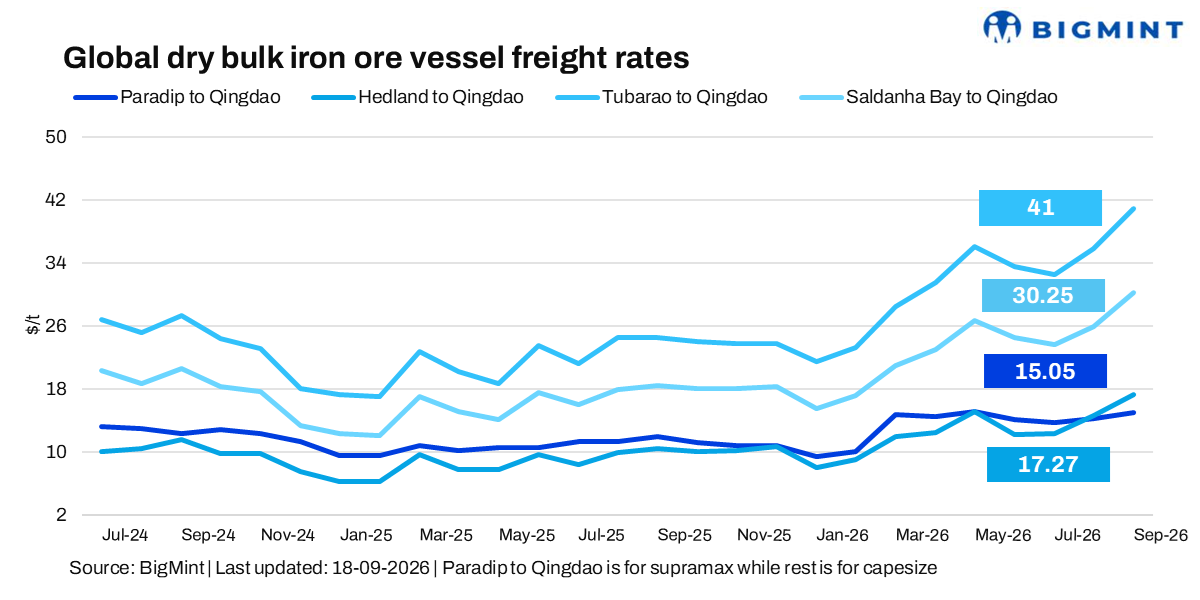
Dry bulk iron ore freight sentiment remained mixed but relatively firm in the week ended 18 September, with the Atlantic continuing to outperform the Pacific.
Brazilian and South African Capesize freights gained on tighter prompt tonnage and steady cargo activity, while Australia-China rates softened amid calmer weather, weaker fixing, and more available tonnage. Supramax remained resilient on firm enquiries, supported by steady iron ore cargo enquiries and relatively balanced vessel availability.
A shipbroker stated, “Market sentiment remained broadly firm across vessel segments, with Capesize, Supramax, and Handymax rates holding firm, while Panamax rates remained firm but showed some signs of easing. Firm bunker prices and elevated vessel-hire costs continued to provide support to freights.”
A shipowner informed BigMint, “Atlantic freights continued to firm, while Pacific rates edged lower amid relatively calmer weather conditions and fewer weather-related disruptions.”
A market participant stated, “Vessel availability and bunker prices remain key freight drivers, with tighter tonnage supporting rates, while weaker cargo enquiry could limit upside.”
Another source informed, “Following the Ocean Winner sinking accident, TML has tightened requirements, keeping freight sentiment broadly flat. Market participants expect some softness to emerge toward late November and December.”
Route-wise update

Factors influencing freight rates
- Baltic Dry Index falls 5% w-o-w amid Capesize weakness: The Baltic Dry Index (BDI) declined by 185 points, or 5% w-o-w, to 3,336 on 17 September from 3,521 on 10 September, with the decline largely driven by continued weakness in the Capesize segment. The BCI fell 466 points, or 8%, to 5,656, as softer Pacific activity, weaker late-week fixing and limited Atlantic momentum weighed on sentiment. However, the BSI increased 49 points, or 2%, to 1,762, supported by firmer demand and healthy grain activity.
- Brent crude futures decline marginally w-o-w: Brent crude futures eased by $0.41/barrel (bbl) (0.4%) w-o-w to $103.44/bbl on 18 September, from $103.85/bbl. Prices remained elevated amid Middle East supply risks, while easing Saudi disruption concerns and alternative supply routes capped gains.
- Bunker prices decline w-o-w: Singapore Very Low Sulphur Fuel Oil (VLSFO) bunker prices fell by $23/tonne (t) (2.5%) w-o-w to $880/t on 18 September, from $903/t. The decline followed softer crude prices and easing near-term marine-fuel supply concerns, while Middle East disruptions continued to pose upside risks.
- DCE iron ore futures decline w-o-w: The benchmark DCE iron ore contract declined by RMB 2.5/t ($0.4/t) (0.3%) w-o-w to RMB 715.5/t ($106.7/t) on 18 September, from RMB 718/t ($107/t). Prices remained under pressure from weak steel margins and subdued underlying demand, although pre-holiday restocking by Chinese steelmakers provided some support and limited the downside.

Outlook
Dry bulk freight rates are expected to remain broadly firm in the near term, supported by tight vessel availability and steady Atlantic cargo activity. However, softer Pacific enquiries and cautious Chinese buying could limit upside. Market participants expect the current stability to give way to some softness towards late November and December as cargo demand potentially weakens and vessel availability improves.
Leave a Reply