- Australian exports rise 3% amid firmer Pilbara loading activity
- Shipments from Brazil decrease amid elevated Brazil-China freights
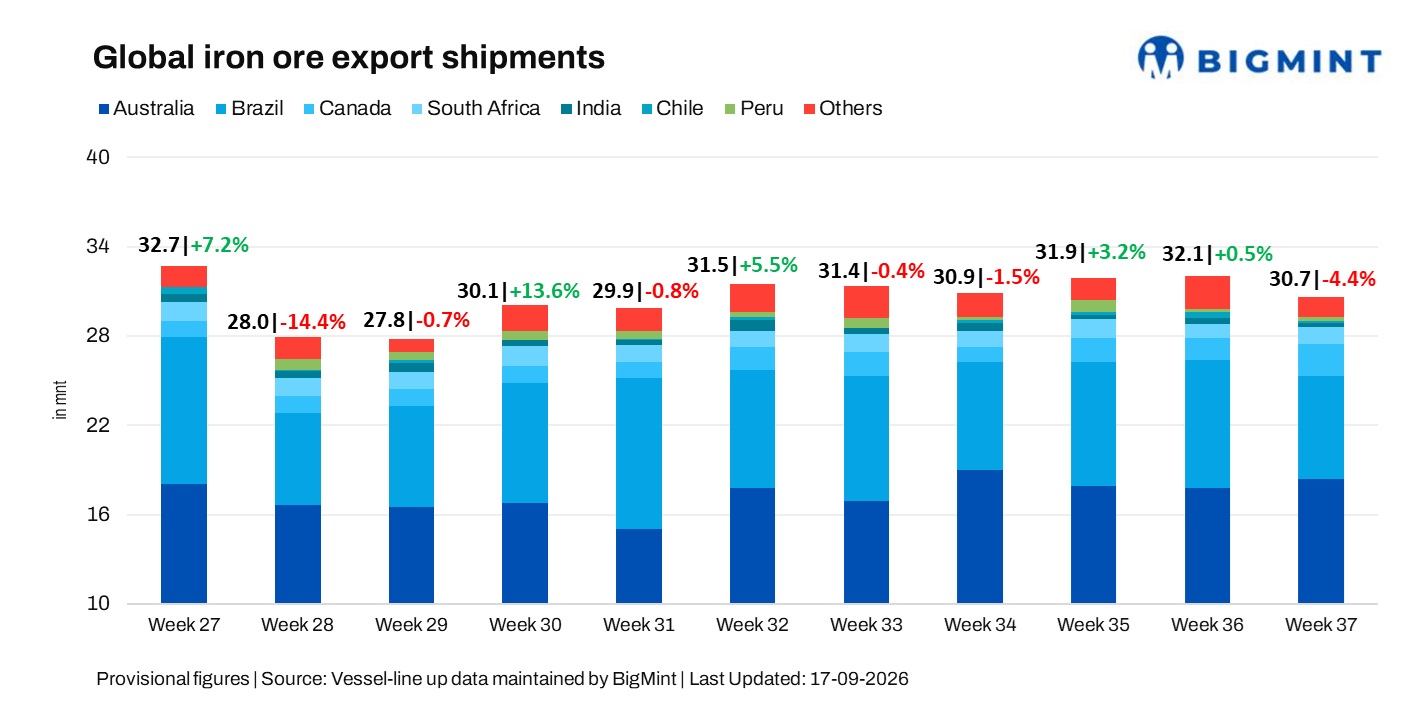
Global seaborne iron ore shipments softened 4.4% w-o-w to 30.7 million tonnes (mnt) in the week ended 11 September, from 32.1 mnt a week earlier. Firmer shipments from Australia, Canada, South Africa, Peru, Sierra Leone, and Mauritania were outweighed by weaker flows from Brazil, Guinea, Liberia, India, Chile and Sweden.
Australia remained the largest contributor, supported by firmer Pilbara loading activity, while Canada and South Africa also recorded stronger weekly flows. Brazil saw softer export momentum amid quieter loading and elevated Brazil-China freights, while Guinea and Liberia posted lower shipments after stronger activity in the previous week.
Country-wise exports

Port & shipper-wise trends
- Australia: Port Hedland led shipments at 11.5 mnt, followed by Dampier at 3.7 mnt and Walcott at 3.0 mnt. Rio Tinto was the largest shipper at 6.6 mnt, followed by BHP at 5.6 mnt and Fortescue Metals at 4.4 mnt. China remained the key destination at 14.2 mnt.
- Brazil: Ponta da Madeira led at 3.5 mnt, followed by Tubarao at 1.5 mnt and Itaguai at 0.9 mnt. Vale accounted for 4.1 mnt, while China received 2.8 mnt.
- Canada: Sept-Iles led at 1.1 mnt, followed by Milne Inlet and Port Cartier. Guinea & Nimba Mines shipped 0.9 mnt, while the Netherlands and China were the key destinations.
- South Africa: Saldanha remained the key port at 1.1 mnt, while Richards Bay handled 0.1 mnt. The Netherlands and China were among the reported destinations.
- India: Dhamra and Kakinada handled 0.1 mnt each, with Malaysia as the key destination. Bengal Energy and Lloyds Metals & Energy were the reported shippers.
- Chile: Totoralillo handled 0.2 mnt, all destined for China.
- Peru: San Nicolas and Matarani handled 0.2 mnt and 0.1 mnt, respectively. Shougang Hierro shipped 0.2 mnt, mainly to China and Japan.
- Guinea: Morebaya accounted for 0.4 mnt, with the entire volume shipped to China.
- Liberia: Buchanan handled 0.2 mnt, with Spain among the reported destinations.
- Sierra Leone: Freetown handled 0.2 mnt during the week.
- Norway: Mo i Rana handled 0.1 mnt, with the Netherlands as the reported destination.
- Mauritania: Nouadhibou handled 0.4 mnt, with Japan receiving 0.2 mnt.
- Sweden: Narvik handled 0.2 mnt, with Germany the key destination, while Lulea shipped a smaller volume to Finland.
Capesize market remains firm in Atlantic, Pacific steady
Dry bulk iron ore freights remained mixed in the week ended 10 September, with Atlantic Capesize supported by firm cargo activity and tighter prompt tonnage, while Pacific rates stayed broadly stable amid balanced fundamentals. Brazil-China freight remained supported, whereas India-China softened on quieter enquiry and adequate tonnage.
A shipowner told BigMint, “Capesize appears softer, while Panamax remains broadly firm with steady but limited enquiry. Supramax enquiries are relatively stronger, although rates are slightly softer.”
Overall sentiment remained cautiously bullish, with higher bunker costs and geopolitical risks supporting freight, while cautious Chinese buying and mixed steel margins could limit further upside.
Outlook
Global iron ore shipments are likely to remain mixed, with Australia, Canada and South Africa providing support, while softer Brazil, Guinea and Liberia flows could weigh on overall volumes. Simandou ramp-up, port performance, and regional logistics will remain key supply-side drivers.
Freight markets are expected to retain a firm undertone, particularly in the Atlantic, amid active miner demand and tighter prompt tonnage. Stable Pacific fundamentals and cautious Chinese buying could keep gains contained, while elevated bunker costs and geopolitical risks continue to underpin voyage economics.
Leave a Reply