- Mills cover October-November needs amid limited metallics
- Firm rebar prices support higher scrap buying
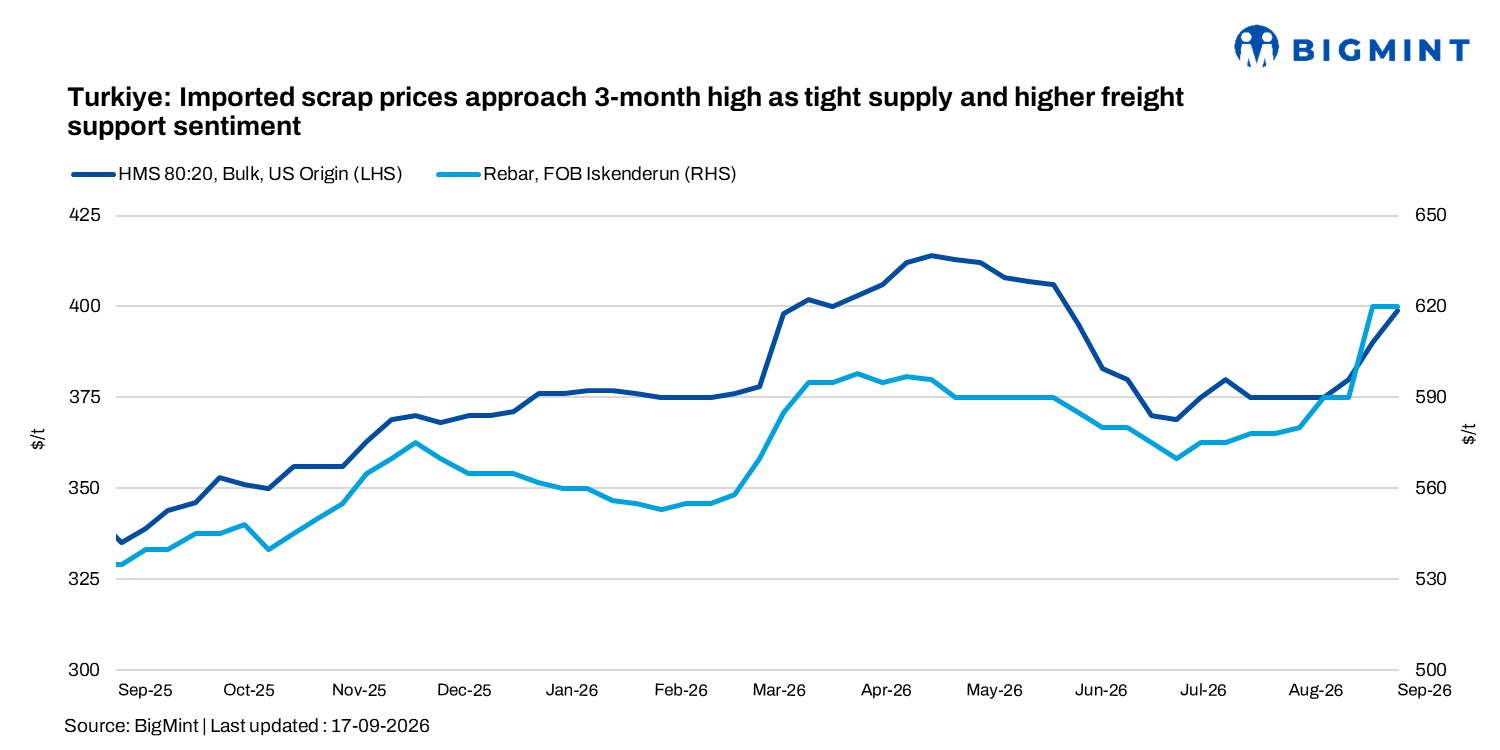
Turkiye’s imported scrap market strengthened further this week, with BigMint-assessed US-origin HMS (80:20) bulk rising $9/t w-o-w to $399/t CFR Turkiye from $390/t.
Prices are approaching a three-month high, with the previous comparable level last seen in early June. The move was driven by mills covering October-November requirements, limited availability of Black Sea metallics, higher freight and collection costs, and firm seller expectations.
Around 11 bulk trades were captured throughout the week, including 2 UK-origin, 4 other European-origin, 1 Baltic-origin, and 3-4 US-origin HMS 80:20 and HMS 85:15 trades, booked at $381-400/t CFR Turkiye.
Fresh activity slowed mid-week as buyers and sellers reassessed the sharply higher price levels.
The recent transaction that pushed HMS 80:20 prices closer to $400/t CFR Turkiye was a US-origin HMS 85:15 booking at $400/t CFR, equivalent to around $397.5/t for 80:20. Another Turkish mill bought Dutch-origin HMS 80:20 at $386/t CFR, although market participants considered this level difficult to repeat because of the specific material quality.
US HMS 80:20 offers were heard around $405-406/t CFR, with some Europe and Baltic suppliers indicating $398-400/t. Mills, however, are resisting these levels.
“Turkish steel export offers are up to $630-640/t FOB, so import offers are likely to cross $405/t HMS from the US/Baltic. Most of US scrap is at $405-410/t as the new offer now, but mills resist paying that high,” a Baltic trader said.
Mills need October-November volumes
Turkish mills are likely to continue sourcing deep-sea scrap as they work to secure their October and November requirements. With Black Sea supplies of scrap, HBI, pig iron, and semis largely unavailable, imported scrap remains a key source of metallics for Turkish steelmakers.
A European scrap trader said buying interest should remain active as mills have further volumes to cover and limited access to alternative metallics.
The market remains driven mainly by mills’ procurement requirements rather than a broad recovery in demand. A scrap supplier source said August activity was stronger than in previous months. A market insider based in Turkiye said higher rebar prices are allowing mills to absorb increased scrap costs, although suppliers remain cautious as higher collection prices could leave limited margins.
Exporters are maintaining firm price expectations amid tight scrap availability, high collection costs, and elevated freight. Supramax freight from New Jersey to Turkiye reached $39-40/t on by mid-September and the highest level in the last three years.
As per a US-based scrap supplier, in the US, mills are expected to remain cautious on scrap buying in October because of the upcoming seasonal outage period.
Market expectations are for October scrap prices to remain broadly stable, with any potential increase more likely to emerge in November. The recent rise in US crude steel production was viewed as inventory building ahead of planned outages, which could provide temporary support to scrap demand before the outages reduce buying activity.
Rebar market supports higher scrap costs
Firm domestic rebar prices are giving Turkish mills greater room to absorb higher scrap costs.
On 16 Sep’26, Kardemir raised its domestic rebar offer by TRY 790/t ($14/t) w-o-w to TRY 35,736/t ($628/t) exw. The sales round reportedly closed within an hour, with sales limited to around 15,000-16,000 t. Other mills raised domestic rebar offers by around $5/t to $630-650/t exw, depending on region.
Sales are good locally and the construction season is underway, which is supporting the current price trend.
Export rebar offers were heard at $630-640/t FOB for the October shipment versus $600-610/t previously. The export market remains weaker than domestic demand, with no sizable contracts reported and only small tonnages changing hands.
Some of the Marmara mills were offering up to $645-650/t FOB, while workable export levels were around $612-615/t FOB. The BigMint export rebar assessment rose $12/t w-o-w to $620/t FOB.
Domestic scrap follows import gains
On 14-15 September, seven Marmara mills raised domestic scrap purchase prices by TRY 200-500/t ($4-10/t), following a cumulative increase of around $10-12/t in import scrap prices over the preceding days. Four mills raised prices by TRY 300-400/t ($5-7/t) on 14 September, followed by three mills increasing prices by TRY 200-500/t ($4-10/t) on 15 September. Improving finished steel demand and higher producer offers also supported the revisions.
Marmara mills, which have the highest rebar prices in Turkiye, have greater room to pay more for local scrap and secure sufficient volumes without sacrificing margins. Other mills kept their purchase prices unchanged, although their dollar-denominated levels declined by around $1/t due to lira depreciation.
“Mills are prepared to pay more for local scrap to secure sufficient volumes, particularly as import suppliers continue to test higher price levels,” a local trader said.
Outlook
Participants expect the market to test $400/t CFR, although the extent of any move beyond this level remains uncertain. Rising energy costs could make buyers more cautious at higher price levels. Some market participants believe US HMS 80:20 could reach $410/t CFR Turkiye. The US shredded premium over Turkish scrap is also narrowing, potentially removing the premium over HMS in Turkiye in October.
If domestic rebar demand remains healthy and Black Sea metallics continue to be unavailable, mills may have room to accept further scrap price increases. However, competitive billet availability or limited steel margins could constrain further upside
Leave a Reply