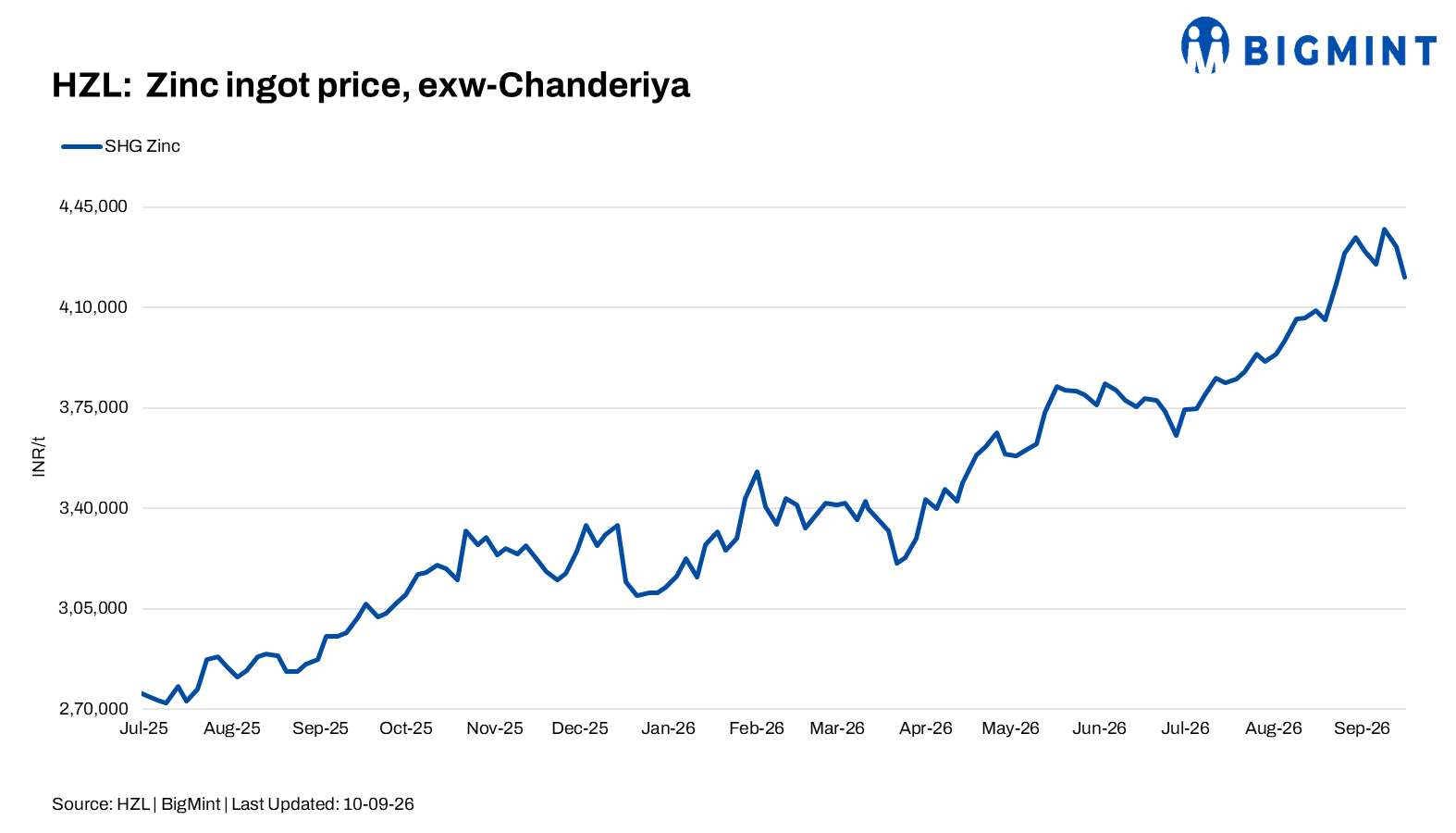
- HZL slashes zinc benchmark by INR 10,800/t
- LME zinc rebounds despite rising exchange stocks
Hindustan Zinc Ltd (HZL) reduced its benchmark Special High-Grade (SHG) zinc ingot price by INR 10,800/t on 17 September to INR 420,600/t. The company also cut its lead benchmark by INR 1,700/t to INR 211,400/t.
BigMint’s latest SHG zinc assessment stood at INR 435,000/t ex-Delhi on 16 September. However, the assessment predates HZL’s latest revision and therefore cannot be directly compared with the revised benchmark.
Global zinc market remains firm
LME zinc prices recovered during the latest session, with the three-month contract at $3,837/t and cash settlement at $3,937/t on 16 September. At 13:20 pm on 17 September, zinc was indicated at $3,862.50/t, up 0.81%.
LME zinc stocks increased to 112,675 t on 16 September from 111,225 t a day earlier, reversing part of the recent inventory drawdown. Stocks remain higher than the 109,575 t recorded on 11 September.
Lead also firmed, with the LME three-month contract at $1,889/t on 16 September. At 13:20 pm on 17 September, lead was indicated at $1,884/t, up 0.56%.
Domestic benchmark diverges from global cues
HZL’s latest revision represents a significant downward adjustment to its domestic zinc benchmark, despite zinc prices remaining relatively firm in the international market.
The INR 10,800/t reduction brings HZL’s zinc benchmark to INR 420,600/t, while the lead benchmark has been reduced to INR 211,400/t. The sharp domestic adjustment comes as LME zinc remains supported above $3,800/t, although rising exchange stocks could limit further upside.
A fresh BigMint domestic assessment will provide a clearer indication of physical market levels following HZL’s latest price revision.

Outlook
Domestic zinc prices will likely track the combined impact of HZL’s revised benchmark, LME price movements and exchange inventory trends. The extent to which physical market prices adjust following the INR 10,800/t producer reduction will be an important indicator in the coming sessions.
Leave a Reply