- Average peak demand rises 21% y-o-y; coal meets 71% of incremental generation
- IEX purchase bids jump fivefold as evening prices repeatedly hit ceiling
India’s electricity demand strengthened sharply during 1-13 September 2026, with average daily maximum demand met rising 20.9% y-o-y to 255.8 GW from 211.6 GW in the corresponding period of 2025.
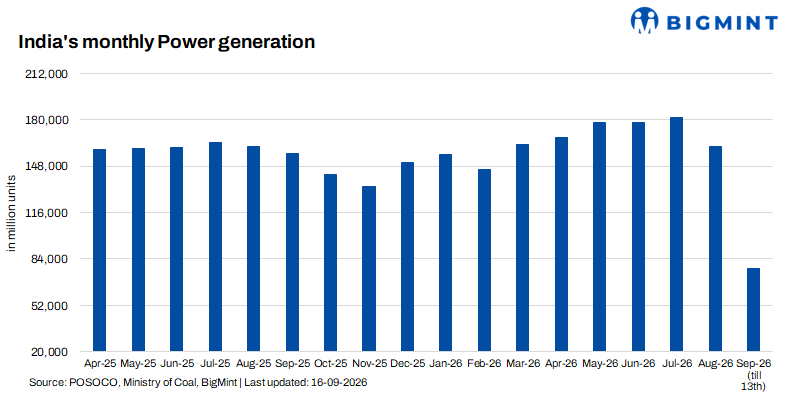
Total power generation increased 17.7% to 77,430 million units (MU) from 65,777 MU. Coal carried most of this increase, while lower hydropower generation intensified dependence on thermal and market-based supply.
Demand and generation comparison
Daily maximum demand exceeded 249 GW on 11 of the 13 days in September 2026. By comparison, demand did not exceed 224 GW during the corresponding period last year.

The national peak also shifted materially. During early September, almost all daily peaks occurred in the evening, mainly between 7:11 pm and 7:40 pm. This year, every daily peak occurred between 9:43 am and 3:48 pm, indicating a much stronger daytime load profile.
Cooling, commercial and industrial consumption may have contributed to this shift, although weather and sector-wise demand data would be required to isolate the underlying causes.
Coal meets bulk of incremental generation
Coal generation increased by 8,237 MU, accounting for approximately 71% of the 11,653 MU rise in total generation. Its share in the generation mix consequently increased to 63.2% from 61.9%.

Renewable generation rose by 3,434 MU and its share increased to 17.8% from 15.7%. However, hydropower declined by 1,239 MU, reducing its share to 12.4% from 16.5%.
As a result, hydro and renewables together supplied 30.2% of generation, down from 32.2% a year earlier, despite strong renewable growth. Coal, lignite and gas collectively increased their share to 66.8% from 65.2%.
Gas-based generation rose sharply from a low base, suggesting greater use of flexible but relatively costly capacity to support the system.
IEX market signals acute supply tightness
The Day-Ahead Market (DAM) moved from excess offered supply to severe oversubscription. Purchase bids increased more than fivefold, while sell bids fell by nearly 45%.

Only 12.9% of submitted purchase volume cleared, compared with 71.2% last year. In contrast, 76% of offered supply cleared, indicating that most available power found buyers.
Despite the surge in procurement interest, clearing volumes declined 5.5%. The market therefore adjusted largely through higher prices rather than additional supply.
Evening scarcity contrasts with solar-hour availability
Hourly DAM activity showed a pronounced divergence between solar and non-solar hours.
During 8 am-4 pm, sell bids exceeded purchase bids, cleared volumes were highest and the average price was around INR 3,603/MWh. After solar output declined, supply tightened sharply.
Between 6 pm and midnight, average purchase bids reached around 97,839 MWh/hour against sell bids of only 3,148 MWh/hour. Every hourly observation during this period reached the INR 10,000/MWh ceiling. Overnight prices also remained close to the ceiling.
Overall, 194 of the 312 hourly observations — or 62% — reached the maximum price. This highlights scarcity of dispatchable and flexible supply rather than an across-the-day energy shortage.
Outlook
India’s power system is likely to remain heavily dependent on coal while demand stays elevated and hydropower underperforms. Renewables are easing daytime conditions, but the sharp reduction in available supply after sunset is creating severe evening price pressure.
Improved coal availability, hydro generation, battery and pumped-storage capacity, demand response and flexible thermal operation will be critical. Without these, strong demand could keep evening DAM prices elevated even as additional renewable capacity suppresses prices during daylight hours.
Leave a Reply