- Captive-commercial mines already account for around one-fifth of national coal output
- FY27 production expected above 228 mnt as new mines ramp up
India’s August coal production reflected two contrasting trends: monsoon conditions constrained output from the country’s established state miners, while captive and commercial mines continued their structural expansion, increasing their importance in the domestic coal balance.
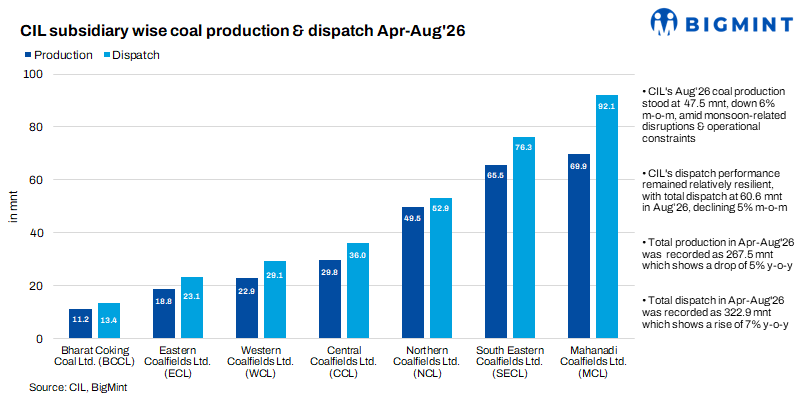
Coal India Ltd (CIL) produced 47.5 mnt in August 2026, down 5.8% m-o-m and 5.6% y-o-y. Singareni Collieries Company Ltd (SCCL) produced around 4.3 mnt, with rainfall affecting mining across major producing regions.
CIL nevertheless dispatched 60.6 mnt, up 5.6% y-o-y, drawing on inventories to maintain supplies despite weaker production.
The more important structural development, however, is occurring outside CIL and SCCL.
Captive-commercial production becomes material
Production from captive and commercial mines has risen sharply over the past three years.
As per Ministry of Coal, India’s captive and commercial coal production has increased steadily, rising from 147.12 mnt in FY24 to 190.95 mnt in FY25 and further to 210.47 mnt in FY26. Production is projected to exceed 228 mnt in FY27, reflecting continued expansion in captive and commercial mining capacity and a stronger contribution to domestic coal supply.
If the FY27 projection is achieved, production will have increased by more than 80 mnt, or around 55%, from FY24.
The segment already contributed around 20% of India’s approximately 1.04 billion tonnes of coal production in FY26. In effect, roughly one tonne in every five produced domestically now comes from captive and commercial mines.
This increasingly provides a third supply pillar alongside CIL and SCCL.
Growth continues through difficult monsoon period
The expansion has continued in FY27 despite weather-related mining constraints.
Captive and commercial mines produced 14.78 mnt in July, up 9.6% y-o-y, taking cumulative output through July to 63.16 mnt.

The Ministry’s latest update shows captive mine production at 68.98 mnt through 10 September, up 5% from 65.78 mnt in the corresponding period last year. Dispatches rose faster, increasing 5.94% to 75.68 mnt.
The figures are particularly relevant given the contrasting performance at CIL during August.
The August experience illustrates the value of a more diversified production base: when monsoon conditions restrict CIL and SCCL output, additional production elsewhere in the system can partly cushion the impact.
Captive and commercial mining play different roles
The combined number also conceals an important distinction.
Of the approximately 210 mnt produced in FY26, captive mines contributed around 184 mnt while commercial mines produced nearly 26 mnt.
Captive production primarily improves security of supply for mine owners in sectors such as power, steel and aluminium. Every additional captive tonne can reduce the owner’s requirement for CIL coal or imports.
Commercial mining potentially has a broader impact. Unlike traditional captive mines, commercial producers can sell coal into the wider domestic market, creating an alternative source of merchant supply alongside CIL and SCCL.
Commercial volumes remain relatively small, but their significance could therefore be greater than their current share suggests.
New mines support further growth
The FY27 expansion is not dependent solely on existing mines producing more.
The Ministry expects nine captive and commercial mines with combined peak rated capacity of 20.67 mnt/year to begin production during FY27. Three mines representing 7.51 mnt/year have already started, leaving another six with around 13.16 mnt/year of capacity scheduled to commence during the remainder of the year.
Mine development is also becoming faster. The Ministry says the time required to operationalise fully explored blocks has fallen from 51 months to 40 months, while partially explored blocks have moved from 66 to 52 months.
Together with continuing commercial mine auctions, this creates a pipeline for further supply growth beyond FY27.
Why this matters for India’s coal balance
The expansion comes as India’s coal requirements remain elevated across power and industry.
Captive mines reduce pressure on CIL by supplying their owners directly, while commercial mines can place additional tonnes into the wider market. Both can potentially reduce import requirements.
This becomes particularly important during periods such as the monsoon, when domestic production weakens seasonally while coal consumption may remain high.
CIL’s August performance illustrates this pressure: production fell 5.6% y-o-y while dispatch increased 5.6%, requiring inventories to bridge part of the production-consumption gap.
BigMint view
India’s August coal numbers reveal a more important structural story than the seasonal decline in CIL production.
CIL remains the backbone of Indian coal supply, but captive and commercial mines are increasingly becoming the source of incremental production growth.
Their combined output has risen from 147 mnt in FY24 to 210 mnt in FY26 and is expected to exceed 228 mnt in FY27, already giving the segment around one-fifth of national production.
The next stage could be even more significant. Captive mines principally strengthen supply security for their owners, whereas growing commercial production has the potential to broaden India’s merchant coal market and provide industrial consumers with an additional alternative to CIL and imported coal.
India’s coal growth story is therefore gradually shifting from simply asking how much more CIL can produce to how quickly captive and commercial mining can scale alongside it.
If that continues, the domestic coal market should become more diversified and better able to absorb seasonal production disruptions while containing dependence on imports.
Leave a Reply