- Rising mill consumption and lower stocks strengthen the domestic demand equation
- Large global inventories and Brazil’s export strength remain key upside constraints
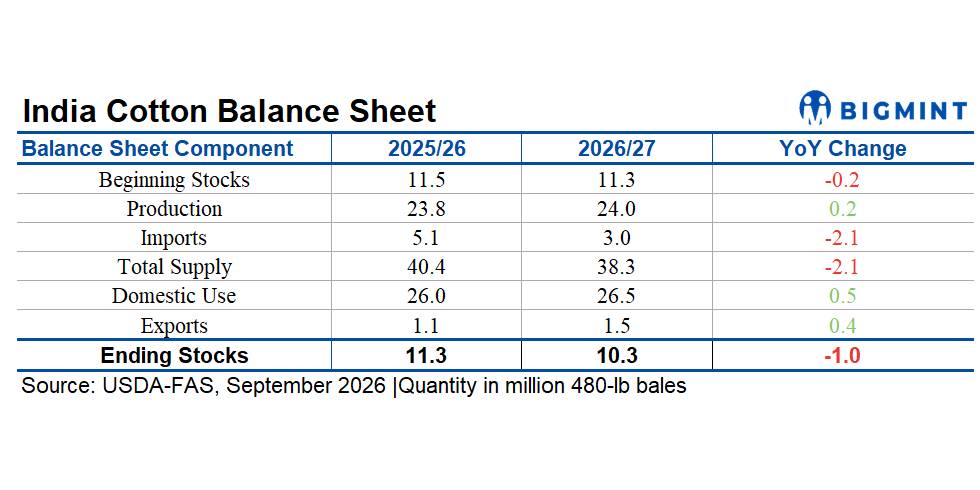
India’s cotton market is entering 2026/27 with a tighter domestic balance, shifting the market’s focus from overall availability to the price at which mills can secure quality cotton. USDA forecasts production at 24 million bales, only marginally higher than 23.8 million bales in 2025/26, while domestic consumption is expected to increase to 26.5 million bales from 26 million bales. The widening gap between production and mill demand keeps India structurally dependent on imports, although the scale of that dependence is expected to decline.
Lower imports sharpen the domestic supply equation
India’s imports are projected at 3 million bales, sharply below 5.1 million bales in 2025/26, while exports are forecast to rise to 1.5 million bales. At the same time, ending stocks are expected to fall by 1 million bales to 10.315 million bales. The combination is significant because it reduces the cushion available to the domestic market if arrivals disappoint or mill procurement accelerates.
For ginners, this makes kapas procurement and lint realization increasingly important. A firm lint market could support ginning margins, but aggressive kapas buying without corresponding yarn demand could quickly compress margins. For spinners, the critical variable will be whether higher cotton costs can be absorbed through yarn prices and downstream demand.
The decline in imports also increases the importance of import parity. If Brazilian or US cotton becomes competitive on a landed basis, mills could switch origins and limit domestic price gains. Conversely, expensive imports would strengthen the pricing power of domestic cotton.
Global deficit offers support, but stocks remain the ceiling
The global balance is fundamentally more constructive, with consumption forecast at 122.9 million bales, against production of 117.3 million bales. Yet global ending stocks remain substantial at nearly 69.9 million bales. This means the projected 5.6-million-bale production-consumption gap does not automatically translate into a physical shortage.
Brazil is particularly important. Its exports are projected at 15.5 million bales, compared with India’s 1.5 million bales. Aggressive Brazilian offers could therefore keep Asian mills well supplied and limit India’s export competitiveness.
India’s Shankar-6 benchmark has already strengthened to 92.8 cents/lb from 90.8 cents/lb between August 10 and September 8. The next leg of the market, however, will depend less on futures alone and more on domestic arrivals, mill buying, yarn realizations, import parity and Asian textile demand.
Outlook
Indian cotton prices are likely to remain firm but volatile. A sustained rally would require stronger mill offtake and faster stock drawdown, while weak yarn demand or aggressive Brazilian supply could trigger renewed price pressure.
India’s cotton market is tightening, but it is not yet a shortage market. The decisive factor will be whether rising domestic consumption converts into actual physical demand strongly enough to absorb declining stocks.
Leave a Reply