- Mustard arrivals rise to 225,000 bags as demand remains weak
- INR 8,500 resistance holds; INR 8,650 key for a bullish shift
India’s mustard market is showing early signs of recovery as global edible oil prices rose on the back of crude oil rising above $100/barrel. Jaipur mustard is trading near INR 8,425/100kg, with INR 8,500 emerging as the key resistance. However, weak domestic demand and higher arrivals continue to limit fresh buying.
Mustard prices remain under pressure
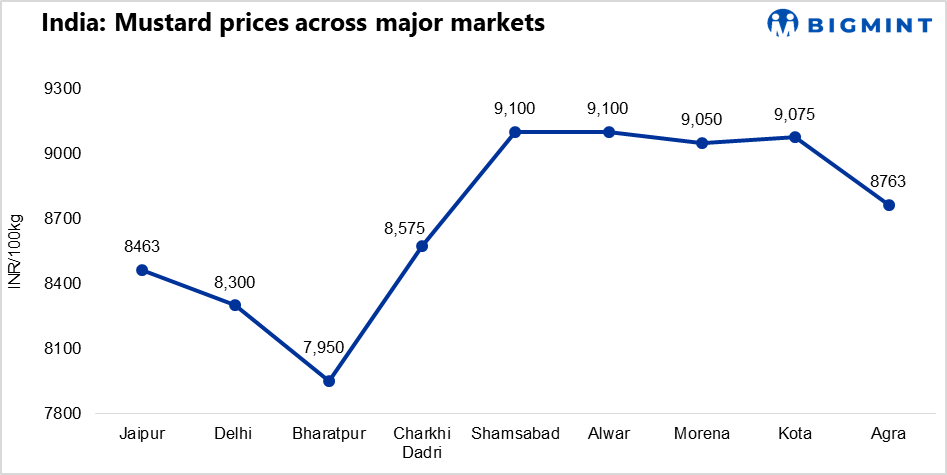
Jaipur mustard was quoted at INR 8,425-8,500/100kg on Thursday. Delhi 42% condition fell to INR 8,300/100kg, Bharatpur to INR 7,950/100kg and Charkhi Dadri to INR 8,575/100kg. Major processing plants reduced prices by INR 75/100kg after failing to sustain INR 9,200/100kg at Saloni.
According to market sources, mustard prices at major processing plants stood at INR 9,100/100kg in Shamsabad and Alwar, INR 9,050/100kg in Morena and INR 9,075/100kg in Kota. Prices in Agra were quoted at INR 8,750-8,775/100kg, while Kota prices stood at INR 8,250/100kg. Other major processing plants quoted mustard at INR 8,475-8,525/100kg. All-India mustard arrivals increased to 225,000 bags from 200,000 bags the previous day, adding near-term supply pressure.
Crude oil changes edible oil sentiment
Brent crude rose to $108.60/barrel and WTI to $103.87/barrel. Sustained strength in crude could improve biodiesel economics, raise imported edible oil costs and support mustard oil’s competitiveness in India.
Palm oil strengthened in night trading as crude oil rose. October palm oil futures closed at 4,770 ringgit, November at 4,939 ringgit, December at 5,084 ringgit and January at 5,209 ringgit, gaining 51-55 ringgit across contracts.
Soybean oil futures on the Chicago market rose around 1.8-1.9%. September stood at 71.28 cents/lb, October at 71.41, December at 71.92 and January at 72.19 cents/lb. Soymeal prices ranged from $349 to $358.90/short ton across key contracts, while soybean futures stood at 1,332.20-1,352.60 cents/bushel.
Strength across the global edible oil complex could provide support to mustard oil prices. However, the impact on mustard seed will depend on whether crude oil and overseas markets sustain their gains.
Firm mustard cake supports crushing margins
Mustard oil prices remained mixed, with Jaipur Expeller at INR 1,671/10 kg, Charkhi Dadri at INR 1,665/10 kg, Mumbai at INR 1,740/10 kg, Ganganagar at INR 1,660/10 kg and Morena at INR 1,670/10 kg. Kachi Ghani oil stood at INR 1,691/10 kg in Jaipur, INR 1,681/10 kg in Bharatpur, INR 1,680/10 kg in Morena, INR 1,690/10 kg in Ganganagar and INR 1,721/10 kg in Alwar.
Mustard cake prices remained firm. Jaipur cake was quoted at INR 3,385/100kg, Bharatpur at INR 3,300/100kg, Niwai at INR 3,310/100kg, Sumerpur at INR 3,380/100kg and Charkhi Dadri at INR 3,230/100kg.
Bharatpur cake rose INR 140 to INR 3,400/100kg, Sumerpur gained INR 40 to INR 3,380/100kg and Charkhi Dadri increased INR 10 to INR 3,280/100kg. Firm cake prices are supporting crushing margins despite limited weakness in mustard oil.
Falling availability may support recovery
Mustard availability is gradually declining as the market approaches the next crop arrival, which could limit downside pressure. However, weak domestic demand and cautious buying at higher prices continue to restrict recovery.
The approaching festive season may support edible oil consumption and refinery activity. Jaipur mustard was quoted at INR 8,488/100kg, keeping the market close to the key INR 8,500/100kg resistance. A sustained move above this level could improve sentiment, while failure to break higher may keep prices range-bound.
Outlook
Mustard’s near-term direction will depend on the sustainability of the crude oil rally, continued strength in palm and soybean oil markets, and Jaipur’s ability to hold above INR 8,500/100kg.
If these factors align with improving festive demand, the INR 8,400/100kg area could develop into a stronger base. If crude oil weakens and Jaipur fails to cross INR 8,500/100kg, the market may return to its earlier range-bound structure.
The market has not yet confirmed a bullish trend, but the external environment is changing. INR 8,500/100kg is now the key level to watch for a shift in mustard’s market direction.
Leave a Reply