- Recovery reaches 98%, with 35% lower energy consumption
- Eight more projects licensed with over 15 mnt/year capacity
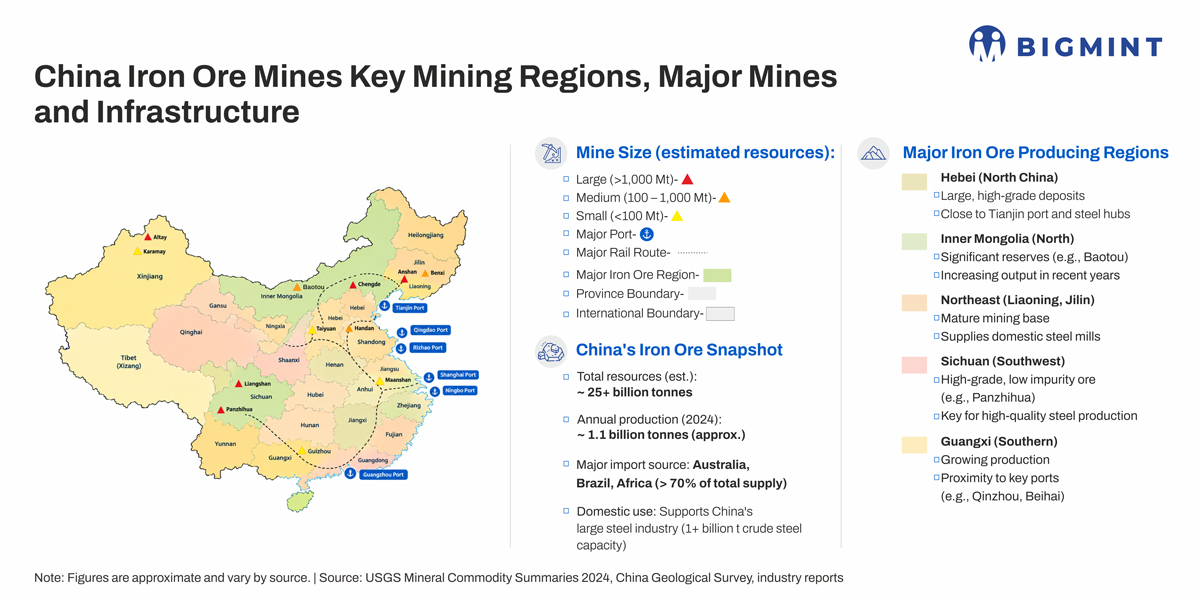
A breakthrough beneficiation technology capable of upgrading refractory low-grade iron ore into high-grade concentrate has proved successful at Ansteel Mining’s Anshan facility in Northeast China’s Liaoning province, marking a technically credible route to activating China’s long-idle low-grade iron ore resources, state media Xinhua News Agency reported. The concentrating project, which passed completion acceptance on 1 September, comprises three production lines, each with an annual capacity of 1.85 million tonnes (mnt)/year, for a combined processing capacity of 5.56 mnt/y.
Main construction began in March 2024, and commercial production started in January this year. What sets the facility apart, however, is the grade of ore it can handle. The plant can transform low-grade ore containing just 11% iron into a high-grade concentrate with 65% Fe content — a quality ideal for steelmaking, according to Zhu Qingshan, a researcher at the Institute of Process Engineering of the Chinese Academy of Sciences, who leads the team behind the new technique. A specialised roasting process is applied to alter the magnetic properties of iron minerals, allowing iron to be separated from waste rock far more efficiently, Zhu said.
Recovery rates reach 98%, while energy consumption of 0.82 gigajoules per tonne is 35% below comparable existing methods. The technology, assessed by an expert panel from the Metallurgical Mines’ Association of China as top-notch in its field, should help address a long-standing structural weakness in China’s domestic iron ore supply.
Despite topping global steel output for years, China remains heavily dependent on iron ore imports: its sizable domestic reserves are largely low-grade and refractory, and traditional beneficiation cannot recover the metal efficiently or affordably. As a result, roughly half of the country’s reserves remain untouched. With the new technology, nearly 30 billion tonnes of hard-to-process ore and about 10 billion tonnes of iron-bearing industrial waste across China could eventually be tapped in an efficient and environmentally friendly way, Zhu suggested.
Notably, the model is already being replicated: eight additional projects have been licensed, with contracted processing capacity exceeding 15 mnt/y. Since commercial-scale rollout will take years, China’s seaborne import volumes of iron ore are unlikely to shift in the near term, Mysteel Global notes. Still, the project — backed by China’s top economic planner, the National Development and Reform Commission, and the Ministry of Natural Resources — signals a credible shift in China’s long-term iron ore supply landscape and offers a new way for the country to reduce its reliance on iron ore imports.
Note: This article has been published in accordance with a content exchange agreement between Mysteel Global and BigMint.
Leave a Reply