- China’s aluminium exports remain elevated amid weaker domestic demand
- Oil continues march towards $100/bbl
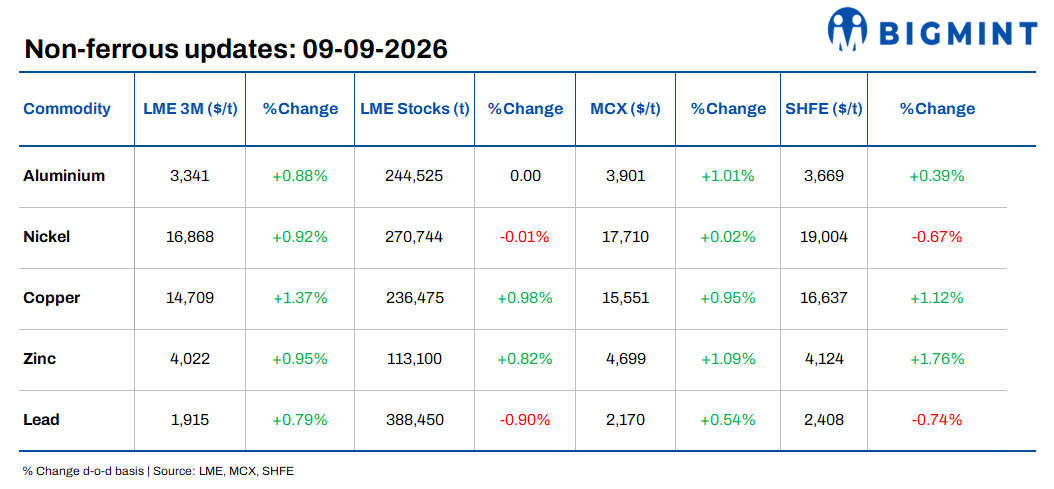
LME base metals rallied across the board on 8 September. Copper led the advance, rising 1.37% d-o-d to $14,709/t, followed by zinc at 0.95% to $4,022/t, nickel at 0.92% to $16,868/t, aluminium at 0.88% to $3,341/t and lead at 0.79% to $1,915/t. The broad-based move signals firm buying momentum across the complex and could support prices in the near term.
LME inventories recorded mixed trends. Copper stocks posted the sharpest rise, gaining 0.98% d-o-d to 236,475 t, followed by zinc stocks, which rose 0.82% to 113,100 t. Lead inventories declined 0.90% to 388,450 t, while nickel stocks eased 0.01% to 270,744 t and aluminium stocks remained unchanged at 244,525 t.
Domestic market overview
India’s non-ferrous scrap market witnessed mixed trends on 8 September. Aluminium tense scrap (loose) remained unchanged at INR 253,000/t ex-Delhi and INR 247,000/t ex-Chennai.
Meanwhile, copper armature scrap (Cu 99%) rose by INR 10,000/t, or 0.8%, to INR 1,316,000/t. The increase came alongside firmer international copper prices, while higher raw-material costs continued to influence domestic replacement values.
P1020 aluminium ingot, ex-Delhi NCR, rose by INR 4,000/t, or 1.1%, to INR 358,000/t from INR 354,000/t. MCX aluminium gained 1.01% to INR 3,901/t, while MCX copper rose 0.95% to INR 15,551/t. Consequently, stronger primary metal prices supported higher replacement costs, although aluminium scrap prices remained stable.

Other updates
Oil continues march towards $100/bbl
Brent crude rose 1.6% to $99.59/bbl on 9 September. WTI gained 1.4% to $93.03/bbl. Renewed Middle East attacks raised concerns over crude supply and shipping disruptions. Brent has climbed about 25% since early August. Meanwhile, higher energy prices are increasing inflation risks across energy-importing economies. A prolonged oil shock could weaken industrial margins and eventually weigh on metals demand.
China’s aluminium exports remain elevated
China exported 626,000 t of unwrought aluminium and aluminium products in August. Exports rose 17.2% y-o-y but fell 2.6% m-o-m from July. Cumulative exports reached 4.67 mnt during January-August, up 16.7% y-o-y. Meanwhile, softer domestic demand and high aluminium output continue to support overseas shipments. Sustained exports are adding supply to global markets. As a result, they could limit upside in aluminium premiums unless demand strengthens or supply disruptions deepen.
Rio Tinto acquires Aurukun bauxite project
Rio Tinto agreed to acquire the Aurukun Bauxite Project in Queensland from Glencore and Mitsubishi Development. The deal remains subject to regulatory approvals. The undeveloped project has about 357 mnt of bauxite resources. It could produce up to 8 mnt/y of washed bauxite for more than 20 years. However, the project still requires development approvals and a mining lease. Therefore, it will have no immediate supply impact. Over the longer term, the project could strengthen Rio Tinto’s bauxite position and support additional alumina and aluminium supply.
China copper scrap buying weakens as spread widens
Chinese copper scrap prices rose by 300 RMB/t on 8 September. Meanwhile, the cathode-to-scrap spread widened by 1,072 RMB/t to 4,649 RMB/t. Secondary copper rod orders remained firm. However, scrap-consuming companies delayed procurement as higher tax-inclusive costs squeezed processing margins. Consequently, weaker scrap buying could tighten effective feedstock availability. It may also reduce secondary copper output. As a result, some consumers could rely more on refined cathode, supporting primary copper demand while pressuring secondary smelters and rod producers.
Leave a Reply