- Bangladesh maintains Kanto tender presence after Vietnam’s July purchase
- JPY strengthens to 153/$ as BOJ hike expectations reshape scrap export parity
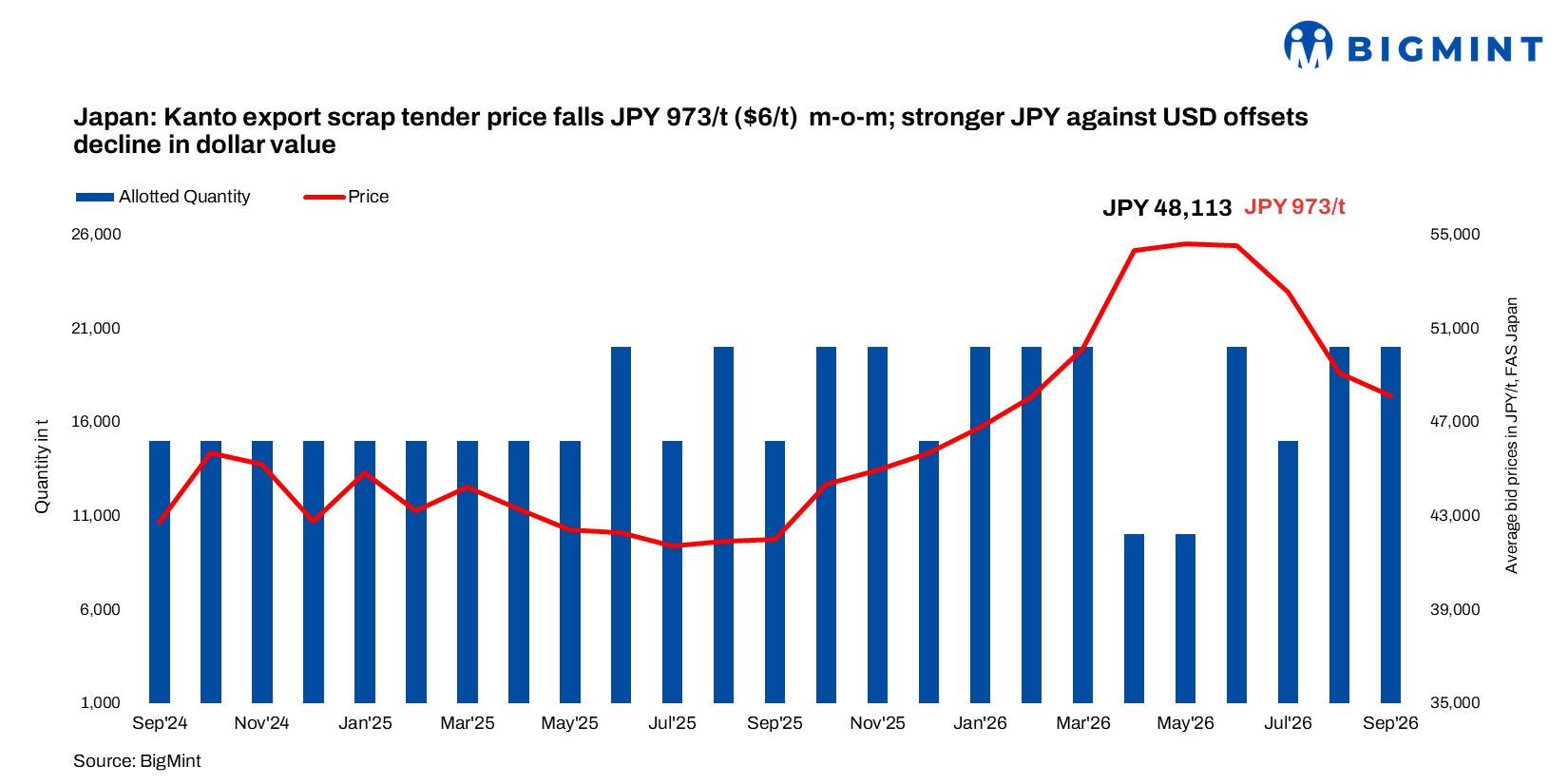
Japan’s September Kanto export scrap tender settled at JPY 48,113/t FAS ($313.6/t), down JPY 973/t ($6.3/t) from August’s JPY 49,086/t ($309.9/t). This marked the fourth straight monthly decline, mainly due to the stronger yen and higher freight costs. Despite the drop, the tender price stayed above domestic electric-furnace mill buying levels and Gulf prices.
JPY strengthened to around JPY 153.5/$ on 9 September, from JPY 158.4/$ during the previous tender on 7 August. Despite the decline in the JPY-denominated winning bid, the stronger JPY pushed up its dollar-denominated value by around $4/t, the impact of currency movements on export scrap pricing.
A Japanese trading firm said the recent JPY appreciation was an important factor in the September Kanto tender.
The tender attracted 14 bids from 14 trading companies, with no withdrawals. Total bid volume was 100,400 t, down 5,000 t from August but remaining above the 100,000-t mark for the second consecutive month. Only the first bid, for 20,000 t at JPY 48,113/t, was awarded. The shipment deadline for the September contract is 31 October.
Meanwhile, shipment of the 20,000 t August contract, which began on 28 August, was scheduled for completion on 10 September. The shipment schedule for the remaining 5,000 t from the July contract had not yet been decided.
Bangladesh remains successful bidder
This time, a Chattogram-based mill won the September Kanto tender, securing 20,000 t through a Japanese trading company. Bangladesh’s participation marks another consecutive presence in the Kanto tender, following Vietnam’s purchase of the July shipment.
Based on the winning bid and prevailing freight, the landed cost is estimated at around $380-385/t CFR Chattogram, including approximately $75-80/t freight from Japan to Bangladesh. This level is broadly in line with current import parity for Japanese H2 scrap.
Association Chairman Minami attributed the m-o-m decline in the tender price to the stronger yen and higher freight costs. He also noted that overseas buying interest is emerging and that the market is entering a price-recovery phase.
Buying interest for Japanese scrap appears to be strengthening in major export destinations, including Vietnam and Bangladesh. Freight for 20,000-t vessels has risen to above $75/t to Bangladesh and above $60/t to Vietnam, limiting buyers’ scope to bid higher.
Meanwhile, shipment of the 20,000-t August contract, which began on 28 August, was scheduled for completion on 10 September. The shipment schedule for the remaining 5,000 t from the July contract remained undecided.
BOJ hike expectations push JPY higher
A Southeast Asian trader said the recent JPY appreciation was largely driven by comments from US and Japanese officials, which changed market expectations and prompted traders to cut JPY-short positions and unwind carry trades. “The shift in expectations has made traders more cautious about holding short JPY positions,” the trader said.
For the tender market, the stronger JPY is an important factor, as it directly affects the economics of exported material.
JPY has strengthened from above JPY 160/$ to around JPY 153/$ in about a week, its strongest level since February. Expectations of a BOJ rate hike have also supported the currency, with markets pricing a high probability of a 25-basis-point hike to 1.25% on 18 September. Stronger Japanese wage growth and an upward revision to economic growth have further reinforced expectations for higher Japanese rates.
Japanese scrap has become more competitive in export markets as domestic prices have held up better since July. Buying interest from Vietnam and Taiwan has also improved, although overall overseas activity remains selective. Further declines in domestic prices could make exports more attractive and encourage additional overseas sales. Japanese H2 export prices increased by JPY 500/t ($3/t) to JPY 48,800/t ($313/t) FOB Tokyo Bay. Offers were heard at JPY 49,000-50,500/t ($314-324/t) FOB Japan, while buyer bids were around JPY 48,500-49,000/t ($311-314/t). Market activity remained subdued as most overseas buyers had already covered their September requirements.

In the domestic market, scrap sentiment remained cautious amid weak steel production and limited mill buying. However, demand could improve as the summer slowdown eases and construction activity gradually picks up.
As of 9 September, actual H2 purchase prices among Kanto electric-furnace mills were around JPY 46,500-47,500/t ($303-309/t), while Gulf prices were mainly JPY 46,000-47,000/t ($300-306/t). Higher-grade HS was around JPY 53,000/t ($345/t). H2 prices have shown limited movement in recent weeks. The September Kanto tender price therefore remained above both domestic mill purchase prices and Gulf market levels.
Outlook
The BOJ’s upcoming rate decision could provide greater clarity on yen movements and Japanese export scrap price parity. However, infrequent buying from Asian markets could limit upside, while Vietnamese restocking may offer fresh support. The next Kanto export scrap tender, scheduled for 9 October, is expected to provide the next key price signal for Japanese scrap.
Leave a Reply